Slavophiles, Westernizers, and the East-West Dichotomy
There are few civilizational and cultural gulfs quite like the divide between Russia and the West. It has remained a source of polemical rhetoric and hopeful visions of reunification in recent decades, but the genesis of the East-West divergence spans centuries, profoundly emerging in the wake of the Petrine reforms of the eighteenth century, continued under Catherine the Great’s reign.
The Napoleonic wars’ impact on Russian soil, coupled with these reforms, which sought to adopt European thought and culture, marked a profound departure from Lomonosov’s mythologizing of Peter to seeing his reforms as an oppressive, forced Europeanization of Russian culture.[1] Although these reforms and the ensuing debate are often cast within socio-political dimensions, there is less discourse over the socio-religious consequences of the same civilizational division.
The East-West dichotomy is a living discourse that emerged out of the explosive rhetoric of Pyotr Chaadaev’s “First Philosophical Letter” and the Slavophile response which it engendered. Chaadaev’s letter sparked the Russian intellectual milieu to fervent action with his characterization of Russia as ahistoric, passing through barbaric and superstitious epochs, and possessing no collective memory.[2]
He bears an Occidental gaze in his letter, celebrating the collective memory and advancements of Western Europe, woven as they are into the very fabric of its society.[3] Despite Chaadaev resisting capture by either Westernizer or Slavophile philosophical camps, his “Letter” claiming that Russia and its people were superfluous became the shot that rallied both camps.[4] While Belinsky and Herzen followed with Westernizing rhetoric, the counterpoint was given voice by Ivan Kireevsky, Aleksei Khomyakov, and Konstantin Aksakov.
As the Westernizers advocated the adoption of European advancements and governmental systems, the Slavophiles articulated a unique vision of Russia. Khomyakov agreed generally with Chaadaev that “Russians have no history and no traditions,” but felt this only concerned that part of society which had lost its roots to the people and the land, “It is not Europe, therefore, that salvation lies, but in a return to the people and the ancestral religion, in a reconstruction of the former traditional community life weakened by Europeanization.”[5]
The primary principles of Slavophile philosophy were Khomyakov’s sobornost’ (organic community grounded in mutual self-giving and loving cooperation) and Kireevsky’s tsel’nost’, or “integral knowledge” (an elevation of reason facilitating direct cognition). These figures sought a positive alternative to Westernizing policies and values, which they viewed as inherently atomizing, materialistic, and non-Russian. For many, the Slavophiles’ critique of the Western intellectual tradition is what defined them most.
The secular academic consensus traces the particular principles of Slavophilism not to an indigenous philosophy, but to Germany and its post-Enlightenment philosophic response: Romanticism. Riasanovsky set the academic precedent in Russia and the West in the Teaching of the Slavophiles, putting forth the intellectual genealogy of German Romanticism being adopted and then expressed polemically by the Slavophiles. This has remained the dominant scholarly interpretation of this mid-nineteenth-century phenomenon and its ripple effects in philosophical, theological, and socio-political discourse.
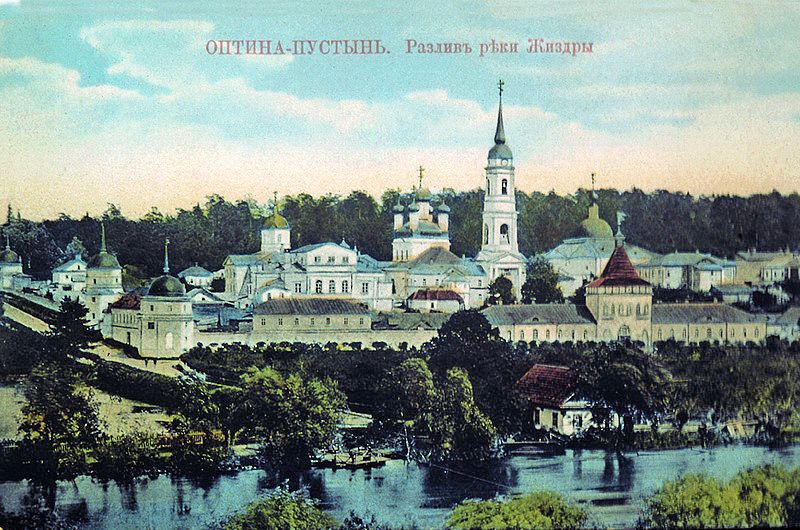
However, this interpretative model risks the same Westernization of a Russian phenomenon which it seeks to explain. The privileged constructivist theory, grounded in intellectual genealogy, commonly interprets nineteenth-century Slavophilism as a Romantic nationalist reaction against Western modernity. A closer examination reveals that the movement’s articulation of a genuine ontological divergence between the Christian East and the post-Enlightenment West was decisively shaped by the Philokalic revival of the late eighteenth and early nineteenth centuries. The recovery and dissemination of the Philokalia and the hesychastic tradition through the Optina Pustyn monastery provided the Slavophiles, notably Ivan Kireevsky, with a communal and experiential epistemology rooted in Orthodox patristic sources.
This study postulates that the secular historiographical tendency to reduce Slavophilism to a Romantic or ideological reaction is downstream of deeper metaphysical and ontological commitments. A clear distinction is necessary: paradigms are interpretive frameworks, while ontology concerns the actual structure of being and participation in divine reality. Paradigms, it can be argued, are subordinate to ontology. “Personhood,” for example, is not merely a paradigmatic construct but an ontological category; any paradigm we adopt is more or less plausible depending on how well it corresponds to the actual properties and reality of what a person is.
Therefore, this project advances an ontological claim rather than a merely paradigmatic argument. The Slavophile articulation of the East-West binary—influenced by the Philokalia and hesychastic practice—reflects a genuine divergence in modes of being which cannot be reduced to Romantic intellectual history or cultural reaction. Secular historiographical paradigms often fail to account for these ontological dimensions not because of a lack of evidence, but because their interpretations are informed by their own metaphysical assumptions.
Secular Paradigm
The historicist method traces historical phenomena through contextualization and visible intellectual influences; this is valuable, but also potentially limiting the method’s ability to see beyond observable connective tissue. Riasanovsky writes of Khomyakov and Kireevsky, noting their familiarity with German Romantics despite their bitter criticism of German idealistic philosophy and later exposition and dependence on Eastern theologians, “in general their knowledge of the West antedated their appreciation of Orthodox thought.” He further cites Vladimir Soloviev’s criticism of the Slavophiles’ “attitude toward religion itself as… romantic rather than Christian.”[6]
Andrzej Walicki, in The Slavophile Controversy, builds on Riasanovsky’s foundation. Focusing on Kireevsky, Walicki argues: “To the German romanticists Kireevsky owed not only the general orientation of his philosophy—his criticism of rationalism, of social atomization, and of legalistic and naturalistic modes of thought—but also a number of specific concepts.” Walicki traces Kireevsky’s ideas to Friedrich Herinrich Jacobi’s notions of ‘immediate knowledge’ and ‘reason vitalized by faith,’ as well as to Schelling, Müller, Schlegel, and Franz von Baader.[7] He agrees with Riasanovsky that Kireevsky’s turn to Orthodoxy occurred only after the complete Romantic shaping of his worldview.[8]
Laura Engelstein’s Slavophile Empire extends this interpretation, demonstrating how both Westernizers and Slavophiles relied on German Romanticism, while arguing that the Slavophiles’ illiberal articulation of Russia’s identity was foremost a reaction against Western modernity. This nineteenth-century illiberal reaction, according to Engelstein, shaped Russia’s imperial self-understanding through the Soviet period.
These contextual interpretations and intellectual genealogies are insightful and comprehensive; the works of Riasanovsky and Walicki in particular remain invaluable and set the standard for intellectual history of the twentieth-century. Nonetheless, because of their historicist, history-of-ideas approach, there is potential for oversight and under-engagement with other historically contingent factors. When Walicki claims that Kireevsky—and by extension the Slavophiles—are simply repeating Schelling’s arguments, he risks a genetic fallacy by reducing Slavophilism to a mere branch of German Romanticism. Engelstein’s privileged socio-political lens similarly risks a sociological reduction by suggesting that the movement was merely a reaction against Western Enlightenment values.
Despite Riasanovsky’s vivid biographical sketches of the Slavophiles, they potentially flatten their interiority. In his treatment of Ivan Kireevsky’s relationship with Optina Pustyn, he writes matter-of-factly: “[Kireevsky] received spiritual guidance from Father Makarii of the famous Optina Monastery… visited [it] often, helped the monks with the translation and the edition of the works of Eastern Doctors of the church, and sought their direction in the formulation of his own philosophy.”[9].
Such passing treatment under-engages with what was arguably a transformative element of Kireevsky’s life. It reflects an assumption that religiosity functions primarily as a byproduct of socio-cultural structures—an interpretation Kireevsky himself would likely have seen as a category error.
Engelstein’s characterization of hesychasm reveals similar limitations, describing it as “a form of contemplative Orthodox mysticism that stressed the worshiper’s inward mental focus and outward stillness,” with the Jesus Prayer “mumbled continuously under one’s breath… designed to connect the supplicant with the Holy Spirit.”[10] The emphasis on externalities largely overlooks the internal dynamics, noetic purification, union of mind and heart, and apophatic dimensions of the practice. The superciliousness rhetoric, notwithstanding, Engelstein’s engagement reduces a sophisticated, disciplined ascesis to observable behaviors while minimizing its ontological implications for knowledge and personhood.
The treatment of Orthodox theology cannot be reduced to socio-cultural or paradigmatic differences, because Orthodox theology is ontologically distinct from Western theological models, something the Slavophiles were precisely attempting to articulate. Rather than simply classifying these interpretations as erroneous, it is more appropriate to emphasize historical underdetermination: the same body of evidence can support different determinants depending on the historian’s methodological assumptions and metaphysical commitments. As Patrick Lally Michelson notes in his review of Engelstein, Slavophilism was a “contingent, multivalent phenomenon that encompassed and expressed a variety of intellectual positions” which cannot be reduced to a single paradigm or thinker.[11]
Riasanovsky ironically highlights this notion, anticipating and challenging the very argument this study seeks to explore. In his critique of H. Lanz, Riasanovsky rejects Lanz’s claim “that it was absurd ‘to identify such a complex spiritual phenomenon as Slavophilism with a provincial branch of Hegelian philosophy,’” retorting that Lanz’s “analysis failed to take into account that the Western romantic influences of the Slavophiles had been by no means limited to Hegelianism, least of all in the case of Ivan Kireevskii.”[12]
However, while Riasanovsky rejects reducing Slavophilism to Hegelianism alone, he maintains that patristic influence was effective yet limited to the “sphere of basic religious and psychological problems of man” and “had no appreciable influence on the Slavophile social, political, or historical views which were purely romantic.”[13]
This bifurcation of religious psychology from socio-political thought ironically imposes the very Western rationalistic fragmentation that the Slavophiles sought to overcome. If patristic and hesychastic sources genuinely shaped the Slavophiles’ understanding of religion and personhood, then that influence should logically extend into their broader vision of society, politics, and history; to suggest otherwise reveals a methodological commitment that compartmentalizes what the Slavophiles understood as ontologically integrated. In that regard, the dominant secular interpretations risk a form of epistemological colonialism: reading Russian religious thought through categories forged in the post-Enlightenment West. Secular scholarship has limitations, but they are not restricted to academia; similar methodological restraints appear in theological interpretations as well.
Theological Interpretations
Georges Florovsky’s Ways of Russian Theology is a comprehensive survey of Russian theological history from the baptism of St. Vladimir of Kiev to the end of Nicholas I’s reign. At the heart of this work lies Florovsky’s diagnosis of a theological “pseudomorphosis,” the notion that Eastern Orthodox theology had fallen under an oppressive, often unconscious Western captivity. For Florovsky, this Western captivity could be traced back to the seventeenth century with the establishment of the Kiev Academy by Metropolitan Peter Mogila.[14] It intensified under Peter the Great, whose reforms Florovsky characterized as “a displacement or even a rupture in Russia’s spiritual depths.”[15] During the period of reform, Protestant teachings, pietism, deism, idealism, and even freemasonry were increasingly absorbed by Russian Orthodox thought.[16]
The Slavophiles, for Florovsky, were not immune to this pseudomorphosis, but rather exemplified it. Influenced by his broader critique, he traced their intellectual genealogy to German Romanticism, characterizing them as Schellingians and even suggesting that, psychologically, they resembled Freemasons.[17] His treatment of the Slavophiles represented one of the first systematic critiques of their philosophy from an academic perspective. In response to the problems he identified, Florovsky advocated for a “neopatristic synthesis,” a return to the Church Fathers; their work, for him, was a living stream which needed to be embodied as much as studied. This recovery of the patristic sources would cultivate the phronema—the mind—of the Fathers and purge Russian theology of what he saw as contaminant Western categories.
Nevertheless, Florovsky’s historical philosophy and neopatristic project are not without criticism: due to his work emerging from a polemical context, it was partly directed against the Russian Religious Renaissance thinkers such as Vladimir Solovyov, Pavel Florensky, and Sergius Bulgakov, whom he saw as preserving Western captivity. Consequently, Florovsky appears to have been partially blind to the ironic Romantic underpinnings of his own thought.
As Brandon Gallaher has noted, Florovsky’s appeal to the phronema, with its privileging of “vision” and “experience,” bears resemblance to the Romantic notion of “intellectual intuition.” In this context, Florovsky’s construction of a Pan-Orthodox Eastern identity set against the heterodox Western “Other” risks collapsing into the very dialectic he criticized in the Slavophiles. Gallaher argues that “his construction of Eastern Orthodoxy is dependent on German Romanticism and… his polemicism blinded him to this fact.”[18]
A particularly striking omission in Florovsky’s comprehensive survey is any mention of Optina Pustyn Monastery and the hesychastic tradition it embodied. For such a thorough examination of Russian history and its theological underpinnings, the absence of this living center of patristic renewal and its direct influence on figures like Ivan Kireevsky is notable.
Methodological limitations, therefore, exist on both sides of the scholarly divide. While secular historians tend to reduce Slavophilism to Romantic ideology, even sympathetic theological interpreters like Florovsky can underplay the full ontological weight of the Philokalic and hesychastic sources due to their own polemical and philosophical commitments. This sets the stage for a closer examination of the Philokalic revival itself as the decisive, yet often overlooked, influence on Slavophile thought.
The Philokalic Revival
Although Florovsky omits Optina Pustyn in his survey, he does acknowledge and celebrate the late eighteenth-century monastic revival. Despite the Enlightenment-inspired reforms under Catherine the Great, he writes that “the century ended with a monastic revival and with an unmistakable intensification and increase of spiritual life.”[19] This spiritual reawakening was led by St. Paisius Velichkovsky (1722–1794), a Ukrainian-born monk who recognized that even in Russia’s best Orthodox schools he “was not being given the pure teaching of Holy Orthodoxy from the patristic sources,” but rather something second-hand that obscured the first-order realities of Orthodox faith: love and zeal.[20]
Velichkovsky, while being educated at the Kiev Academy, grew dissatisfied with its emphasis on externalities and formalism. At the age of seventeen, he left the Academy and continued his formation in the monasteries of Moldavia, where he encountered a living hesychastic tradition transmitted from Mount Athos. Eventually, he left for Mount Athos, where he spent nearly twenty years—including extended periods as a hermit—during this time he became an abbot and devoted himself to gathering and translating Greek patristic manuscripts.
He returned to Moldavia with disciples and manuscripts, continuing to translate and compile these patristic works, culminating in the first Slavonic edition of the Philokalia, published in 1793 in Moldavia. Through Velichkovsky and his disciples, the Philokalia and the practice of spiritual eldership (starchestvo) were transmitted to Russia, fueling a genuine monastic and hesychastic revival.
This revival found its most influential expression in nineteenth-century Russia at the Optina Pustyn Monastery. Some scholars have suggested that the starchestvo and hesychastic practice were, along with influence from the East, a synthesis of Western Catholic or Protestant pietist themes, as some scholars have suggested.[21]
Conversely, recent scholarship has re-emphasized its deep continuity with the earliest desert Fathers and the Athonite tradition.[22] Paisius Velichkovsky thus serves as a crucial historical vector: his work demonstrates that the spiritual and intellectual currents shaping the Slavophiles—especially Ivan Kireevsky—were not primarily the result of Romantic importation from the West, but rather the recovery and dissemination of an ancient Eastern Christian tradition.
The Slavophiles
The secular emphasis on Romantic scaffolding, though documenting real influences, fails to account for the visible transformation of Kireevsky’s thought in the latter half of his life. A closer examination of his intellectual and spiritual development reveals that the Philokalic and hesychastic tradition provided not merely an alternative linguistic and paradigmatic structure, but a different ontological foundation: a participatory mode of being and knowing rooted in the recovery of patristic anthropology.
Kireevsky retained his Romantic influences into his marriage with Natalia Petrovna in 1834; despite his absence from Orthodox customs and the deep piety of his wife, the young couple “began to read Schelling together, and when his great luminous thoughts were at an end, and [Kireevsky] turned to his wife, expecting her to be surprised, she answered him forthwith that these thoughts were known to her from the writings of the Church Fathers.”[23] At the time, Kireevsky was indignant about the comparison, continuing to read from the Romantics, however “[b]y the early 1840s, the Fathers had replaced Schelling as the guiding force in his intellectual life.”[24]
Kireevsky’s mature critique of Schelling is especially revealing; in “On the Necessity and Possibility of New Principles in Philosophy,” he writes:
“Heavy must be the lot of the man who languishes in the grip of an inner thirst for Divine Truth, and who cannot find the pure religion which can satisfy this all-pervasive need. He has only one alternative: to seek out and obtain with his own powers from the confused Christian tradition whatever corresponds to his inner notion of Christian truth. A lamentable task — creating a faith for oneself!”[25]
This passage demonstrated that Kirrevsky came to view Romantic philosophy ultimately self-imprisoned by its own fragmented subjectivity and abstract reason; further, he asserts, “Schelling’s Christian philosophy was neither Christian nor philosophy. It differed from Christianity in its most fundamental dogmas, and from philosophy by the very manner of cognition.”
This intellectual shift was grounded in Kireevsky’s deepening participation in the hesychastic tradition of Optina; both Ivan and Natalia received spiritual direction from Elder Macarius, actively collaborating on the translations of patristic texts, including “key texts on the theology and practice of hesychasm.”[26] As Andrew Louth observes, Kireevsky’s admiration for the Fathers “can be seen as reflecting the influence of the Philokalia,” particularly the emphasis on inner prayer, the Jesus Prayer, and spiritual eldership (starchestvo). All of which were embodied by Optina.[27]
Coates highlights how this tradition shaped a distinctly non-Western epistemology, writing:
The hesychastic philosophy “is an experiential rather than an intellectual philosophy. The role of the ‘intellect’ (nous)… does not function by formulating abstract concepts and then arguing on this basis to a conclusion reached through deductive reasoning, but it understands divine truth by immediate experience… The aim of hesychastic prayer was through the elimination of extraneous thoughts to bring about the ‘descent’ of the mind into the heart, to achieve ‘prayer of the heart’, in which the whole person, not just the mind, participates. Consequently, when union with God occurs, it is not merely an intellectual event, but an experience.”[28]
The praxis-oriented vision directly informed Kireevsky’s principle concept of tsel’nost’, writing: “But the main difference in Orthodox thinking is precisely this: it seeks not to arrange separate concepts according to the demands of faith, but rather to elevate reason itself above its usual level [move from dianoetic to noetic thinking] … The first condition for the elevation of reason is that man should strive to gather into one indivisible whole all his separate faculties.”[29]
Kireevsky thus explicitly rejects Romantic “intellectual intuition” as belonging to the “ordinary condition of man”: dispersed and contradictory. His philosophy instead reflected the hesychastic goal of a healed, integrated human person capable of noetic knowledge.
This participatory anthropology received deeper ontological grounding through Kireevsky’s engagement with patristic theology. In a letter to Count E.E. Koarovskii, he stressed the divergence in method of theological thinking between East and West, writing of the Eastern thinkers who pursued “an inner wholeness of the intellect,” asserting that what came to Russia from the East was learned in the West in the fourteenth-century.[30] For scholars like Dmitry Biriukov, this “is a clear-cut reference to Palamism.”[31]
The significance of this cannot be overstated: the energies-essence distinction—articulated by Palamas—provided a framework for a “real, non-exhaustive knowledge of God,” reinforcing the anthropological and epistemological divergence Kireevsky saw between East and West.[32]
This patristic-hesychastic influence extended beyond Kireevsky, though it finds its most profound articulation in his meager, yet substantial, writings. Khomyakov’s doctrine of sobornost’, though often compared to the Catholic Romantic Johann Adam Möhler, reflects a distinctly Orthodox communal ontology.[33]
Khomyakov, characterizing the Orthodox Church in the beginning of his definitive expression of sobornost’ writes, “The unity of the Church follows the necessity from the unity of God; for the Church is not a multitude of persons in their separate individuality, but a unity of the grace of God, living in a multitude of rational creatures, submitting themselves willingly to grace.”[34]
For Kohmyakov, the Church is a living organism of truth and love; this cannot be reduced to merely a Romantic expression. It suggests the patristic epistemic driver of participation in the life of the Church rather than an intuitive, sentimental, or rational way of knowing and encountering transcendent realities.
Although Khomyakov was less immersed in the living spirituality of Optina than Kireevsky, “by the mid-forties,” when The Church is One was written, “a network of salon, school, and cloister had formed. To the extent that by the forties a high valuation of Optina and its literary and contemplative traditions became a recognizable entity within this network, there existed… an ‘Optina intelligentsia.’”[35] This network linked Russian intellectuals to Optina Pustyn, and the monastery, in turn, helped shape their thought. Ivan Kirrevsky, his wife Natalia Petrovna, and brother Peter, exemplified this quiet, ascetic and embodied faith.
Kireevsky exhibited an observable struggle between the world and the spiritual life during this time. Westernizers, like Alexander Herzen, observed in Kireevsky the “unmistakable traces of suffering and conflict,” and judged “[h]is life was a failure.”[36] Some later scholars, including Engelstein, have questioned the depth of his “conversion,” suggesting it may have been a posthumous “myth” penned by his widow.[37] Yet Kireevsky’s own words reveals a serious spiritual struggle and experiential insight. In a letter to his friend, Koshelev, he advised:
“For this reading [of the Fathers] to be truly beneficial, it must be tailored to the individual nature of each individual… more essential for you than any books or any thinking is to find a holy Orthodox elder who could be your guide, to whom you could communicate your every thought and hear about it not his opinion, more or less intelligent, but the judgment of the holy fathers.”[38]
Far from representing a disingenuous spiritual life, Kireevsky’s commitment bears itself in his own writings, consciously wrestling, and even confessing to his pitfalls, “before I grasped the fundamentals and the general, I grasped at the lofty, the kind befitting only accomplished and experienced men… with this conceit I paralyzed my powers.”[39]
These pitfalls are notable in other spiritual literature, indicative of one genuinely striving toward perfection, precisely his focus in the wake of his conversion.[40] As I. M. Kontsevich notes, “Of all the laymen who went to the Optina Hermitage, Kireevsky came closer to its spirit than all the rest”; he, his wife, and brother were the first laypeople buried at Optina.[41] This shows the final witness to Kireevsky’s life and work fully embedded in the lived tradition of Optina.
Together, Kireevsky’s integral knowledge and Khomyakov’s sobornost’ reveal a shared ontological vision shaped by the Philokalic revival; at the core of this vision is the apophatic character of Orthodox theology. Often referred to as negative theology, this theological method asserts that the Divine is known not primarily through abstract thinking but through a purified nous, approaching the Divine by what the Divine is not.
This apophatic grounding, reinforced by hesychastic prayer and Palamite theology, guarded against the rationalism and subjective intuition that Kireevsky came to criticize in Western thought—including Romanticism. This grounding produced not simply a different paradigm, but a different mode of being: a modality oriented toward wholeness, communion, and participatory knowledge of the Divine rather than a fragmented, rational engagement.
Conclusions
Considering how the Slavophiles viewed themselves, their work, and philosophical ethos, their articulation of an East-West dichotomy was more than a nationalist or Romantic reaction. It reflected an attempt to express and defend a living Orthodox ontological reality against the encroaching Western civilization, founded on very different principles; to reduce their philosophy to paradigmatic incommensurability risks the same epistemological colonialism that much previous scholarship has practiced.
Russian religio-philosophical thought cannot be approached through post-Enlightenment Western categories. As Riasanovsky’s bifurcation of religious and psychological spheres from socio-political structures shows, such interpretations impose a Western compartmentalization on a worldview which understood these spheres as ontologically integrated.
Ivan Kireevsky’s life is a profound witness to this integrated vision: his deepening commitment to the hesychastic tradition at Optina, collaboration with Elder Macarius, and his lay burial, alongside his wife and brother, at the monastery all demonstrate a genuine spiritual struggle and transformation that cannot be explained by a mere paradigm shift.
This mode of being, combining religious thought and national identity resists quantification; as Susanna Rabow-Edling notes, for the Slavophiles—and Russians more broadly—religious identity and the national idea were profoundly linked through the spiritual essence of the Orthodox Church, grounded in apophatic theology, experiential, communal epistemology, and the transformative power of hesychasm.[42]
This does not mean the Slavophile movement was a monolith; as Michelson reminds us, “there was not a single Slavophilism but… a variety of Slavophilisms.”[43] Yet the core impulse remained consistent: as assertion that the Christian East preserved a different mode of being, one oriented toward deification—or being made godlike by God’s grace—wholeness, and communion which was fundamentally distinct from the legalistic and rationalistic tendencies that had come to dominate Western thought in the wake of the Great Schism.
Recent scholarship, including Ruth Coates, Andrew Louth, and others has begun to recover this Philokalic and hesychastic dimension; accordingly, historians’ research can begin taking the Slavophiles’ own claims seriously and, in foregrounding the Philokalia and Optina Pustyn, can gain both a better explanatory power for the Slavophiles’ writings and deepen their insight into the enduring Russian cultural imagination. Approaching such religiously infused sources demands epistemic humility; historians must remain aware of, and acknowledge, their own methodological and metaphysical assumptions, so as not to reduce, minimize, or silence voices that speak from a different ontological standpoint.
The East-West dichotomy is not merely paradigmatic, nor is this analysis natural; it is an interpretive act that subsumes Russian thought into Western categories. If we do not re-examine the implications of such methodological misinterpretations, not only will we continue to misunderstand the Slavophiles, but we will perpetuate the civilizational estrangement they sought to diagnose. Genuine engagement requires the willingness to let the Slavophiles speak on their own terms, even when those terms challenge our own pre-existing conceptual frameworks.
[1] Marc Raeff, ed., Russian Intellectual History: An Anthology (New Jersey: Humanities Press, 1978; reprint, Harcourt, Brace & World, Inc., 1966), 32.
[2] Ibid., 163.
[3] Ibid., 165.
[4] Andrzej Walicki, The Slavophile Controversy: History of a Conservative Utopia in Nineteenth-Century Russian Thought, trans. Hilda Andrews-Rusiecka (Oxford: Clarendon Press, 1975), 338.
[5] Ibid., 343.
[6] Nicholas V. Riasanovsky, Russia and the West in the Teaching of the Slavophiles: A Study of Romantic Ideology (Cambridge, MA: Harvard University Press, 1952), 176-177.
[7] Walicki, Slavophile Controversy, 161.
[8] Riasanovsky, Russia and the West, 177.
[9] Ibid., 43.
[10] Laura Engelstein, Slavophile Empire: Imperial Russia’s Illiberal Path (Ithaca: Cornell University Press, 2009), 109.
[11] Patrick Michelson, “Review Essay of Laura Engelstein, Slavophile Empire: Imperial Russia’s Illiberal Path (2011),” The Soviet and Post-Soviet Review (2011): 65-74, doi:10.1163/187633211X564166.
[12] Riasanovsky, Russia and the West, 175.
[13] Ibid., 176.
[14] Georges Florovsky, Ways of Russian Theology, trans. Robert L. Nichols, vol. 1 (Belmont, MA: Nordland, 1979), chap. 2, https://www.myriobiblos.gr/texts/english/florovsky_ways_chap2.html.
[15] Georges Florovsky, Ways of Russian Theology, trans. Robert L. Nichols, vol. 1 (Belmont, MA: Nordland, 1979), chap. 4, https://www.myriobiblos.gr/texts/english/florovsky_ways_chap4.html.
[16] Ibid.
[17] Ibid.
[18] Brandon Gallaher, “‘Waiting for the Barbarians’: Identity and Polemicism in the Neo-Patristic Synthesis of Georges Florovsky,” Modern Theology 27 (2011): 659-91, https://doi.org/10.1111/j.1468-0025.2011.01707.x.
[19] Florovsky, Ways of Russian Theology, 1.
[20] Seraphim Rose, “Introduction to Blessed Paisius Velichkovsky: The Man Behind the Philokalia,” in Blessed Paisius Velichkovsky, by Schema-monk Metrophanes, trans. Seraphim Rose (Platina, CA: St. Herman of Alaska Brotherhood, 1994), http://orthodoxinfo.com/phronema/intro_bpv.aspx.
[21] Engelstein, Slavophile Empire, 110.
[22] Ruth Coates, “Russia’s Two Enlightenments: The Philokalia and the Accommodation of Reason in Ivan Kireevskii and Pavel Florenskii,” The Slavonic and East European Review 91, no. 4 (2013): 675-702, https://www.jstor.org/stable/10.5699/slaveasteurorev2.91.4.0675.
[23] Leonard J. Stanton, The Optina Pustyn Monastery in the Russian Literary Imagination: Iconic Vision in Works by Dostoevsky, Gogol, Tolstoy, and Others (New York: Peter Lang Publishing, Inc., 1995), 92.
[24] Ibid., 90.
[25] Ivan Kireevsky, “On the Necessity and Possibility of New Principles in Philosophy,” trans. Peter K. Christoff, rev. T. R. Valentine, accessed April 09, 2026, https://www.oocities.org/trvalentine/orthodox/kireyevsky_new-principles.html. Originally published in Russkaya Beseda (Moscow, 1856)
[26] Coates, “Russia’s Two Enlightenments.”
[27] Andrew Louth, Modern Orthodox Thinkers: From the Philokalia to the Present (Downers Grove, IL: InterVarsity Press, 2015), 9.
[28] Coates, “Russia’s Two Enlightenments.”
[29] Kireevsky, “On the Necessity and Possibility of New Principles in Philosophy.”
[30] Raeff, Russian Intellectual History, 193.
[31] Alexander I. Kyrlezhev and Dmitry Biriukov, “The Specifics of the Palamite Doctrine, Its Origins, and Its Latest Reception in Russia: A Discussion with Dmitry Biriukov,” Journal of Orthodox Christian Studies 6, no. 1 (2023): 79-102, https://doi.org/10.1353/joc.2023.a923037.
[32] Wojciech Słomski, “Hesychasm as a locus theologicus: The epistemology of experience in Gregory Palamas,” HTS Teologiese Studies/Theological Studies 82, no. 1 (2026): a11277, https://doi.org/10.4102/hts.v82i1.11277.
[33] Walicki, Slavophile Controversy, 192.
[34] Alexei Stepanovich Khomiakov, “The Church is One,” in Russia and the English Church During the Last Fifty Years, ed. W. J. Birkbeck, vol. 1 (London: Rivington, Percival & Co., 1895), chap. 23, https://pages.uoregon.edu/sshoemak/325/texts/Khomiakov/Khomiakov%20The%20Church%20is%20One.htm.
[35] Stanton, Optina Pustyn Monastery, 93.
[36] Alexander Herzen, My Past and Thoughts: The Memoirs of Alexander Herzen, trans. Constance Garnett, vol. 2 (London: Chatto & Windus, 1924), 287-288, https://web.english.upenn.edu/~cavitch/pdf-library/Herzen_Memoirs_v2.pdf.
[37] Engelstein, Slavophile Empire, 131-132.
[38] . I.V. Kireevsky, “Letter to A.I. Koshelev (on the publication of Orthodox literature),” 1892, in Biography of Alexander Ivanovich Koshelev, by N.P. Kolyupanov (Moscow, 1892), 2:101-3, accessed May 11, 2026, https://dugward.ru/library/kireevskiy/kireevskiy_koshelevu.html.
[39] Ibid.
[40] Engelstein, Slavophile Empire, 140.
[41] I. M. Kontsevich, Optina Hermitage and Its Times (Sergiev Posad: Holy Trinity-St. Sergius Lavra, 1995), accessed May 11, 2026, https://orthochristian.com/147119.html.
[42] Susanna Rabow-Edling, Slavophile Thought and the Politics of Cultural Nationalism (Albany: State University of New York Press, 2006), 87.
[43] Michelson, “Review Essay of Engelstein.”
 Witness, NM