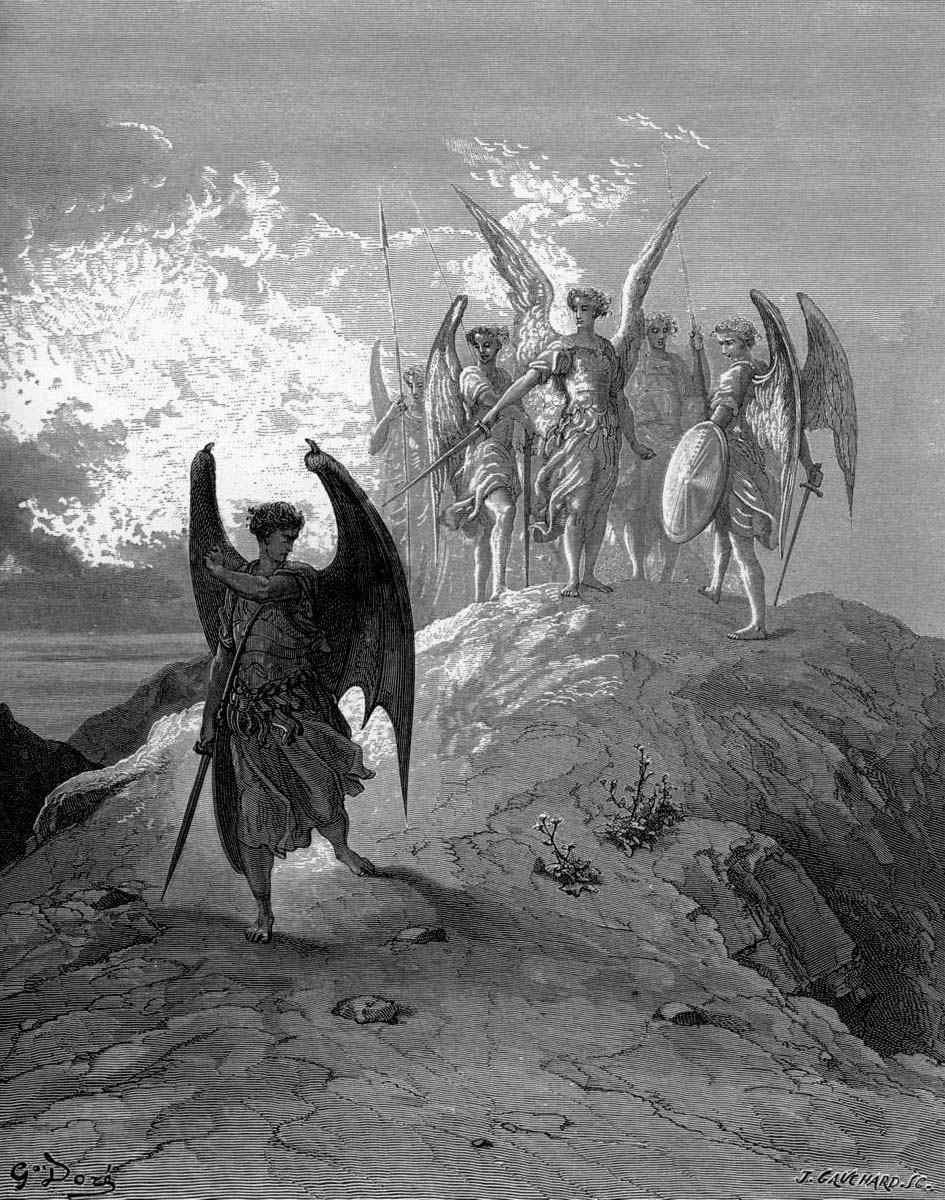
The Days of Noah: Giants, Crossbreeding, and Sacred Marriages
“Now it came to pass, when men began to multiply on the face of the earth, and daughters were born to them, that the sons of God saw the daughters of men, that they were beautiful; and they took wives for themselves of all whom they chose.
And the Lord said, ‘My Spirit shall not strive with man forever, for he is indeed flesh; yet his days shall be one hundred and twenty years.’ There were giants on the earth in those days, and also afterward, when the sons of God came in to the daughters of men and they bore children to them. Those were the mighty men who were of old, men of renown” (Gen. 6:1-4).
The last time we looked at the Fall and its recursive pattern, we had seen the murder of Abel and the development of the unholy priesthood of Cain, the rapid urbanization of Mesopotamia and its symbolically representing the counterfeit church; it represents the fragmentation of man, the proliferation of sin within ambiguity.
Cain has become, through jealousy and pride, the archetypal mediator between man and the fallen angels: he has established a new priesthood counter to God’s initial desire for man to be the mediator between Him and Creation, subduing the world through stewardship and offering up Creation to God as a doxology in communion. Cain’s murdering of Abel is the Fall in recursion, destroying that which gives thanks and praise to God, ultimately treating Creation as a thing-in-itself, not as a gift.
Recently, there has been newfound interest in the above passage from Genesis. Fr. Stephen De Young’s interview with Tucker Carlson being one of the more popular iterations of this growing fascination. There is a lot of reason for such capture of our attention and imagination, indeed, the Epstein files and now alien disclosure are converging to depict a certain world that we, who occupy normal space, are having to come to terms with in a real way: according to the release of all this information, there has been dialogue between man and an unseen realm for decades, if not centuries.
What is interesting to me is that the alien disclosure news is combined with voices proclaiming that these entities are, in fact, demonic in nature. Furthermore, it is increasingly difficult to discuss these matters without this type of sensationalism, regardless of what one believes.
So, when the government begins telling us about aliens (especially proceeding from the revelations of the Epstein files), then I am somewhat at a loss for what we are supposed to do with this information.
Are we supposed to be afraid?
Are we supposed to see them as potential saviors?
Are we expecting a new age of enlightenment to descend from the stars?
If so, where have we read this before?
The First Book of Enoch is, for the Orthodox Church, an apocryphal text, meaning that it is hidden; in practice, this means it is suitable for private reading at home rather than public liturgical use. The text describes the prophet Enoch, the great-grandfather of Noah (Gen. 5), being revealed the hidden structures of reality and how the antediluvian world was overwrought by the sins of fallen angels and man. It is a kind of elaboration on Genesis 6:1-4, by looking at who and what these giants were, these mighty men of renown.

The First Book of Enoch is both popular and controversial due to what it puts forth as revelation:
“And it came to pass, when the sons of men had increased, that in those days there were born to them fair and beautiful daughters. And the Angels, the sons of Heaven, saw them and desired them. And they said to one another: ‘Come, let us choose for ourselves wives, from the children of men, and let us beget, for ourselves, children.’
And Semyaza, who was their leader, said to them: ‘I fear that you may not wish this deed to be done, and that I alone will pay for this great sin.’
And they all answered him, and said: ‘Let us all swear an oath, and bind one another with curses, so not to alter this plan, but to carry out this plan effectively. Then, they all swore together, and all bound one another, with curses, to it.
And they were, in all, two hundred, and they came down on Ardis, which is the summit of Mount Hermon. And they called the mountain Hermon, because on it they swore, and bound one another with curses. And they took wives for themselves, and everyone chose for himself, one each.
And, they began to go into them, and were promiscuous with them. And they taught them charms, and spells, and they showed them the cutting of roots and trees. And they became pregnant and bore large giants. And their height was three thousand cubits.
These, devoured all the toil of men, until men were unable to sustain them. And the giants turned against them in order to devour men. And they began to sin against birds, and against animals, and against reptiles, and against fish, and they devoured one another’s flesh, and drank the blood from it. Then the Earth complained about the lawless ones” (I Enoch 6-7).
This ancient expansion on Genesis 6 has shaped much of the debate and discourse—including my own wrestling.
My aim for the Lenten project was to make a positive case for the Sethite hypothesis, that is, the “sons of God” in Genesis 6 were referring to the sons of Seth rather than literal angels descending and mating with human woman—the “daughters of men” referring to Cain’s line.
One of the reasons that this has taken so long to write is my own research (alongside taking a step back from the investigation of evil) going back and forth on whether it is, indeed, the Sethite hypothesis or the Enochian interpretation that is true. I have read through Michael Heiser’s Reversing Hermon, Fr. Andrew Damick’s Lord of Spirits and Arise, O God, Fr. Stephen De Young’s The Religion of the Apostles and even the more fringe The Nephilim looked like Clowns by Paul Stobbs.
One day, I was writing an essay defending the Sethite position and the next I’d write a completely different essay putting forth the supernatural, Enochian position. The Lord of Spirits podcast by the aforementioned Frs. Andrew Damick and Stephen De Young has an entire episode dedicated to this: “A Land of Giants.”
In it, they make the surprising claim that the Sethite hypothesis was originally articulated by Rabbinic Jews between the late second and early third centuries; they go on to state that during this period Patristic writings claim that the Jewish communities at the time were rejecting the Book of Enoch because it was too Christian. The Rabbinic interpretation, therefore, became the mainstream Christian Patristic consensus primarily through Sts. Ephrem the Syrian in the East and Augustine in the West.
While this hypothesis originating from Rabbinic Jews who—during this period—were formalizing and articulating a religious position that was a reaction against the nascent Christian communities in the second to fifth centuries (Religion of the Apostles, 1-2), this does not mean that it is untrue. However, the issue that I have been coming to has been, primarily, tensions arising from the text itself when taking the Sethite view. The Old Testament is less coherent from this position; the conquests, the campaigns, and the presence of literal giants (cf. Num. 13; Josh. 13; I Sam. 17).
Ironically, the internal issues arising from the Scriptures when taking the Sethite position undergirds the more-likely possibility that the Enochian interpretation is correct! Further, by following the broader consequences of the later Church Fathers taking the Sethite position we see the beginnings, especially in Western theology, of a slow deracination of the biblical worldview.
It would be methodologically egregious to simply state that, due to the Sethite hypothesis originating from Talmudic sources it is therefore false—this is a genetic fallacy—nevertheless, it would be equally egregious to not take seriously what the early Church Fathers had to say, especially if their perspective provides a better explanation for the tensions arising from the Sethite position.
St. Irenaeus of Lyons is one of those Fathers; he is the spiritual grandson of St. John the Evangelist, whose spiritual son, the Apostolic Father Polycarp, discipled Irenaeus. In his On the Apostolic Preaching, he writes:
“And wickedness, spreading out for a long time, seized the entire race of men, until there was very little seed of righteousness in them. For <unlawful> unions occurred on earth, as angels united themselves with <…> daughters of men, who bore them sons, who, because of their exaggerated height, were called giants. The angels then gave <their> wives, as gifts, wicked teachings, for they taught them the powers of roots and herbs, of dyeing and <cosmetics>, and the discovery of precious material, love-potions, hatreds, loves, infatuations, seductions, bonds of witchcraft, [and] all kinds of divination and idolatry hateful to God. When these entered the world, the things of wickedness overabounded, while those of righteousness decreased” (On the Apostolic Preaching, 18).
St. Irenaeus’ work echoes the Book of Enoch’s eighth chapter, wherein the angels who plotted with Semyaza teach men divine technologies:
“And Azazel taught men to make swords, and daggers, and shields, and breastplates. And he showed them the things after these, and the art of making them; bracelets and ornaments, and the art of making up the eyes, and of beautifying the eyelids, and the most precious and choice stones, and all kinds of coloured dyes. And the world was changed.
And there was great impiety, and much fornication, and they went astray, and all their ways became corrupt.
Amezarak taught all those who cast spells and cut roots, Armaros the release of spells, and Baraqiel astrologers, and Kokabiel portents, and Tamiel taught astrology, and Asradel taught the path of the Moon” (I Enoch 8:1-3).
As we see in the Book of Enoch and St. Irenaeus, the fallen angels, or Watchers, sought to destroy man by first distorting the image of God within him, providing divine technologies and wisdom that—like the fruit of the tree of the knowledge of good and evil—man was not prepared to partake of at this point in his spiritual maturation. Man, through the lineage of Cain, opened himself up to encounter with these fallen intelligences that provided him with these technologies. Nonetheless, this does not mean the Watchers were biologically mating with women in the way some modern interpretations assume.
St. Irenaeus describes Cain, leading up to the murder of Abel, as being filled with the spirit of the apostate angel—the Devil—and made him a fratricide (On the Apostolic Preaching, 17). This parallels the spirit of Satan entering Judas leading him to betray Christ for thirty pieces of silver.
These instances help clarify and reveal what is going on in this antediluvian age: these fallen angels—the Watchers—are not biologically mating with human women; they are filling men with their spirit and, in procreating with women, that spirit is preserved through the generations.
We have a hint at this with the mark of Cain that would act as a generational inheritance through his descendants who, bearing this mark in spirit, became increasingly violent (cf. Gen. 4:23-24).
When we comb through Near Eastern pagan practices, we find a ritual referred to as hieros gamos, or the sacred marriage. This involves sacred prostitution and the assumption of godforms by the male—typically a king—who himself is a kind of divine figure thereby procreating with the sacred prostitute producing a two-thirds divine heir. The best documented sources we have to this practice are from Mesopotamia (Sumer and Babylon); Ancient Egypt, Canaan/Phoenicia, Ancient Greece, India and South Asia, Mesoamerica, and even finding similar themes within Victorian-era and modern occultism.[1]
Side note: Gilgamesh is one of the more popular examples of a literal demigod who is two-thirds divine.
Therefore, these cultic practices were not only being practiced but were legitimately bringing together man and spiritual intelligences which had a material effect on the world. This is the origin of our word symbol, which unfortunately has been re-defined by the modern age as implying something that is not real, or something that is pointing toward something that is. Symbolism as we know it today would be an unheard-of concept to the ancients.
Symbol is derived from the word symbolon (which comes from symballein) meaning “to throw together”; a true symbol is where the visible and the invisible come together in a fusion. So, in the purest sense these rituals were a symbol, and the proliferation of these practices were, for the antediluvian world, cause for man to descend into greater and greater sin.
However, as we see in Genesis 4, Cain being filled by the spirit of the Devil—and Judas later on—does not mean man is not responsible for his own actions; we all face the adversary through temptations and, as we see with these cultic, sexual rites to be filled by the fallen spirits is to open oneself up to them. The Lord encourages Cain to fight against sin and return to the path of righteousness, to faith, but Cain, in his wrath and jealousy, becomes an image of the Adversary and, by extension, open himself up to the devil’s spirit.
Reading the Old Testament through this lens we see concretely the need for the Incarnation and its profundity, because these men were—especially in the antediluvian period—overcome by these fallen spirits. Combined with man’s spiritual immaturity at this time, he was easy prey to the bondage of sin and subjugation by the fallen angels and their progeny. Thus, the Fall recursively occurred through the generations, as man descended further and further away from God, led astray by the adversarial spirits who rebelled against God and sought to destroy man, filling him with their spirit and energies.
The product of unholy unions are called ‘giants’, because they did, indeed, possess a great stature, according to the Bible, the Book of Enoch, and the early Church Fathers as well as Second Temple literature. Although this was not always the case; giant is also a word to refer to tyrants and even thugs, so there are two ways of understanding the Book of Enoch when it says:
“These, devoured all the toil of men, until men were unable to sustain them. And the giants turned against them in order to devour men… and they devoured one another’s flesh, and drank the blood from it. Then the Earth complained about the lawless ones”
We can see this as a metaphor, relating to the tyrants who were the spawn of these unholy unions, filled as they were with the fallen spirits energies, who waged war with other kingdoms, devouring men by sending them to fight, devouring livestock to feed the engines of war, devouring one another’s flesh and drinking the blood—which alludes clearly to cannibalism—destroying one another, influenced by the powers and principalities of the fallen angels. They sinned against nature by showing no respect for Creation, seeking to dominate rather than to steward it, forgetting God and exalting themselves as demigods to be worshipped and paid fealty.
This can be the case, and it can also be the case that the seemingly rarer event of the progeny being literal giants existing simultaneously. If we draw from later encounters with giants by the Hebrews then we can see the double witness of the Book of Enoch: both the predatory tyrants who consumed human life through warfare and domination, and the literal presence of physical anomalies, giant-led tribes in the wilderness, attacking the communities unguarded by city walls. These giants were, according to the texts, between nine to thirteen feet tall, leading bands of raiders in continual chaos and mayhem.
There are other interpretations, stemming from Second Temple literature, claiming that the giants were hybridizing man and animals, creating abominable creatures which defied God’s Providence and Creation. The Book of Enoch writes: “And they began to sin against birds, and against animals, and against reptiles, and against fish.” This implies a system of crossbreeding and sorcery, dissolving differentiation, blurring boundaries, and thereby attacking the order of Creation (Gen. 1:20-25).
Regardless of how we understand this passage, Genesis 6:5-7 depicts a fallen world that, no matter what our speculation as to what it may have looked like, was far worse than we can imagine. Indeed, it seems the greatest obstacle to this interpretation may be our modern incredulity (as fallacious as it is), which tends to categorize things such as giants, ritual magic, demons, and even a Personal God as primitive, backwards, or unenlightened.
The point is these rituals were being performed because they worked; they were producing a demonic hybrid of man and fallen spirits that were sinning against Creation. This sets the stage for the Flood; God shortens the days of man, because His Creation, being filled more and more by the adversarial spirits, were becoming increasingly demonized. The Flood reflected man’s departure from God, His righteousness, and grace ultimately leading to His withdrawal of His grace—the Flood.
The Flood was a severe mercy; a cosmic purgation designed to rescue the image of God within man from total demonization. Therefore, It follows the pattern of expulsion from the Garden for the sake of man. And for man’s sake, his primordial vocation was taken up by Noah who, in donning the mantel of Abel, preserves man’s connection to God through the Ark signifying a type of Baptism, of the Spirit hovering over the waters of Creation—a microcosm of the Garden—prefiguring the Temple and, ultimately, the Church.
Ο ΧΡΙΣΤΟΣ ΕΝ ΤΩ ΜΕΣΩ ΗΜΩΝ! ΚΑΙ ΗΝ ΚΑΙ ΕΣΤΙ ΚΑΙ ΕΣΤΑΙ
[1] While modern scholars tend to downplay these ritual acts or frame them as symbolic reenactments or metaphors, the text themselves do not imply that the ancients thought that they were performing a symbolic act; they describe concrete and physcial acts which involve real human participants.
The convergence of human participants with spiritual entities cannot be understood as mere metaphor, especially considering that the pre-modern world believed that they were, indeed, participating in an unseen reality via their rituals.
 Witness, NM