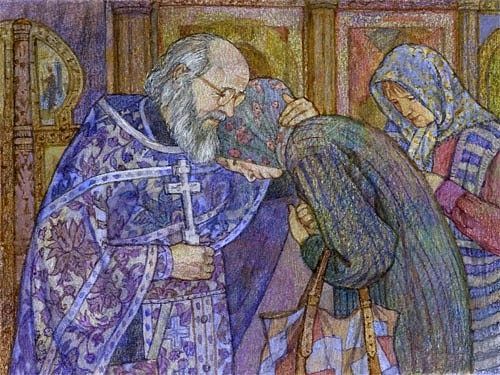
Reflections for Forgiveness Sunday
“My friends, pray to God for gladness. Be glad as children, as the birds of heaven. And let not the sin of men confound you in your doings. Fear not that it will wear away your work and hinder its being accomplished. Do not say, ‘Sin is mighty, wickedness is mighty, evil environment is mighty, and we are lonely and helpless, and evil environment is wearing us away and hindering our good work from being done.’
Fly from that dejection, children! There is only one means of salvation, then take yourself and make yourself responsible for all men’s sins, that is the truth, you know, friends, for as soon as you sincerely make yourself responsible for everything and for all men, you will see at once that it is really so, and that you are to blame for everyone and for all things. But throwing your own indolence and impotence on others you will end by sharing the pride of Satan and murmuring against God.”[1]
Dostoyevsky, particularly through Fr. Zosima’s teachings, reveals a profound truth that mirrors the heart of Orthodox spirituality—namely, that salvation comes through bearing the burdens of others, embracing humiliation, and recognizing our responsibility for the sins of the world.
Woven throughout Dostoyevsky’s works is a pattern reflecting the true, immersive, and often repugnant reality of the Christian life: That is the way of the Cross. His novel, “Crime and Punishment” portrays the character Raskolnikov passage from darkness to light, from pride to repentance, and—ultimately—redemption predicated on the breaking down of his pride through humiliation. Humiliation is integral to the lived experience of the Christian passage, or Pascha, toward spiritual perfection and unceasing communion with God.
Humiliation should not be mistaken for, or limited to, simply shame, but the stripping away of self-reliance, pride, and being brought to the realization of one’s true condition before God. In the space that is created by the burning away the dross of self-love, there is room for God’s love and grace to fill us, sanctify and transform us.
This Orthodox vision of bearing one another’s burdens finds its most vivid expression on Forgiveness Sunday. In this sacred act of mutual forgiveness, we embody Fr. Zosima’s exhortation to take responsibility—not only for our own sins but for the sins of the whole world.
Forgiveness Sunday in the Orthodox Church is an invitation to taking on this humiliation, in community, coming forward as persons who fall short of the glory of God, every day. As we bring ourselves forward, as sinners, our community embraces our fallenness, forgiving us as we forgive them, just as God forgives all who come to Him in repentance. In the vespers service, we enact Christ’s command to love God and neighbor, acknowledging our shared fallenness beneath the thicket of worldly desires.
Fr. Zosima’s soliloquy demonstrates the all-embracing nature of love within the Orthodox Church and how this love, Who is God (cf. I Jn. 4:8), completely transforms us, our approach to the world, and even how we see it. This love is how we embrace and endure the suffering of this fallen world and, despite our inclination toward self-loving abandonment, actually how we participate in God’s sanctification of reality by acknowledging our own contribution to the suffering and fallen state of this world.
What the Gospel reading reminds us, what Jesus Christ our Lord is teaching us, is that repentance, forgiveness, and salvation are communal. Salvation lies in our ability to put down the need to self-justify and, like the Pharisee from a few weeks ago (The Sunday of the Publican and the Pharisee), set ourselves apart from those we deem inferior to us, worse: sinners. Fr. Zosima exhorts us to think higher than this Pharisee by uniting ourselves with those who we might judge as lower than us:
“Remember particularly that you cannot be a judge of anyone. For no one can judge a criminal until he recognises that he is just such a criminal as the man standing before him, and that he perhaps is more than all men to blame for that crime.” Take, instead, the crime that he has committed upon yourself, judge yourself and suffer for him, letting him go without reproach.[2]
Fr. Zosima emphasizes the words of the Apostle, writing to the church of Rome: “Let love be without dissimulation. Abhor that which is evil; cleave to that which is good. Be kindly affectioned one to another with brotherly love; in honour preferring one another” (Rom. 12:9-10). Let love, therefore, be without pretense; brotherly love is the spiritual foundation by which we offer worship to God “in spirit and in truth” (Jn. 4:24). The elder Zosima urges us to think of Creation as “like an ocean, all is flowing and blending; a touch in one place sets up movement at the other end of the earth.”[3] Brotherly love means that we are responsible for one another, not better than anyone, but—like Christ—a servant to all (cf. Matt. 20:28): Bearing one another’s burdens and so fulfilling the law of Christ. For we are deceiving ourselves if we think ourselves to be something, when really, we are nothing (cf. Gal. 6:2-3).
Fr. Zosima provides an ointment to the illness of sin directed toward our neighbor, wherein we judge and set ourselves apart and above them, highlighting the forgiveness our Lord calls us to in the Gospel passage and in His very life,
“If the evil-doing of men moves you to indignation and overwhelming distress, even to a desire for vengeance on the evil-doers, shun above all things that feeling. Go at once and seek suffering for yourself, as though you were yourself guilty of that wrong. Accept that suffering and bear it and your heart will find comfort, and you will understand that you too are guilty, for you might have been a light to the evil-doers, even as the one man sinless, and you were not a light to them. If you had been a light, you would have lightened the path for others too, and the evil-doer might perhaps have been saved by your light from his sin.”[4]
“For if ye forgive men their trespasses, your heavenly Father will also forgive you: But if ye forgive not men their trespasses, neither will your Father forgive your trespasses” (Matt. 6:14-15). This does not simply mean forgiving people for hurting us or transgressing the laws of society but radically shifting the disposition of our heart to see our brothers and sisters’ weaknesses’ as deep reflections of our own. No one sins in a vacuum but rather they bring forth what has been deposited in their hearts by the fallen nature of this world and the suffering that emerges from it.
As Fr. Zosima observes we are all inextricably entangled together and responsible for one another. The Lord of all commands us to forgive one another, just as He has forgiven us, and when we step into the reality that we are all responsible for one another in the sense that we are deeply, deeply connected like an ocean and its movements then we might begin to see that by forgiving others and shouldering their sins to bring them before God in repentance is absolute freedom.
The contrast between the Pharisee’s self-justification and the Publican’s repentance mirrors Fr. Zosima’s exhortation: we are all responsible for one another. To acknowledge this is not to embrace defeat, but to enter into the radical freedom of love—the freedom found in shouldering the sins of the world and offering them to Christ.
When we love as we ought, as the Lord calls us to and the elder Zosima reminds his spiritual children to follow, then we, like St. Simon of Cyrene, take upon ourselves our brother’s burdens, their crosses, and identify with their struggle, bringing it into our being, and allowing the suffering of our fallen world sanctify us through repentance. That is, acknowledging and taking responsibility for our contributions to the suffering and sin of this world.
Love! Love! Love!
Love is the wellspring from which the life-giving waters of forgiveness, fasting, and prayer flow (cf. Jn. 4:15). St. Porphyrios of Kavsokalyvia writes: Love towards one’s brother cultivates love towards God.[5] To love the self above all is egotism, a spiritual sickness that cuts us off from the divine life. The Pharisee, standing apart in his pride, found himself in communion with no one but himself. This is not the way of Christ. The love of Christ is the love that He wishes to share with us that we might share it with the world, just as He did, no matter the circumstances. Despite them!
Dr. Timothy Patitsas, ethics professor at Holy Cross Greek Orthodox School of Theology writes,
We begin, according to Orthodoxy, by acknowledging the severe limitations on our freedom and rather than using our current lack to justify our actions, we take on the responsibility of even other people’s sins, in order to see our own agency strengthened.[6] In this way, we are imploring God to exercise His ultimate freedom to purify our free will and unite us to Jesus Christ. This is the way of the Cross: offering ourselves to God in place of our brothers, repenting for their sins and our own.
Dr. Patitsas continues saying, that it is in this taking on a more developed sense of our own sins that enables us to realize our true humanity, and freedom, in Christ: “Orthodoxy counsels us to repent not only of our sins but of the sins of the entire world. That way, we address our responsibility more accurately… only if we are willing to repent of the sins committed by others—since they also possess a limited moral freedom that we are in part responsible for their sins—can we ourselves become more fully free… The path to our freedom is the taking of responsibility for the sins of others, there is no other path that actually works. In taking the sins of the entire world upon ourselves, we are freed from all circumstance.”[7]
Orthodoxy counsels us to embrace the pattern of sanctification and healing revealed by Christ: “Hereby perceive we the love of God, because he laid down his life for us: and we ought to lay down our lives for the brethren” (I Jn. 3:16).
To embrace the sins of the world as our own is not an abstract concept—it is the very pattern of the Cross. Christ, the sinless One, “became sin for us” (II Cor. 5:21), taking upon Himself what was not His in order to set us free. Likewise, when we repent for the sins of the world, we participate in this same self-emptying love. We do not justify ourselves. We do not claim innocence. We take up our cross and follow Him, for there is no other path to true freedom. Through the Cross, Christ’s Divinity was revealed—through humiliation, He was glorified. If we wish to be like Him, we must embrace this same path: repenting not only for ourselves but for the world. Then, transformed by repentance, we will shine as a heavenly light, guiding all men to Christ, the true Light (Jn. 1:9).
Ο ΧΡΙΣΤΟΣ ΕΝ ΤΩ ΜΕΣΩ ΗΜΩΝ! ΚΑΙ ΗΝ ΚΑΙ ΕΣΤΙ ΚΑΙ ΕΣΤΑΙ
[1] Fyodor Dostoevsky, The Brothers Karamazov, trans. Frederick Whishaw (Grand Rapids, MI: Christian Classics Ethereal Library, n.d.), https://www.ccel.org/ccel/d/dostoevsky/brothers/cache/brothers.pdf?
[2] Ibid. 279.
[3] Ibid. 278.
[4] Ibid. 279
[5] Wounded by Love: The Life and Wisdom of Saint Porphyrios, ed. Sisters of the Holy Convent of Chrysopigi, trans. Fr. John Raffan (Limni, Evia, Greece: Denise Harvey, 2005), 180.
[6] Timothy G. Patitsas, The Ethics of Beauty (Maysville, MO: St. Nicholas Press, 2019), 58.
[7] Ibid. 60-61.
 Witness, NM