“Our Father in heaven,
hallowed be your name.
Your kingdom come,
your will be done,
on earth as it is in heaven.
Give us this day our daily bread,
and forgive us our debts,
as we also have forgiven our debtors.
And lead us not into temptation,
but deliver us from evil.
“For if you forgive others their trespasses, your heavenly Father will also forgive you, but if you do not forgive others their trespasses, neither will your Father forgive your trespasses” (Matthew 6:9-15).
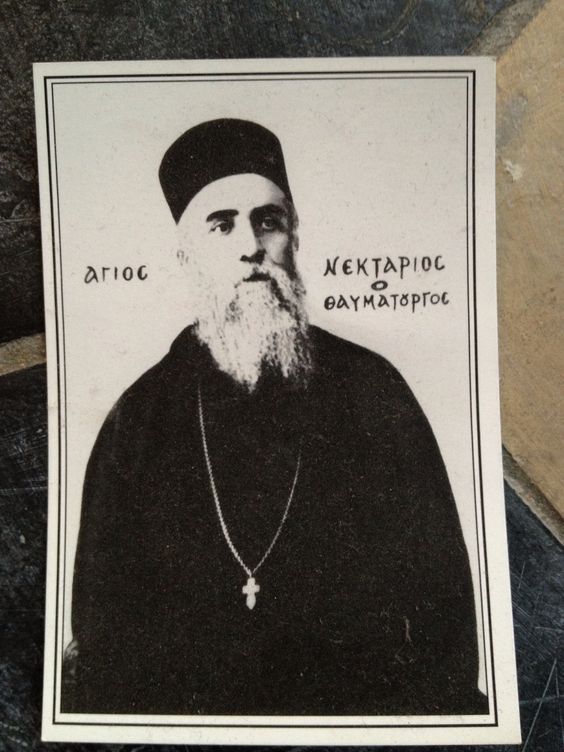
Saturday was my name day and the feast day of St. Nektarios of Aegina, my patron saint.
He is my patron saint for many different reasons, he, indeed, chose me. This is a not uncommon story that I have come across with other people’s experiences entering the Church and finding a patron saint. I love St. Nektarios because of his express desire to know God better to serve and love Him, the very thing I am eager to do, too.
Today, in reflection of the life of my patron saint, seeing his embodiment of the Lord’s call to humility and forgiveness, I want to offer some thoughts based on the Lord’s prayer. In celebrating the (eternal) life of his feast, I am reminded of the profound connection between forgiveness, the Eucharist, and our salvation.
Give us this day our daily bread.
When the word daily is used, typically, in the New Testament it is the Greek, ἡμέρα (hemera), however when it issued by our Lord here, He is using the unique word: Ἐπιούσιον, or epiousion. This renders the verse, Τὸν ἄρτον ἡμῶν τὸν ἐπιούσιον δὸς ἡμῖν σήμερον.
Give us this day our epiousion bread.
The Eastern Church translates this word, epiousion, to the more accurate supersubstantial. Fr. Thomas Hopko, of blessed memory, writes that this means “more-than-necessary” bread. The bread of the coming age; the bread that when you eat it, you never die. The bread of life, Jesus Himself. The deified flesh and blood of God’s lamb Who teaches us that, to eat of His flesh is to have eternal life. It is the Eucharist, the bread necessary for existence as it is translated in Church Slavonic (насущный).
Herein lies the proper understanding of the Lord’s prayer and why we recite it, together, during Liturgy right before Communion. We are praying and beseeching He Who “He who comes down from heaven and gives life to the world… ‘Lord, give us this bread always’” (John 6:33-34).
This supersubstantial bread, that prepares us for and is eternal life, is inextricably linked with forgiveness, as Christ immediately teaches after sharing this prayer with His disciples. Forgiveness is godly. It is righteous and, in an eschatological sense, it is a part of our salvation; forgiveness is a part of our divine purpose, our telos, and our duty as Christians. To never die is to forgive others their trespasses so that God may forgive us our trespasses, our shortcomings, and our all too often fall into sin.
This is how to follow the teachings of Christ, to lose our lives to gain them; forgiving others is dying to the self, and is a loving, self-sacrifice. Forgiveness is the means in which we die before we die so that we don’t die when we die. Forgiveness itself is grounded in the other elements of importance in this chapter: Fasting, prayer, and almsgiving. Releasing our trespassers from their spiritual debts through forgiveness is answering the same call to give alms, generously, releasing others from the burdens of material need.
It is righteous to give to the poor, yes, and when we look at it in tandem with fasting and prayer then all of it is revealed to be a part of this loving, self-sacrifice. Kenosis, or self-giving, is how we develop our personhood, by giving and being in a loving relationship with others.
When we withhold alms from the poor and needy it is the same as harboring hatred and resentment for our brethren, it is akin to murdering our brother like Cain, and actively moving away from community by practicing an individual piety on par with the pharisaical hypocrisy to be seen praying and fasting.
The synagogues and churches become the stage for such hypocrites (which originally meant actors) to garner applause and praise from men, but this is vainglorious spirituality and not reflective of the Trinity.
The Trinity, in its essence, is unified and diverse. One God and three distinct Persons Who know themselves in and through their relationship and knowledge of the Other.
We realize ourselves in community mirroring this communal aspect of the Trinity. We realize ourselves in and through realizing the other. This is the beauty of almsgiving; we do not give alms merely because we have been instructed to, but to strengthen community, give dignity to others, and reveal their personhood. The process of deification is a communal one; God became man so that man could become God.
This process of deification, what the Church also calls theosis, happens in and through the Body of Christ. Christianity is not a set of doctrines or dogmatic positions for individual salvation, but for persons. And by becoming deified we allow the grace of God to flow through us, touching the world around us, and eternity entering the temporal.
The Eucharist being taught right alongside forgiveness is no accident, without forgiveness we have no part in Christ, and is therefore a call to eternal life through humility.
My patron, St. Nektarios of Aegina is an exemplary embodiment of forgiveness and humility. He blessed those who cursed him, prayed for those who reviled him, and returned good for the evil slanders which were thrown at him. God’s eternal presence is made manifest through humility and forgiveness; they are the cornerstone of prayer, fasting, and almsgiving, because to be like God is to live in community and offer yourself in a kenotic love for others which realizes the personhood of all.
When we help others, we are helping ourselves, because we are all one in Christ. It is an implicit recognition of the distinct personalities, talents, and dignity of all people in Him. When we contribute to building up the Body the Body becomes stronger, and those talents and personalities can be actualized in their fullness. When we forgive others, we are forgiving ourselves by the compassion and forgiveness of our Father.
Eternal life is a present reality that we participate in through the Eucharist, by eating Life itself we become likened to Life, that we might exclaim like the Apostle, “it is no longer I who live, but Christ lives in me; and the life which I now live in the flesh I live by faith in the Son of God, who loved me and gave Himself for me” (Galatians 2:20).
When we address God as our Father, we are putting voice to the fact that, through Baptism and Chrismation, we were made children of God by the grace of adoption, and we become more and more His children, deified in and through the firstborn of all Creation (Colossians 1:15).
To be a child of God is not a passive act of confessing a certain belief, but by faith acting in accordance with our Father’s commandments to love our neighbor and forgive them their trespasses, to “Pursue peace with everyone, and also sanctification, without which no one will see the Lord” (Hebrews 12:14). The reality of our deification, by God’s grace becoming heirs of the promise of eternal life is actualized by our righteous participation in community.
We will not see God unless we forgive, letting go of all bitterness, resentment, and hatred for our brethren. We will certainly not see God if we practice an outward display of piety like the Pharisees, the hypocrites who seek applause like actors in the theatre pretending to love, to give themselves, and to seek God. This was precisely the fault of the slanderers that pursued the destruction of St. Nektarios, who despite his enemies’ evil, lived a life in and through Jesus Christ, pursuing peace, forgiveness and embodying the humility that leads to eternal life.
The supersubstantial bread that to eat it, is to never die (John 6:51).
To eat of this bread, to partake of the divine nature; to be and become a child of God necessitates that we embrace the Christian duty to pray, to fast, and to give alms; to be humble and to forgive our debtors because we have been forgiven and we are being forgiven our debts. We are called not to act piously like the hypocrites, but to be doers of the word, not pretenders (James 1:22).
This is the bread that leads to eternal life, not only is this predicated on eating of the supersubstantial bread, but it is also based on how we treat others. Almsgiving and fasting is not simply about the money we give to those in need, but it is also about letting go of the poisonous root of blindness, to stop trafficking with darkness, and to love others just as we have been loved by our Father, Who art in heaven.
Finally, this is a call to a grounded and communal spirituality. We Christians are not followers of Christ for spiritual experiences or individual mystical ascent. We become sanctified and deified in and through Christ, together. It is true that we are meant to struggle for our own salvation with fear and trembling (Philippians 2:12), but we support one another in our striving and only realize our personhood in relationship with others reflecting the Indivisible Trinity. So, let us all be doers of the Word of God, following in the footsteps of my beloved patron, St. Nektarios of Aegina, who, may we too walk this path that leads to life eternal.
May God bless us with our supersubstantial bread from this time forth and to the ages of ages. Amen.
Saint of God, Nektarios, pray for us!
Ο ΧΡΙΣΤΟΣ ΕΝ ΤΩ ΜΕΣΩ ΗΜΩΝ! ΚΑΙ ΗΝ ΚΑΙ ΕΣΤΙ ΚΑΙ ΕΣΤΑΙ

