Theology of the Cross
St. Paul’s gospel message was meant to combat the inclinations of mere humans by giving his spiritual children milk and honey, slowly weaning them off the things of this world bringing them closer to Christ. The meat of the gospel preached by Paul is the cross, his own theology of the cross and resurrection of his Lord, the Christ Jesus which—as it was solid food—was not comprehended by those walking on merely human ways,
“The word of the cross is a nonsense to those who belong to the world that perishes; but to us who experience the salvation, it is a divine world power.
“Scripture says: I will let the wisdom of the wise perish; the understanding of the clever I will topple from its height […]
“Humanity, which once lived with divine wisdom, has lost the wisdom by which it could perceive the divine world. For this reason, it was God’s will for salvation, through the paradoxical nature of the Christ proclamation, to grant salvation to those in whose heart the faith lives.
“Whereas the Jews demand a wonder shall happen, and whereas the Greeks concern themselves with the old wisdom, we proclaim the crucified Christ, over which the Jews stumble and which for the non-Jews only means that foolishness has taken the place of wisdom. But to those who sense the call of the Spirit, be they Jews or Greeks, we proclaim Christ as a divine power and as the source of a new divine wisdom. What in God is foolishness is yet wiser than human beings, and what is weakness in God is yet more powerful than human beings” (1 Corinthians 1:18-25).
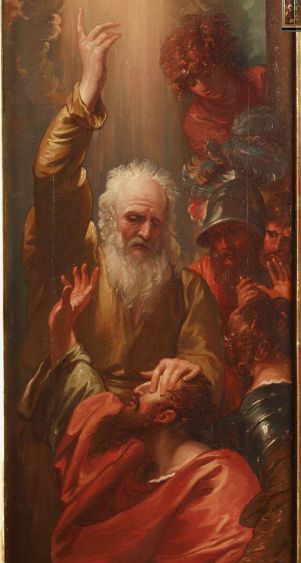
The cross is a triumph in Christian thought; St. Paul presents it as the end of the earthly wisdom and the beginning of the glory and power of God, because where some saw the weakness of the so-called messiah executed on the cross, those with eyes to see and ears to hear saw salvation and the love that God has for the world.
The cross was a stumbling block to those who did not understand the free gift of love and the wisdom upheld in this love. It is in weakness that God reveals Himself, even the weakness of death on a cross, and it is in the foolishness of man where His glory is manifest through the resurrection of Christ.
“The love of Christ lays upon us the duty to follow this pointer; since One has died for all, then all have died, and he died for all so that the living should no longer live only for themselves. From now on, their life is a part of the life of him who died and rose for them. Therefore, in future our knowledge of Man no longer rests on what is physical. And even if we had known Christ in his physical form, such knowledge is no longer the decisive thing: whoever is in Christ, in him begins the new creation. All that is old has passed away; see, something new has come into being.
“All this has been caused by God who has transferred us back towards HIMSELF in Christ, and has commissioned us to carry out the priestly service of transformation. God worked through Christ and, transforming it, HE raised the world back to HIMSELF. No longer did HE look upon its errors, but in our mindset HE instituted the creative Word of transformation.
“In the service of Christ we carry out our priestly task, in that God speaks through us. On behalf of Christ we ask you: strive on the way of transformation towards God! God made him, who did not know sin, into a part of the world of sin for us, so that we might become members of righteousness, of true being, through him in God” (2 Corinthians 5:14-21).
This is the theology of the cross; the reconciliation of the estranged. St. Paul understood that it was the cross and resurrection that was the ministry of Christ: He was the revelation of God and He did not die for the people of Israel, but for the whole world that it might become new in Him.
The believer returning to God is the gospel of Christ.
For we are all one in Christ and no longer we do live only for ourselves.
Reality is defined by the cross; the cross is the construct of the phenomenal and noumenal worlds which then becomes the story that the Followers of the Way take part in through their baptism into Jesus the Christ.
And because of the coeternal nature of Christ and the Father when we are baptized into Christ then we become one with Him through Him. And that is through the cross, “I am crucified with Christ. So it is not I who live, but Christ lives in me. (Galatians 2:20).
This faith is outlined by St. Paul through the cross and therefore is ultimately realized by the resurrection that, by uniting ourselves to Christ, we take part in just like the cross,
“We know that HE who raised the Lord Jesus will also lead us to resurrection with him and will make us and you a part of the new existence. All this is for your good, in order that the working grace, which is fulfilled in a shared sacramental life, will lead ever deeper into the richness of the revealing, divine light” (2 Corinthians 4:14-15).
The sacramental life includes the prescriptive dimensions of following the Christian life as given in the Didache, namely by partaking in the Eucharist and practicing contemplative prayer bringing one closer to the divine presence of the revealed God through Christ. The Followers of the Way participate in the death of Christ by the cross and His resurrection being raised back to God.
St. Paul used his post-resurrection revelation of the Lord Jesus Christ to affirm his authority of the gospel he preached–the same gospel he took to the apostles who knew Christ to confer with them regarding its contents, “I went up in response to a revelation. Then I laid before them (though only in a private meeting with the acknowledged leaders) the gospel that I proclaim among the Gentiles, in order to make sure that I was not running, or had not run, in vain” (Galatians 2:2). The apostles recognized the divinity that had graced Paul and, “They asked only one thing, that we remember the poor, which was actually what I was eager to do” (Galatians 2:10).
OK.
Now, this meeting with the apostles is important, and I do not mind repeating the extreme significance of this, because it was the revelation that St. Paul received and this meeting that changed the entire face of the world–as the resurrection changed the order of the cosmos, so did this meeting change the course of human history. St. Paul comes into fellowship with the apostles of Christ and continues his mission to spread the true gospel among the Gentiles.
St. Paul is the reason Christianity is a world religion.
Full stop.
The theology of the cross is the definitive principle at work in early Christianity and why, to my mind, the Roman state decided to adopt it as the religion of the empire.
Again, without St. Paul, this might never have happened.
Before the Roman annexation of this spiritual tradition it was a peoples’ Christianity–an ecclesia of men and women, “I commend to you our sister Phoebe, a deacon of the church at Cenchreae” (Romans 16:1 (Emphasis mine; Come at me!)), a persecuted minority of Followers of the Way of Christ, a tree with many branches focused on a communal liturgical life and direct experience with Divinity. Within movement divinity is the risen savior, Jesus Christ, Who was a mendicant, apocalyptic preacher and prophet Who historically existed, was baptized, and was crucified by the Roman state.
These are things that are generally accepted by the academic world.
There is scholarly interest in the idea that St. Paul invented the messianic figure of the risen savior; there is interest in the idea that the Roman government conjured the Christ figure. Perhaps, St. Paul, ascending through the divine realms by the practice of Merkabah mysticism, witnessed the throne of God, and because of his obsession with persecuting Followers of the Way, had a vision of the figure who lived rent-free in his head where the divine glory would naturally sit.
And maybe… Maybe St. Paul’s vision was a true revelation—perhaps, he ascended to the chariot of God and saw Christ on the throne. There is a section of the Mishnah called the Hagigah in which four rabbis ascend the thrones of God and only one returns in-tact, with one dying soon after his descent, one going insane, and the last apostatizing. It seems likely that St. Paul, a Merkabah practitioner might find a similar life-changing revelation in his own ascent of the heavenly worlds.
Regardless, the crucifixion of Christ happened, and it was done under the Roman state. So, the preaching of the theology of the cross by St. Paul clearly helped the movement from the beginning, and this theology–right or wrong–strengthened the community of followers of the martyred Jesus of Nazareth in their own persecution under Roman occupation.
A normative model of the early Christian church includes much martyrdom along with the ecclesial structure of the Jewish faith. This was a time of house churches, domus ecclesiae, where the liturgical life of the early Christian movement took place in the privacy of homes. This early movement of the church gave women much more decisive roles in leadership positions as patrons of the movement as it was their homes that were used for service. These places of worship were used for three centuries until the legalization and adoption of Christianity under Constantine I. The use of domus ecclesiae was not an institution given by Christ, but a necessity of ecclesial structure due to the ongoing persecution of Christians, until the Edict of Milan.
The first church building dedicated to the Christian faith is known as the Dura-Europos church, located in Syria and was founded as such in the mid-second century.
The restorationist movement of the Second Great Awakening calls for a return back to this model of worship due to the belief that by doing so, the Christian church is returning back to the standard approach used by early Christians. The house church model is not exclusive to the use of private homes, but also refers to a step toward a stripped-down approach to a worship space as seen in some denominations (and non-denominational groups) utilizing converted department stores as churches, depending on the denomination the leaders of this church might declare a return to the apostolic tradition without being a part of such pedigree. This is because, as mentioned previously, the Apostolic tradition died with the last of the apostles. The problem with both the reliance on the Bible as the inerrant, infallible Word of God, its sole place as directive for the Christian life, and the restorationist vision for a primitive church model like the domus ecclesiae is one of cultural and theological presentism.
The Bible did not come from a vacuum and the organization of church structure did not fall out of the sky—it is not a continuation of the pagan religion dressed up with Christian iconography, another tradition of the church that restorationism looks to undo in a modern iconoclasm. We cannot look at this small movement of Followers of the Way through modern eyes nor should we understand their “primitivism” as a call by Christ to worship the way they did while under threat of persecution. The Russian Christians worshiped in catacombs due to the persecution they faced during the 20th century. If we look at Christianity through the restorationist lens then these persecuted Orthodox Christians, having to practice liturgy in the catacombs of Russia to avoid imprisonment is the normative model for this faith tradition.
And I bet the restorationists would still find fault with these Orthodox witnesses because they celebrate the Eucharist, which—because the Didache is not a part of the New Testament canon—is not associated with “right worship.”
How ironic.
This form of worship, done under threat of imprisonment or death, means a lot to us looking back at the early church. It is through this frame that Christianity comes into better focus. St. Paul might have established Christianity as a world religion through his perseverance in ministry, but it is the Christians that kept the faith and the liturgical life of the early church that make Christianity what it is; it’s a faith built around oppression. In the same way we cannot understand the ministry of Christ, and few did during His time, without looking to the disenfranchised then the same can be said about the development of the religion that His ministry founded. The marginalized peoples of the Hellenistic world were the first to make up the Body of Christ and it was the religious and political authorities who were opposed by St. John the Forerunner, Jesus Christ, St. Paul, and even the writer(s) of the Gospel of Mary.
There are different arguments revolving around why the figure known as Jesus Christ was executed by those same authorities. Biblically, it was the Will of God that brought Christ to the cross—where His ministry met its brief, three days pause, before its fulfillment in His resurrection.
That is how the community who would go on to call themselves Christians saw themselves: through the cross. This religious body’s perspective was shaped by the crucifixion and their environment; they were a small mystery cult existing within a larger, dominant culture which was the pagan, Roman world. The Body of Christ, a being-at-work, understood itself through moving within this world and fulfilling itself through its own self-conception as a marginalized group led by the Godman Who was executed by the state. Thus, the Christian tradition was validated by Roman persecution in an inversion of the state’s will to power and exerting its authority.
The oppression, in turn, would then become edifying to the Followers of the Way by reinforcing Christ’s own words to be in this world and not of it—to go against the greater culture, no longer walking on merely human ways. Hence a peoples’ Christianity is the cloud of witnesses: those who came before who finished the race, put up the good fight, and kept the faith–martyrs, witnesses, confessors. From St. Φωτεινή (Photine) at the well to the women at the tomb, to all those who were put to death for confessing His Name. This is Christianity. The Christian phronema was developed through the cross of Christ and the cross of His followers. The mind of the church originally developed through the eyes of the oppressed, the marginalized, the outcasts living under Roman rule.
Their victory was in the cross of Christ, His followers’ victory was in their cross—dying to self and striving on the way of transformation towards God!
It is the victory that we all participate in communion, having the mind of Christ, in one body, “The cup of blessing, over which we speak the words of consecration, does it not offer the communion of the blood of Christ? The bread which we break, does it not offer the communion of the body of Christ? Because it is one bread, therefore we are together one body, for we all share in the one bread” (1 Corinthians 10:16-17). The sacramental life binds us not only to our physical brothers and sisters in Christ in our earthly forms; it goes further and unites us to the cloud of witnesses, helping align our minds and bodies to the ἐνέργεια of God, becoming united in spirit to His essence.
The liturgical and sacramental life of the church is the way in which the unmanifest potential of God actualizes and becomes reality through us, and by uniting to the peoples’ faith who have come before, who cheer us on, then we generate a self-sustaining Body, ever-aligning with His will. This is the Way, and it began with His death on the cross and the triumph of His resurrection challenging the very order of the cosmos. The reordering of the divine realms descending to the very last of us: the forgotten, the infirm, the very weakest sinner…
This tectonic shift of cosmic proportion usurped the authority of Rome, and by the grace of God, they would get it back.
Si comprehendis, non est Deus

