A rant, the fruits of fracture, and unholy patterns
My capstone course for my history degree, historiography, is making me realize how abstract and nonessential much of what passes as academically rigorous is essentially, myth-making. Myth in this case means a narrative construction supported by meaningful frameworks and prior commitments.
Not only that, but depending on which historical lens one is using, the question of whether a certain interpretation can offer actual substantive knowledge-claims becomes a point of serious concern. For one, empiricism often risks an embedded closed-loop such as cultural limitations and beyond that—the underdetermination problem—the notion that evidence does not determine what beliefs we should hold in response to it.
While not a complete solution to the problem, Allen Megill introduced abductive reasoning to historical research which offered a way for historians to justify their assertions by preferring some explanations over others without appealing to epistemic certitude. Empiricism and a philosophy of history grounded in materialism is not neutral, even if historians try to be objective—because of their biases and philosophical frameworks—they will always be interpreting beyond the evidence.
Marxist historians risk the same systemic issue, exceeding the evidence in their interpretations while also assuming the conclusion of their own model: when everything is assumed to have an economic basis, the risk is both reductionist tendencies and a myopic view. Psychoanalytical history, same problem but to a greater degree.
And that makes me frustrated because at best it dissolves history into a kind of relativistic pick-your-own-adventure and at worst it reduces history to pure subjectivism where history becomes realized only through interpretative models. Why this is frustrating is that it undermines the objectivity of reality. Further, it undermines the objectivity of history and casts doubt on the possibility of knowledge.
Naturalism is the predominant metaphysical standard in academia so much so that it is an unquestioned fact which draws many issues regarding historical inquiry, namely, anything that falls outside of naturalist assumptions is viewed with suspicion or dismissed entirely.
This itself is an interpretation of data and a conclusion based on a priori reasoning, it highlights the issue with Megill’s applying abductive reasoning historical thinking with David Hume’s problem of induction: if the simplest, most easily verifiable fact or solution ought to be preferable explanations over others, how do we justify believing that what is observable and verifiable is a constant and recursive even when unobserved?
All this to say, just because a historian doesn’t believe what the data is telling them happened does not justify dismissing the data entirely or, more likely, projecting a new narrative onto the archival fragments which produces a coherent story grounded in a historian’s theory and assumptions (which is often the case).
An example of this is the secular dating of the Gospels to the late first century, rather than within a few decades as the Church tradition holds. Naturalist methodologies rule out predictive prophecies, so the fact that Christ prophecies about this event—before it happened—is principally dismissed. Therefore, all the instances of Christ prophesying about the Second Temple destruction had to be redated or reinterpreted based on these methodological commitments.[1]
So, naturalism and empiricism are not at all neutral but operate from their own a priori assumptions that are used when interpreting data.
My big problem with all of this is how it relates to Scripture, with naturalist privileging older textual fragments as source for later fragments seen as derivatives. This isn’t to say there is some naturalist conspiracy is trying to deracinate Christianity and convince people that it is not true. A conspiracy does not need to exist when naturalist metaphysics create fertile ground for skepticism that is structurally symmetrical.
In our modern world, Christ is treated as a permissible target of critique in ways that other sacred figures and traditions are not.
Regardless, recently I’ve had kind of a change in perspective. Maybe it’s because I’ve had the flu for almost two weeks. Maybe it’s because I’ve been preparing for Lent. Maybe it has a lot to do with these files… But this is kind of a line in the sand moment.
Christianity is either true or it’s not; nothing in the Bible can be reduced to mere allegory divorced from history without dismantling the entire message and paradigm. Patristic exegesis relies on literal, typological, moral, and anagogical interpretations; that means all of them are elements in revealing the complete picture of any given passage. The symbolic-liturgical vision of scripture is not an either/or exegetical process, but a both/and. To understand the symbolism of Scripture is to affirm its historicity and vice versa.
Nothing in the Bible can be conflated to parallel thought with other religious perspectives or derivative of older material.
It’s either true or it’s not.
If it’s not true, then reduction isn’t helpful; the whole thing ought to be abandoned. But if it is true, then everything changes, namely our heart; if we are not willing to live a life where we are open to God’s grace changing our hearts then the truth is not in us (cf. I Jn. 1:8) and neither does the objectivity of Christianity matter. It’s knowledge without love; theory without communion.
The line in the sand is that these things are true, and that demands action. Living in the knowledge of truth.
Frankly, every age constructs narratives shaped on its presuppositions. The contemporary narrative presupposes a closed cosmos: under this worldview, prophecy is excluded as an explanation, miracles cannot stand principally, and revelation is reduced to primitive meaning-making. But Christianity operates within a dynamic cosmos, one saturated by the redeeming nature of Christ’s Incarnation and Resurrection: Christ is real and that’s true of every age (cf. Heb. 13:8); it used to make me angry that people would target Him and His Church, ridiculing and mocking.
Now, it just makes me sad and hurts my heart. It’s painful to live in a fallen world, because we are a part of it and we contribute to it. So, the only option left is to continue contributing or to be transformed by the light of Christ.
If the option is to believe in a preferable explanation that relies on blind chance and contingency over a more coherent story of God’s love for man which may not preferable because it demands action from us and to willingly work with a Person to change then I’d rather struggle to change my heart, embrace the crucible of suffering, and walk with a Person Who loves us rather than live in a relativistic myth.
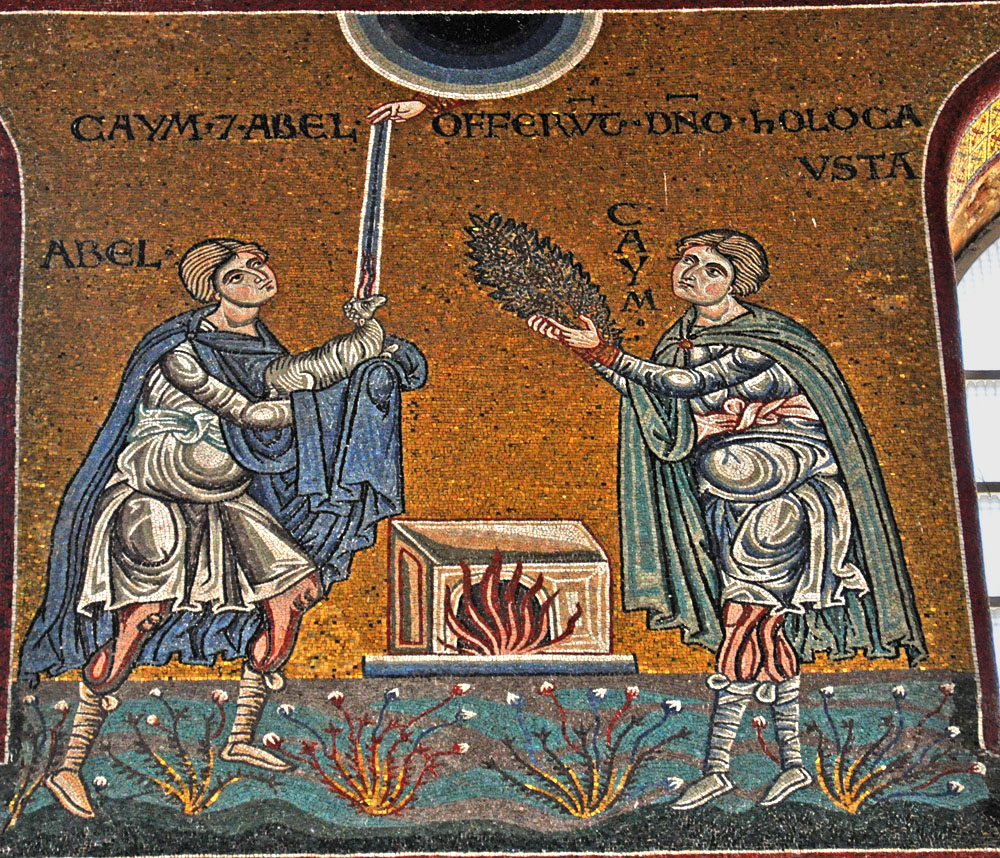
And so, with this flu-riddled catharsis out of the way, we can turn to Cain and Abel. If this story is viewed through the naturalist lens, it might be interpreted as a sociological fable about the transition from nomadic pastoralism to industrial agriculturalism; if seen psychologically, it could be reduced to an analysis of sibling rivalry. While these are worth exploring, they risk losing the typological pattern of history seen through the hinge of the Cross, reducing events to chronological sequence. In the story of Cain and Abel we have history’s first instances of the recursion of the Fall.
“Now Cain talked with Abel his brother; and it came to pass, when they were in the field, that Cain rose up against Abel his brother and killed him.
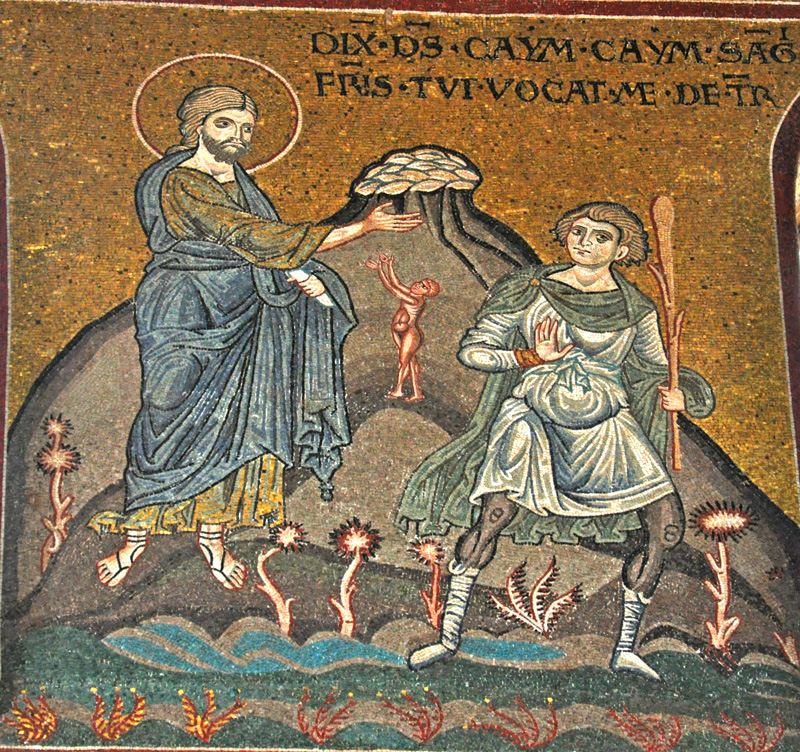
Then the Lord said to Cain, ‘Where is Abel your brother?’
He said, ‘I do not know. Am I my brother’s keeper?’
And He said, ‘What have you done? The voice of your brother’s blood cries out to Me from the ground. So now you are cursed from the earth, which has opened its mouth to receive your brother’s blood from your hand. When you till the ground, it shall no longer yield its strength to you. A fugitive and a vagabond you shall be on the earth.’
And Cain said to the Lord, ‘My punishment is greater than I can bear! Surely You have driven me out this day from the face of the ground; I shall be hidden from Your face; I shall be a fugitive and a vagabond on the earth, and it will happen that anyone who finds me will kill me.’
And the Lord said to him, ‘Therefore, whoever kills Cain, vengeance shall be taken on him sevenfold.’ And the Lord set a mark on Cain, lest anyone finding him should kill him.
Then Cain went out from the presence of the Lord and dwelt in the land of Nod on the east of Eden. And Cain knew his wife, and she conceived and bore Enoch. When he built a city, he called the name of the city after the name of his son, Enoch” (Genesis 4:8-17).
Cain and Abel are primarily the first-fruits of the Fall. They embody the fragmentation of the ancestral heart of Adam, plunged into duality through his transgression in the Garden, as realized expressions of his disobedience and call to repentance. Distilled, the cosmic fracture of the Fall is externalized through the brothers.
On one hand, we have a type of priestly line symbolized by Abel as a shepherd; he reflects man’s attempt to return to God, an image of repentance and living out the primordial faith of man. He represents the natural law of man’s heart to seek union with God; to do what is right and pleasing to God and to steward His Creation—taking up the vocation of his father, the vocation of primordial man. Cain, however, becomes a kind of express reminder of Adam’s sin, made manifest in his progeny as Cain’s self-assertion, self-determination, and ultimately, his rejection of God embodies the disobedience in Eden. He represents the law of the flesh.
Therefore, we have humanity’s first fragmentation no longer concealed within Adam, but springing from a single root man departs from unity to duality and from there a multiplicity of sin. The children bear the imprint of the father reflecting man’s being made in the image of God. The two paths of life and death become manifest through Adam’s sons.
Interestingly, this also reflects how the fallen angels themselves spring from a single root—God the Father—and in their self-assertion, pride, and disobedience depart from unity in heaven; however, this does not create a metaphysical duality but causes a distortion of the good. Man’s duality imaged by Cain and Abel is not an ontological dualism of equal opposing forces, but a fragmentation of the will—a privation of communion with God which divides the once-unified heart, introducing man to the instability of double-mindedness.
This is precisely what Cain does in the murder of his brother: God deems Abel’s sacrifice good, as it follows a heavenly pattern of worship while Cain’s sacrifice he rejects. Instead of Cain becoming an image of cosmic duality in his improper worship of God he destroys what is good. He does not try to usurp Abel as good; he does not present himself as an equal, but opposite; he simply destroys what God has deemed good. In this way, Cain does not simply image the disobedience of his father, but he takes it further in destroying what is of God. Cain here becomes an archetypal rebel and God-hater.
To take this further, where Abel was a type of priest seeking and shepherding Creation toward union with God Cain becomes a type of earthly-priest, in spilling Abel’s blood, Cain is not simply committing the first murder, he is offering it ritually, inverting Abel’s heavenly pattern into an earthly, demonic one. This sets the template for later abominable forms of worship, from the fires of Moloch to the blood rituals which echo through history.
Abel’s blood being spilled caused the earth to groan to God which would be answered by the Flood. However, by leaning into the Enochic reading to illuminate a deeper pattern, we can see that this sacrifice opened Cain’s eyes to forbidden influences—his fractured perception becoming a channel for darker forces, such as those associated with the Enochian Watchers (or fallen angels), who, in accepting such offerings, help realize through him knowledge which was not meant for man at that point in his spiritual maturation, reflecting the knowledge received by Adam and Eve which caused the Fall.
As mentioned in the previous post:
“There was/is an established hierarchy which structured creation.
Hierarchy, in our modern world, has become almost a taboo word, but hierarchy means order and differentiation. Order, according to St Dionysius is not for power, but for sharing (Celestial Hierarchy, IV.I-II).
Within the liturgical vision of the world, this means that without differentiation there can be no identity and without identity there is no being, for being itself is communal, as seen in the life of the Holy Trinity (also, we only become ourselves in relation). Further, this hierarchical dimension highlights how being is sustained through mutual self-giving.”
Abel was participating in a divinely ordered pattern of worship while Cain was not, as echoed in the retelling in the Book of Jubilees. Cain was unwilling to participate in such worship which led to his destruction of the head of the representative head of the priestly hierarchy in Abel.
Therefore, the blood of Abel becomes the first sacrifice in an unholy pattern of worship with Cain usurping the patriarchal role and taking it for himself. He becomes the priest of, and through, sensual passions: jealousy and wrath. He destroys order and differentiation through his killing of Abel.[2] In so doing, Cain sets himself apart from God and in response God expels him from the land. He leaves and heads East to the land of Nod, a land of wandering, moving further away from Eden and communion with God.
Much can be said about the mark of Cain which grants him to lead out the rest of his life without being the subject of murder; while the mark is a mercy of God, given with the that Cain might one day come to repentance, it is transformed by its recipient into the foundation of a fortress—guarded against God.
It is also symbolic of the very city-structures that Cain establishes far from Eden. Cain uses this longevity to build these cities and perpetuate the fall within them. He draws closer to the demonic pattern of being as cities symbolize the dissolution of order and differentiation: fragmentation, the normalization of sin, and alienation of man causing human life to become cheap.[3] Man’s anonymity fuels sin and societal degradation.
In a Patristic sense, the city is the counterfeit Church, where the Church offers communion, the city offers division; where one embodies self-giving, the other self-seeking.
Traditionally, Cain is understood to be the founder of what would become known as Mesopotamia. What is fascinating about this is this establishment corresponds to the questionable (and mysterious) origins of the Sumerian civilization. In the third millennium urbanism emerges in the region with compelling evidence of prior knowledge of how to establish networks of cities and hydroengineering with no clear evidence to where this knowledge originates.
The compelling evidence for a sophisticated society substantiates a preternatural hypothesis for this knowledge and rapid urbanization. The time corresponds to Cain’s expulsion from the land of Eden and journeying East. While mainstream archaeology sees gradual development, a theory of Sumer’s definitive origins continues to perplex and resist consensus.
As a new high priest of an unholy pattern of worship his communion with fallen angels lays the foundation of the unfolding generations and their subsequent inventions which corresponds to the Book of Enoch’s revelation that these same inventions are divine technologies given to man by the Watchers. Cain, in his jealousy and wrath, becomes the archetypal mediator between man and the Watchers. This unholy mediation recurs through the antediluvian age, reaching its most revulsive recursion in Genesis 6.
Ο ΧΡΙΣΤΟΣ ΕΝ ΤΩ ΜΕΣΩ ΗΜΩΝ! ΚΑΙ ΗΝ ΚΑΙ ΕΣΤΙ ΚΑΙ ΕΣΤΑΙ
[1] Yes, there are other reasons for a late dating, however textual dependance (Markan priority and Q hypothesis) prioritizes theory over Apostolic witness; the ecclesial development argument overlooks Second Temple period Judaism and patterns of worship present in the Scriptures. While these are not primarily anti-supernatural commitments, they still overlook contrary evidence which supports an early dating/
[2] This is why it is so important to guard our hearts and not to kill or hate our neighbors even and especially within our hearts.
[3] Additionally, cities symbolize economic freedom. If we tie the mark of Cain and the mark of the Beast together, then we see how they reflect one another through the dissolution of differentiation and order underscored by the distortion of free will, no longer about the path of life and death, of righteousness or wickedness, but about the freedom of choice in the marketplace. Cities, therefore, symbolize a distortion of heavenly patterns and the natural law of man who seeks to unite with God.
Further, cities also image rapid technological development which is seen through the subsequent generations of Cain (according to the Book of Enoch, this technology has infernal origins). With rapid technological development, man loses his sense of self under the proliferation, and normalization, of sin. The freedom of choice becomes yet another ritual which masks the distortion—and loss—of personhood.
This is compounded with technological advancements underlying search for immortality most recently championed by transhumanist efforts to find a way to upload one’s consciousness into a machine further underscoring the cheapness of the human body and self-seeking efforts to become a god without God.
 Witness, NM