The files, Fractals, and fighting evil
“And let us strive that wrath rule us not nor lust overcome us, for it is written, ‘The wrath of man worketh not the righteousness of God. And lust, when it hath conceived, beareth sin, and the sin when it is full grown bringeth forth death.’
Thus living, let us keep guard carefully, and as it is written, ‘keep our hearts with all watchfulness.’ For we have terrible and crafty foes—the evil spirits—and against them we wrestle, as the Apostle said, ‘Not against flesh and blood, but against the principalities and against the powers, against the world-rulers of this darkness, against the spiritual hosts of wickedness in the heavenly places.’
Great is their number in the air around us, and they are not far from us” (St Athanasius, Life of St Antony, 21).
Last week, I drew on some priestly advice and guidance emphasizing that the more clearly you know your calling, the easier it is to discern what is not. This applies to everyone, especially in our age where technology fuels distraction and poses an existential risk, pulling us away from who we are and what we’re here to do. There is an insatiable desire to be everything, to know everything.
I may be in the minority here, but I don’t think these files are good for us. They’re being released without a container and may be doing us more harm than good. The preponderance of evil is great within their pages that I get the sense that reading them, without the proper care, is spiritually damaging. For many people, a lot of the content in these files is new or has been previously hand waved as nonsense.
But they weren’t nonsense.
Much of what people have been speculating as especially heinous has now come out as the tip of the iceberg, and the iceberg stretches for miles beneath the surface.
The main thing is that these files are nothing new. Man’s eyes being opened to the nature of good and evil is primordial. We need to guard ourselves against being overcome by the reality of evil; this isn’t to say ignore it or put our heads in the sand, but to suggest that, by being drawn in by horror, we may be abandoning our path. In thinking that we’re shining light on evil, we end up being overcome by it. The risk in fighting evil head-on is losing the self in the process, becoming more of what we fight against.
So, in a world where the headlines are forcing us to confront the reality of institutional evil and untold horrors, we remember communion, not as an escape from the world’s realities but the very ground in which we face them. It’s in that ground that we are better able to discern what is ours, and what is not.
I set out a few weeks ago—in fact I tried writing about this two years ago, ended up with almost fifteen pages of biblical genealogies, and no sense of direction—to articulate what the origin of evil is. I quickly realized that this wasn’t a good use of time and it reminded me of my years sliding down the rabbit hole boiling with the need to do something about it. But I never did anything except groan in my own helplessness and sense of smallness compared to these giants.
It felt like we were grasshoppers in comparison (cf. Num. 13:33). Often the kind of knowledge that awaits us down the rabbit hole pushes us to despair and paranoia. A crippling despondency that is, frankly, sin. I know firsthand what this kind of doom-scrolling and rabbit holes lead to: staring into the void and being consumed by it, it’s like being caught in a recursive loop of powerlessness.
Evil exists, but we’re not called to return evil for evil, nor are we exhorted to return hopelessness for evil. We’re told to love our enemies and “Always pursue what is good for one another and for all people” (I Thess. 5:15).
Christ and His Church reveal darkness, this is why so many reject Him; this is the judgement: “the light has come into the world, and men loved darkness rather than light, because their deeds were evil. For everyone practicing evil hates the light and does not come to the light, lest his deeds should be exposed. But he who does the truth comes to the light, that his deeds may be clearly seen, that they have been done in God” (Jn. 3:19-21).
The light of Christ does not expose evil by our hatred, but through love. It takes a lot to write that, because—like many people—I have trouble expressing the exact feeling… there are no words. Yet, we must remember in light of all of this darkness, no matter what the world around us looks like, no matter the horrors we face—whether its societal decay in the days of Noah or institutional corruption in our modern day—we always have the choice to reorient toward Christ.
Essentially, what is at the center of this is communion and our free will to choose to commune with God or with powers and principalities that distort us. Man, despite our worse inclinations, was made with a natural will that seeks union with God, which is its natural mode of existence. We have noetic faculties which allow this union to take place and to deepen through prayer, asceticism, and the sacramental life of the Church. What we do, what we worship, and Who we worship—that is what we become; by doing God’s will, by following His commandments, by walking with Him we are, over time, conformed to His image.
A relationship with God is participatory, which underscores how human nature can become defiled and fragmented through demonic practices and habits which pull apart our nature and our relationality with God and neighbor.
Great Lent is a season wherein we walk with Christ in the desert and through ascesis and God’s grace, burning our pride, laying it down—abdicating the throne in our hearts which rightfully belongs to God. It is this season we put our faith in Christ by attending to Him rather than these demon whispers that are looking for our pride to respond and dialogue with them.
I was thinking about this a few days ago in relation to what I, a mere grasshopper, can do in the face of horror. It feels like returning evil for evil when we give in to outrage. When we feel the need to commit violence in response to some of the worst, depraved actions that have come to light it’s too easy; it’s as though pride is compelling us to say we are not like those terrible people. And we may not be, thank God, but it’s not because we are superior to anyone, but it’s because of God’s grace. When we look at Genesis, which will be the focal point of the following essays, we read this crucial verse:
“And the Lord God said, My Spirit shall certainly not remain among these men for ever, because they are flesh, but their days shall be an hundred and twenty years” (Gen. 6:4)
The commentary in the Orthodox Study Bible (OSB) for this passage says, “In his disobedience and expulsion from Paradise, man lost the grace of the Holy Spirit. Nevertheless, His grace was always available to man, but man continually refused it… Without the grace of the Holy Spirit, man is easily overcome by the devil, for his willpower alone is incapable of resisting the devil’s temptations” (OSB, 11).
We should not confuse righteous indignation for moral superiority. We inhabit a world that has fallen into utter institutional depravity; what does that tell us about our hearts? I do not ask this to assign blame, but to suggest that no one is unscathed by brokenness of this world. We may not be giants who victimize those who are smaller, but we may be grasshoppers who, in our brokenness, victimize others. I’d put forth, as well, that the giants themselves are more broken than we could know; it doesn’t excuse their actions nor condemnation, but our enemies are our enemies because of the disease of sin.
A disease that no one is immune from.
In a previous post, I mentioned how I was looking into demons and what is not of God to better walk in His light. My research initially was propelled by cross-cultural analysis of religious phenomena as practiced by a variety of Eastern traditions which formed independent of religious institutions and dogma. This exploration revealed striking similarities with their practices and cosmologies.
As a religious scholar, this is my bread and butter, and while looking closely at these traditions is important—and really cool—what’s become even more central is tracing this brokenness in man and how the Fall in the Garden was the first in a series of falls recurring throughout time. In much the same way these proto-religious practices in the East emerge in a fractal pattern across cultures, so, too, does the Fall recur in fractals across culture and even in our own lives.
To highlight these fractal patterns we’ll be approaching Scripture, apocryphal literature, and proto-religious cosmologies both liturgically and symbolically. This is the lens through which we will attempt to understand everything that follows. I hope by doing so, the reader will see the connection between these ancient events and practices as deeply embedded in how we navigate the modern world.
These materials lend themselves to obsession and paranoia, but revealing patterns can help shed light on what may be capturing our attention and guiding us through life, worshipping—and becoming—what we do not know (cf. Jn. 4:22). The main point of what follows is to highlight what Christ heals through His Incarnation, Crucifixion, and Resurrection.
My intention is to emphasize the cosmic dimension of Jesus Christ, because Christ assumes what’s been fractured and redeems it; Christ’s Incarnation, Crucifixion, and Resurrection reverse the recursive distortion of the Fall. Just as corruption spread throughout the world, so does resurrection. As we will see, ancient cosmologies situated man within a recursive and violent world, yet through Christ these distortions are exposed and undone.
To understand what the Incarnation of Jesus Christ reverses—how He is true Gardener and Adam—we must go back to the beginning…
“Now the serpent was more crafty than any other beast of the field that the Lord God had made.
He said to the woman, ‘Did God actually say, ‘You shall not eat of any tree in the garden’?’ And the woman said to the serpent, ‘We may eat of the fruit of the trees in the garden, but God said, ‘You shall not eat of the fruit of the tree that is in the midst of the garden, neither shall you touch it, lest you die.’’
But the serpent said to the woman, ‘You will not surely die. For God knows that when you eat of it your eyes will be opened, and you will be like God, knowing good and evil.’
So when the woman saw that the tree was good for food, and that it was a delight to the eyes, and that the tree was to be desired to make one wise, she took of its fruit and ate, and she also gave some to her husband who was with her, and he ate. Then the eyes of both were opened, and they knew that they were naked. And they sewed fig leaves together and made themselves loincloths” (Gen. 3:1-7).
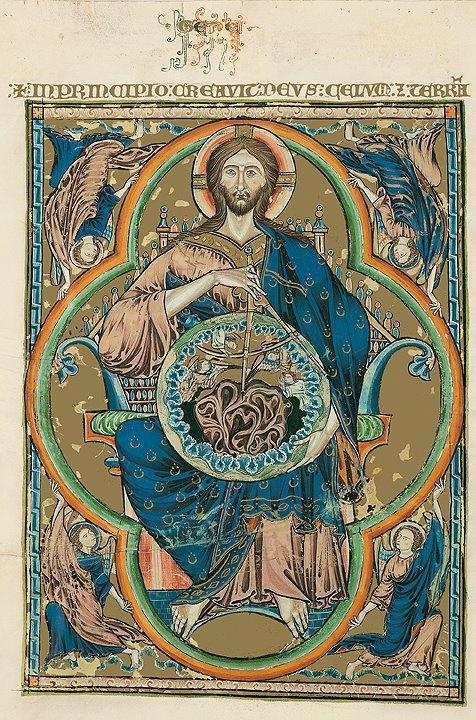
Genesis opens with the creation of the world, Eden, and man. The sequence reveals the Garden of Eden’s cosmic pattern in which heaven and earth are joined. Paradise is on a mountain which represents the meeting place between heaven and earth, of God and man: communion.1
To take this further, Eden reveals a heavenly pattern with man’s role being sacramental. Man reveals God.
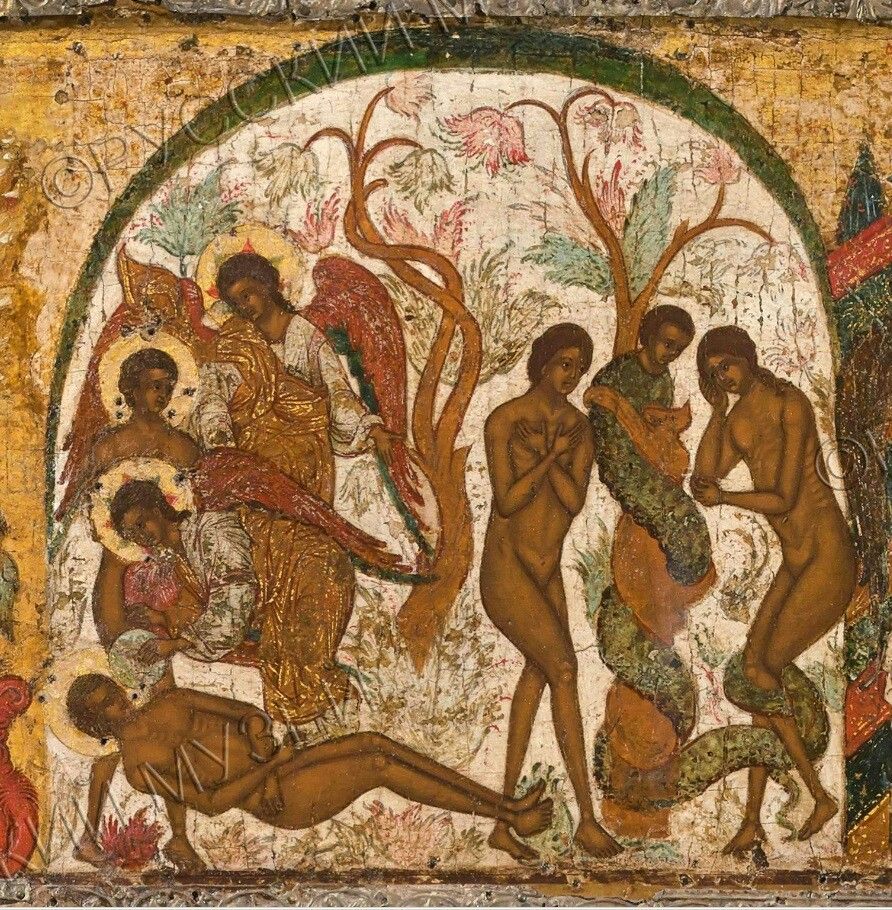
So, Eden represents the ascent of man toward God. The garden in Eden symbolically functions to show how man was placed in Eden to grow in the light of God. As we find in the writings of the Church Fathers like Sts Gregory of Nazianzus, John of Damascus, and Maximus the Confessor, the fruit of the tree of the knowledge of good and evil was never meant to be off-limits forever. As St John explores in his Exact Exposition of the Orthodox Faith, Man was created to mature; the limitations set by God were meant to help structure man’s growth as a contemplative being, dependent on God and as a reminder that man was not God himself (Bk. II, ch. XI).
There was/is an established hierarchy which structured creation.
Hierarchy, in our modern world, has become almost a taboo word, but hierarchy means order and differentiation. Order, according to St Dionysius is not for power, but for sharing (Celestial Hierarchy, IV.I-II).
Within the liturgical vision of the world, this means that without differentiation there can be no identity and without identity there is no being, for being itself is communal, as seen in the life of the Holy Trinity (also, we only become ourselves in relation). Further, this hierarchical dimension highlights how being is sustained through mutual self-giving.
The temptation of the serpent pushed man to use his God-given faculties to ascend improperly; man reaches beyond the ordering limits which were set by God to take what is not his to take. In man’s spiritual immaturity, he is not prepared to receive what he takes from the tree.
He is, in terms of hierarchical structure, usurping the created order and dissolving boundaries. This action is revelation of man’s disposition toward creation; in violating the limitations set by God he is treating God’s gifts as things-in-themselves.
The Fall, then, is not simply the result of man’s disobedience, but through his disobedience the breaking of order and differentiation. In taking from the tree, man disrupted the order that sustained his identity and, ultimately, his being. Man ascended the structure, pulled down what was not his, and—essentially—mixing the sacred with the profane.
What’s also of importance is the symbolism of the serpent. The OSB conclusively identifies the serpent with Satan and in the garden the serpent is depicted as descending the tree, representing the departing from stable knowledge. According to Mathieu Pageau, “The tree is a structure that expresses a principle (the seed) through its various implications (its branches). This corresponds to reason because every assertion must be derived from first principles” (The Language of Creation, 246).
In this view, the serpent, which represents circumstantial forms of knowledge (divinatory), descending the tree to tempt Man represents the angels who departed from the stability of growing, ascending, toward God and bearing His image to a cyclical existence.
It is an interior change, instead of man growing in and toward God, he turns inward, perpetuating a self-contained, self-referential loop. This is characterized by an enfolding posture rather than bearing the fruit of walking with God. The Fall of Man can be seen as reflecting the fall of the angels prior to the creation of man by both choosing to depart from their path and lineage.
The recursive pattern is man’s being drawn away from God, communion, and memory by the offering of what is not his to receive nor what the fallen angels claim to offer. The dynamic is characterized by man reaching out to receive what is not his to receive and the angles giving what is not theirs not give, leading man astray from his primordial vocation of dialogue with God and being made a god by grace.
Ironically, in man’s attempt to become a god without God in breaking the established order, man himself abandoned his role as steward of Creation. In man’s usurping the hierarchical Patriarch, the serpent usurped Adam’s role as patriarch: Adam was a type of shepherd, tasked with caring for Edenic creatures, and especially to attend to his wife, Eve.
The serpent beguiling Eve reflects Adam’s abandonment of his duties as patriarch, as priest, and as shepherd. Adam failed to protect the integrity of his household—in dissolving the boundaries fixed by God Adam’s transgression dissolved the boundaries of his own body and the body of his wife. The failure to safeguard the integrity of the familial sanctuary, a microcosm of the heavenly temple, revealed that he was already drifting from his seat as priest, shepherd, and patriarch—his priorities becoming disordered. This reflects Adam’s forgetfulness of God, falling away from communion, and prioritization of sensuality.
As seen in the Scriptures, “when the woman saw that the tree was good for food, and that it was a delight to the eyes,” this tells us that sensuality precedes the collapse of communion. It was a cause in leading man to depart from God. This recurs throughout the Scriptures as we will see.
Adam and Eve were expelled from Paradise due to their transgression, because God saw that they would become fixed in this state of corruption should they eat from the fruit of the tree of life (cf. Gen. 3:22-24). The heavenly man, meant to mature in the divine pattern of worship within the Garden was cast out, in garments of skin, to till for their bread as earthly beings. Instead of reaching up to take from the branches, by the sweat of their brow they were cursed to bring food up from the earth and its thorns and thistles (cf. Gen. 3:18, 19).
Yet, the story of our descent does not start and stop at the Fall of Man, because the Fall introduced the cyclical, recursive pattern into man’s inclinations and how we engaged with the created world and the distorted heavenly pattern. The antediluvian world is characterized by subsequent falls, culminating in the creation of giants and the withdrawal of God’s grace in the Flood.
Next, we will continue our survey of the movement leading to this cataclysm through the descendants of Adam: Cain and Abel.
Ο ΧΡΙΣΤΟΣ ΕΝ ΤΩ ΜΕΣΩ ΗΜΩΝ! ΚΑΙ ΗΝ ΚΑΙ ΕΣΤΙ ΚΑΙ ΕΣΤΑΙ
- The Garden of Eden, as the axis mundi—uniting heaven and earth is a type of Christ. Communion signifies being within the Garden, abiding in Christ (cf. Jn. 15:4). It is possible for man to, like Adam, walk with God through the restorative nature of the Incarnation. As God put man in the Garden to grow in participation with His grace, so do we need to root ourselves in Christ to grow in God’s grace. ↩︎
 Witness, NM
One response to “The Night is Far Spent”
[…] As mentioned in the previous post: […]
LikeLike