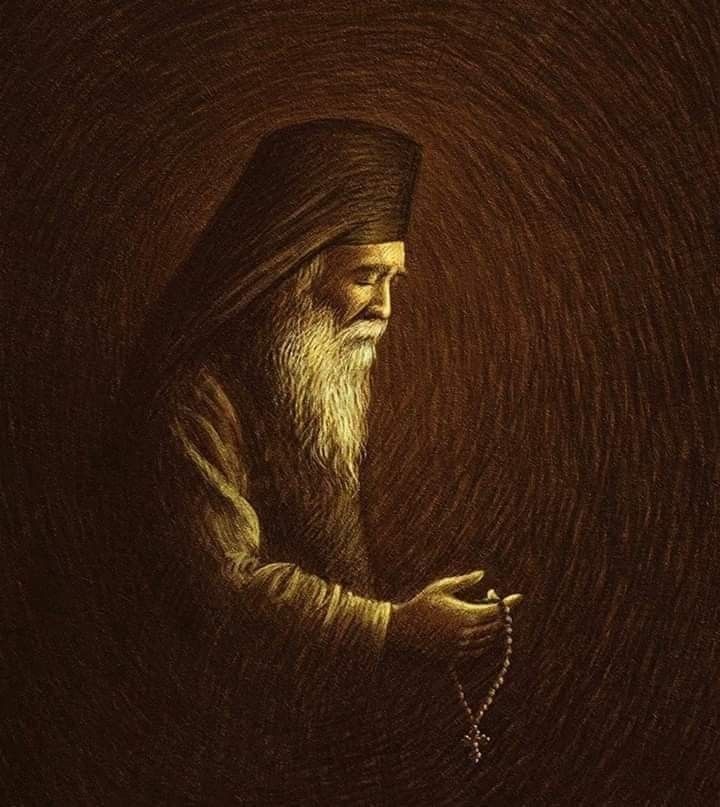
A reflection on my name day
“Nothing is greater than a pure heart, because such a heart becomes a throne of God. And what is more glorious than the throne of God? Of course nothing. God says about those who have pure heart: ‘I shall dwell in them and walk, and shall be their God, and they shall be my people’ (2 Cor. 6:16) … Because they have the greatest good in their heart: God Himself!” (St. Nektarios, The Path to Happiness 1).
St. Nektarios entreats his readers not to seek the happiness of the world, but to seek first the kingdom of heaven: a pure heart. For such a heart becomes the throne of God. This is the center of the Christian life; it ought to capture all our attention, yet it’s easy to forget, where we prefer to reason about truth—philosophize and abstract—rather than purify our hearts.
Lately, I’ve become disinterested in apologetics or putting Christianity against the competing worldviews of our age. These debates are fun and force us to consider meta-perspectives; they may sharpen the mind, but they rarely refine the heart.
Speaking with a priest in Boston, he reminded me that no one hears what they don’t want to hear, nor will they receive what they didn’t ask for. It’s an unfortunate aspect of our modern times, but people aren’t actually interested in truth unless it supports their already comfortable worldview; if something makes them uncomfortable, then they want to hear it less, and will even become angry with those who tell them.
That talk stayed with me because it reminded me that the Gospel is not simply relayed through discourse but is best spoken through a purified heart. We do not evangelize by words, but by our lives. As we celebrate the feast day of my patron, St. Nektarios of Aegina, I thought it would be good to carry this forth, departing from abstract philosophy and pitting Christianity against the wisdom of the world. Christianity is ultimately not of this world or its thinking. To reduce it to such would be betraying its fundamental otherness for the sake of others’ comfort.
I discovered Orthodoxy in 2021. I was not convinced of it by logical proofs or deductions or rationalizing the Faith, but it’s Beauty. Dostoevsky once wrote, “Beauty will save the world.” He’s right. And through His Church, Beauty is saving the world. That was what struck me the most: Beauty. Then what captivated me beyond Beauty was the Church’s mystical theology and the reality of Christ’s Presence.
A week after I officially became a catechumen (with a different patron saint) I heard St. Nekatarios’ story for the first time, at Vespers on a Wednesday. At the time, I was dealing with similar interpersonal problems that were grieving me to no end and, as if a hand reached out from the heavens, St. Nektarios was there to offer me consolation during that trying time. That trying time deepened; after becoming a catechumen, I was flung hither and tither by forces outside my control and outside His Church.
While it all worked to the good (cf. Rom. 8:28), it was a difficult period, but what kept the door open was St. Nektarios; I know that he was praying for me and with me all while I was cast adrift in the dark sea of the world, people-pleasing, self-justification, and being misunderstood by my old friends.
St. Nektarios was with me through it all.
I came back to the Church, thank God, with my wife. This time I submitted the catechumen forms as they had been before, but that week St. Nektarios reached out his hand—mystically—again, and I realized that not only was he my patron, but his prayers and God’s grace were working to bring me back to the Beauty of Christ’s Church.
His quit intercession in my life was an soulful pedagogy. He taught me the saints are real, and they are alive in God. There is a whole chorus of saints on the other side of this temporary life that are, right now, praying for each one of us. They offer their prayers to God on our behalf and carry our prayers to Him. The heavens are a joyous jubilation of hymns and supplications made that all might be saved (cf. I Tim. 2:4). He taught me, in that year and a half, what his students and contemporaries witnessed during his life: that his power as a luminary of the Church was not in clever argumentation, but in his love. That love that reflected the very love of God.
This is Beauty and Beauty saves. Beauty recapitulates. Beauty makes man whole.
For Christ is Beauty.
While St. Nektarios was no stranger to apologetics and defending the faith, yet as we see from Bishop Titos Matathiakis remarking about the Saint, “his simple and guileless style, the goodness of his heart, his extreme humility, together with his great learning, made a deep impression… Through his sermons, unbelievers and enemies of the Christian faith were transformed into ardent champions of it, slanderers and accusers were disarmed, the avaricious and uncharitable became generous to the poor” (Cavarnos, Modern Orthodox Saints: St. Necatrios of Aegina 35).
The Saint’s apologetics were not mere logical proofs, but beautiful: exuding love and compassion for the people under his care and the cities he lived in. “Life,” said St. Nektarios, “is a catharsis. Without the Lord Jesus Christ life on this earth has no meaning… In fact, no matter how you look at it, life is anything but logical” (Chondropoulos, Saint Nektarios: The Saint of our Century 146). He understood that life is a furnace for our purification; yet our Faith does not spread through the fires of debate—it’s blaze spreads through the gentle radiance of Christ’s Beauty.
Creation reacts when we live out a life of repentance. The trees can hear us, but in our fallenness we cannot hear them. Christ’s Beauty does not simply unite all things in Him; it is very lens that allows us to see Creation, reflecting the heavenly pattern, rejoicing and offering hymns to God. Let us, therefore, put away the eyes of the old man and put on the eyes of Christ.
The example of the Saint becomes a lesson in endurance and love: to endure trials, to learn how to honor those who dishonor them, and to love one’s enemies. The lesson is a lifelong struggle in the stadium to forget the old man, to put him, completely, and, putting on Christ, becoming united with Beauty. Becoming a reflection of the heavenly pattern, praising God with our lips and hearts, offering our lives as a doxology. In this way, we become stewards of Creation, not asserting our will over it, but helping lift up the jubilant praises of Creation to the heavens. We become a part of the mystical altar, entering the sublime sacrifice of Christ, and—like the angels—glorifying God in our hearts.
Our common calling is to embrace the catharsis of this life: to cooperate with God’s grace in the cleansing and sanctification of the heart.
When we say heart, we don’t mean the physical organ but the incorporeal eye of the soul — the nous. By healing this eye, fragmented by the fall, we come to know and experience God. It is, as the Apostle says, the very throne of God, which man must cleanse to become a dwelling place of the Spirit (cf. Eph. 2:22).
The Lord teaches that there is nothing from outside a man that can defile him, but that which goes out from him—evil thoughts and passions which spring from the heart—these are what defile a man. (cf. Mk. 7:7:15, 21-23).
It is what comes from within fragments us, defiles, and wounds our communion with God and neighbor. In allowing this ailment to overcome us Creation loses its texture, the praises of the trees dissipate under the deafening silence of the wind, and in our assumed individuality, we lose sight of the sacred nature of life. Thus, this is what we must aim at cleansing; this is what God’s grace must purify, if only we open ourselves to receive Him.
The Apostle calls this the enlargement of the heart (cf. II Cor. 6:13). To be enlarged is to recognize one’s own fallenness and, through humility, face oneself. This confrontation is not punishment but enables us to see our neighbors as sharing in our same woundedness, and encompassing them in our love and compassion, covering a multitude of sins (cf. I Pet. 4:8).
This form of active love is not a therapeutic or moralistic assent, it is a firm commitment to ridding the soul of earthly passions and, in repentance, coming to God as we really are, not as we’d like God or our neighbors to see us. Leaving behind the things of this world: fornications, impurity, and covetousness, which is idolatry (cf. Eph. 5:5) is moving toward God, truly and mystically, becoming his dwelling place.
St. Nektarios teaches the same truth in a letter to his spiritual daughters: “Adorn your lamps with the oil of virtue. Struggle to rid yourselves of the passions of the soul, Cleanse your heart… so that the Lord may enter into you, reside, walk, and create a sanctuary in your heart and soul… Seek the Lord each day, but within your hearts and not outside them, and when you find Him stand with fear and awe, because your heart has become God’s throne. To find the Lord, though, humble yourselves… Your work is the examination of your hearts, so that conceit does not live in them like a venomous snake… Therefore, seek humility, love it, and place it within your hearts so that you may be uplifted from earth to heaven” (Catechetical Letters 101-102).
Our hearts are, made in the image of God, are fathomless.
St. Macarius of Alexandria writes, “The heart itself is but a small vessel, yet dragons and lions are there, and there also are poisonous creatures, and all the treasures of wickedness; but there, too, is God.”
The heart is as mysterious as the sea and as expansive as the heavens.
It is an icon of Creation—a type of Kingdom, one capable of holding either light or darkness.
“For where your treasure is there your heart will be also. The lamp of the body is the eye. If therefore thine eye be sound, thy whole body shall be full of light. But if thine eye be evil, thy whole body shall be full of darkness” (Matt. 6:21-23).
If conceit covers our heart, then our eyes are blind, therefore it is our duty to uproot conceit from within and replace it with humility—with the very light of the world (cf. Jn. 8:12). We have life and encounter Life in and through the Beauty of the Church. The Church is where we come to heal and correct our hearts through the grace of God. Celebrating St. Nektarios’ feast day is a reminder that—despite the waves crashing against us and the wisdom of this world that seeks to steal our hope—we need only remember the Lord and turn our hearts toward Him.
The world is not our home, yet it is here—within its fallenness, our wounds, and the prayerful trees—that God calls us to prepare a place for Him in our hearts. In becoming the receptacle of God’s abundant love, we also become its conduit, spilling out unto others what was freely given to us. It is in this way that we reflect the trees and creatures of Creation, realizing our human roots, seeing how we are interconnected with our neighbors.
In this spirit, St. Nektarios writes, exhorting us to “pursue love. Seek love daily from God. Together with love comes all the multitude of goods and virtues… Give to God all of your heart, so that you remain in love. ‘He who remains in love remains in God and God remains in it.’ (1 Jn. 4:16). You ought to have much attention in your relationships with one another and to respect one another as sacred persons, as images of God.”
Creation reflects the heavenly pattern of worship and praise just as our neighbors reflect the sacred image of God. When we perceive this, the world changes; and when we put love into action, we ourselves are changed with it.
To pursue Love is to pursue Beauty, for Beauty is the light of Christ shining in the world’s darkness. It’s this same light that heals our fragmented hearts and gathers all things to Himself (cf. Eph. 1:10-11). Verily, Beauty will save the world.
St. Nektarios of Aegina, pray for us!
Ο ΧΡΙΣΤΟΣ ΕΝ ΤΩ ΜΕΣΩ ΗΜΩΝ! ΚΑΙ ΗΝ ΚΑΙ ΕΣΤΙ ΚΑΙ ΕΣΤΑΙ
 Witness, NM