On Conspiracies, Cosmology, and the Cross
“Bless the Lord, O my soul!
O Lord, Lord my God, as you were very great.
You wore thanksgiving and dignity,
Throwing off light as a garment, stretching the heavens as a cloak;
The one who covers his upper parts with waters,
The one who places clouds as his steps,
The one who walks about upon the wings of the wind,
The one who makes his angels spirits,
His public servants burning fire.
He laid the foundation of the earth upon its stability;
It will not be moved for eternity of eternity”
(Ps. 103: 1-5 LXX).
Recently, I was having a discussion with someone about space and their incredulity toward a friend who does not believe that man went to the moon. I, regardless of whether or not I believe this statement, agreed with their friend because I thought it was funny how frustrated they were at the idea that someone could potentially believe that man never went to the moon. Not only did I agree with their friend I escalated the statement by declaring that space is fake!
Again, this was most assuredly to get a rise out of my conversation partner and, of course, it did. I continued by discussing hollow earth and Hitler’s supposed emigration to Argentina where he lived out the rest of his life painting and learning Spanish while covering his accent. Apparently, this was beyond the pale for this other person because the idea that Hitler lived out his life in peace after what he did was not, to them, justice.
The intention behind these pieces is not to imply that Hitler’s living out his life in anonymity as an Argentinian painter meets the human standards for justice, whatever that means. Human justice is mostly subjective; it’s not for me to say whether Hitler dying in a bunker or in an abode outside Purmamarca is more just. However, our conversation did remind me of one of my favorite conversation-stoppers and a character that I wrote when I was still working on a comic book: Coyote Witness.
“Space is fake” was one of the more colorful statements that “Timothy Fowch” would let ring in and out of his many drunken tangents about aliens, the Nephilim, and government cover-ups. I love this line: Space is fake.
It is one of those statements that absolutely drips with ludicrous metaphysics draped over a painful amount of research and speculation. One does not simply concoct an illusory cosmology without having something to back it up, whether this be a mayaic vision of reality, a Gnostic inclination, or a few too many conversations with your neighbor who doesn’t trust 5G and has a physcial copy of Industrial Society and Its Future (I’m that neighbor).
For the comic book character, Fowch, the idea that space is fake isn’t about escape from the prison planet of the Gnostic Demiurge and Archons but about awakening to the reality that we are being lied to; there is a tragic quality to his cosmology in that it isn’t about spirituality, but about truth-as-secret, a gnostic (small “g”) hunger for hidden knowledge which, if acquired, supposedly liberates the knower from deception, separating them from the “sheep” who go from trough to trough, gorging themselves on lie after lie.
Fowch’s worldview is fundamentally broken, making him an excellent foil to his counterpart—the-sidekick-is-actually-the-protagonist—firework delivery boy par excellence, Pabst Overdrive. Pabst lives in a similar conspiratorial cosmos but navigates it with a heart full of gratitude and awe. He busts forth into every scene with a sun salutation and smile on his face. Where Fowch says, “Space is fake,” Pabst believes that the planets and stars were legitimate entities one could communicate with, be grateful to, and even love.
Pabst Overdrive is the quintessential optimist. He doesn’t see the glass as half full or half empty—he sees it as a reason to thank the Sun from the bottom of his heart for another day and a chance to hydrate. His aviator-tinted glasses don’t obscure reality but transfigure it, capturing and refracting into a Eucharistic pattern. This restorative vision inspired this series and my engagement with the Flat Earth theory.
Fowch’s statement, “Space is fake,” when voiced by Pabst, becomes a call to repentance.
Space is fake may start as a joke, but the line takes on theological depth: a real articulation of modernity’s disenchantment, which Pabst counters with color, sound, and symbolic intensity. Writing that comic book, unfinished though it is, was the catalyst for my exploration of occultism and esoteric Christianity in high school and again during the pandemic. It ultimately led, by God’s grace, to His Holy Orthodox Church.
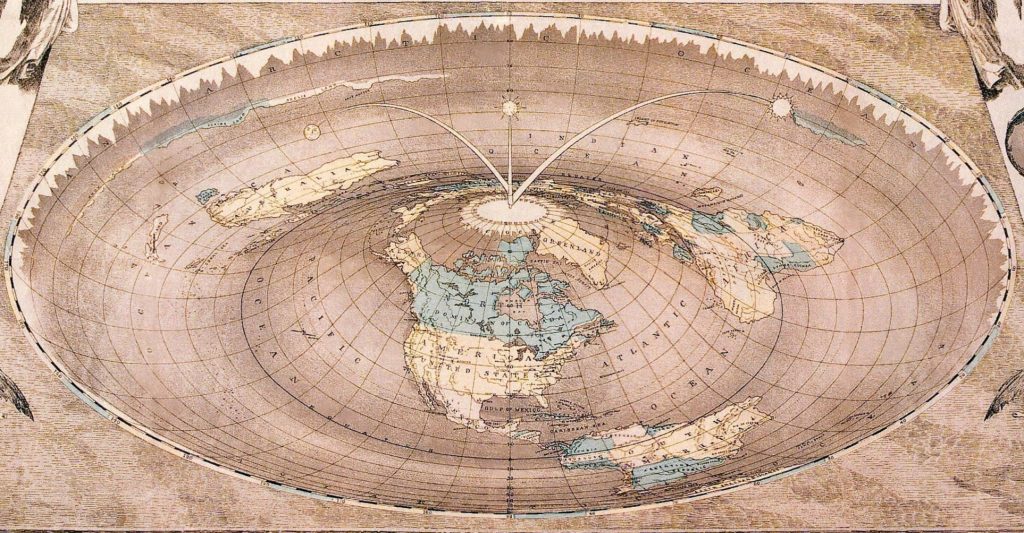
Since casually tossing out that outlandish statement, I’ve been thinking more seriously about it. Space is fake dropped me down the rabbit hole of the Flat Earth theory, which is the reason this series exists. Like many of you, I have scoffed at Flat Earth for as long as I’ve been aware of its modern resurgence. I assumed (and still somewhat assume) that much of the movement is a tongue-in-cheek internet LARP—not unlike my own declaration—meant to rile people up rather than offer a coherent antithesis to scientific inquiry and discovery.
I once thought it was in the same category as the odd signs that read “Birds Aren’t Real”—a satirical conspiracy theory positing that all birds are government drones. The idea is that all the birds in North America were eradicated and replaced by drones to surveil the citizens of the U.S. in the mid to late 20th century. This idea is patently absurd (or is it?). But we now live in a time where the government doesn’t need to replace our avian allies because they are slowly implementing a Sauron-like surveillance system through Palantir.
My concern isn’t just the surveillance itself, which we already know about thanks to men like Snowden, but the ways that AI-driven software like Palantir might shape consensus reality—not just controlling what we do or see, but what we think. And not just what we think, but how we think. My worry is that we’re approaching a moment where dissent and nuance become functionally impossible; where we will fall victim to Large Language Models doing our thinking for us and, eventually, only being capable of thinking, saying, and doing the things which the AI-generative tools (and whoever operates them) wants us to think, say, and do.
O’Brien, in 1984, tells Winston that power over matter depends on control over the mind. If you can govern perception, then you can govern the world. I’m not suggesting that Large Language Models are hiding the Flat Earth. I’m saying that their utility could atrophy our ability to think for ourselves, to seriously entertain and investigate anything that falls outside consensus.
This essay is not meant to debunk the Flat Earth. It’s not meant to champion the spherical earth, either. I’m rejecting the Western either/or dialectic and trying to see through the Orthodox both/and lens of symbolic realism.
These reflections aren’t meant to convince anyone of anything. They’re meant to reorient my heart, to help me see the world differently: as God’s Creation. Not a thing-in-itself, but a gift from God. A doxological reality.
Interestingly, in same passage as above, O’Brien states that, for the Party’s purposes the Earth is the center of the universe while, at other times when it is convenient, the Party assumes a Heliocentric model. Stars are, for their purposes either a few kilometers or millions of kilometers away. He implies that it is not beyond the Party’s influence and desire to construct a dual system of astronomy.
Orwell’s vision of a disinterested Party that uses a dual astronomical system when it suits them introducing confusion into public perception while outlawing any thought that is not approved by the Party; thus, it is an intellectual crime to hold views that are contrary to acceptable political thought.
Orwell may not have meant this literally, but it echoes a dangerous tendency: not symbolic thinking, but instrumental thinking. And Fowch would see this as confirming his beliefs: Not only is space fake, but the government wants it that way.
Flat-Earthers similarly distrust institutional epistemology. Whatever the mainstream says, the default position is suspicion. And, you know, there are reasons for this! For instance, most of the photos that we have of the Earth are composite images created by NASA—this is true and officially acknowledged—and this is used to substantiate the claims of the Flat-Earth movement. There are many “official” reasons that are given to explain but none are accepted, as all are seen as part of the cover-up.
Honestly, I don’t mind that degree of skepticism.
I mean, what do we expect?
Of course, no answers are going to be seen as legitimate, because this movement is founded on the rejection of modern, authoritative narratives. Genuinely, I think it’s underappreciated how deeply Flat-Earthers take issue with the fact that modern, secular structures are in the business of myth-making (regardless of whether we agree, this is a point that cannot be overlooked). This is a fundamental piece of their skepticism. It’s not just bad science they’re resisting; it’s the entire epistemic order of our age.
I took a philosophy of science class last semester and in it, we considered the sociological structure of scientific knowledge. Looking at figures like Bruno Latour and Steve Woolgar’s groundbreaking anthropological study Laboratory Life, this challenged the very premise of scientific realism: the idea that effects follow causes and that facts correspond to external reality. They write: “‘reality’ cannot be used to explain why a statement becomes a fact” because reality only emerges after consensus stabilizes a statement as fact.[1]
Read that again.
This completely flips the script of mainstream science: facts aren’t discovered, they’re made. And they’re not just made, but socially constructed, negotiated, and enshrined. In fact, Christine Garwood’s Flat Earth: The History of an Infamous Idea corroborates modern astronomy’s reliance on philosophical assumptions rather than facts. Garwood’s treatment is a critique of the Flat-Earth movement while substantiating the claims made by Latour and Woolgar’s sociological frame rendering fact-making as something much closer to myth-making than most scientists would like to admit. Furthermore, David Bloor’s Strong Program, which insists we treat both true and false beliefs symmetrically, meaning, truth itself plays no special causal role in scientific knowledge, or why we believe what we believe.[2]
What I’m getting at is that there is an entire intellectual tradition in the philosophy of science that helps us understand the Flat-Earth movement’s internal logic. Importantly, science is not just a methodology, it’s also a philosophy. And that philosophy is often more mythic, more socially contingent, than we’re comfortable admitting (or even understand). Observations aren’t neutral. Interpretations aren’t objective. Neutrality is—like space—fake.
Truth is Relative
For me, the appeal of Flat Earth was never about the science, but the rhetoric. The way Flat Earthers are shut down, not by arguments, but by logical fallacies like appeals to authority, appeals to consensus, and appeals to ridicule. Agree or disagree, those aren’t arguments. They’re circumventions.

Honestly, my interest in the intellectual roots of this movement overlaps with my disbelief of Darwinian evolution due to the unfalsifiable claims of macro-evolution. Add to that Einstein’s theory of relativity, which ironically supports a geocentric model, because it claims any point in the universe can be considered the center, relatively speaking.
Enter Fr. Pavel Florensky, Russian Orthodox priest, scientist, mathematician, logician, philosopher, and martyr. in Imaginaries in Geometry, confronted scientific positivism, which is a philosophical approach to scientific methodology that privileges empiricism and rationalism as the only valid roadways to truth, dismissing metaphysics entirely.
Fr. Pavel’s work interpreted Einstein’s theory through a geometric lens: “In it Florensky proclaimed that the geometry of imaginary numbers predicted by the Theory of Relativity for a body moving faster than light is the geometry of the Kingdom of God.”[3] This interpretation allowed Florensky to go further, using the general theory of relativity, he proposed a “perfectly coherent mathematical model in which the Earth is the reference of motion. This model would in fact correspond to Ptolemy’s cosmological descriptions.”[4]
This was too much for the Soviets. They sent him to the gulag for his efforts where, despite the horrendous conditions, he continued his scientific work until his execution in 1937. Now, Florensky wasn’t a Flat-Earther. He believed in a geocentric cosmos, not a disc-world with an ice wall. But his fate reveals what many Flat-Earth thinkers suspect: that science isn’t always about truth, it’s often about power. And when truth threatens power, it gets silenced.
It’s more Orwellian than we’d like to admit.
It is no surprise, then, that the Flat-Earthers believe that if the state can convince us we’re spinning on a cosmic rock, alone in a meaningless void, they can convince us of just about anything. This is what I appreciate about Flat-Earth philosophy, it isn’t just about “proving” that Antarctica is a perimeter ice wall. It’s about reclaiming one’s own personal autonomy in sea of consensus reality and the digital matrix.
Naturally, many Flat-Earth theories drift into a kind of Gnostic framework, a kind of Truman Show, Plato’s cave, simulation theory, Philip K. Dick’s Black Iron Prison.The idea being, we’re trapped in an illusion, and only the enlightened can see through it. And this is where I depart. I don’t buy simulation theory. I don’t like quantum mysticism. Saying the Earth is enclosed in an “energy field” is just a New Age response to a New Age problem. The same goes for the “awakening” to the truth of the Flat Earth, setting oneself apart as truly seeing what is, not like the ‘sheep’ who passively accept the deception. Hidden knowledge is not the solution, because often it leaves one cut off and adrift reflecting the very “lie” of the nihilistic, cold and lonely universe that the Flat-Earth movement is against.
Hidden knowledge isn’t salvation. It’s often alienation. As much as I see space exploration as a Tower of Babel so does Flat Earth theory become another tower, where one becomes the ultimate reference point of their own existence. Believing the logismoi, whispering, “I am not like them.”
Orthodoxy offers something different. Where the Gnostic craves secret knowledge to escape the material world and archonic illusions, the Church teaches that true knowledge is communion. Our communal ontology sees knowledge relating to love as truth relates to communion, a rupture between these creates a false dichotomy which atomizes information and fragments people where individuality becomes the arbiter of truth, making knowledge relative.
Metropolitan John Zizioulas writes, “True knowledge is not a knowledge of the essence or nature of things, but of how they are connected with the communion-event.”[5] This communion-event is not abstract—it’s the Eucharist. Such knowledge is not esoteric, but doxological. Truth isn’t hidden behind the veil of power structures or encoded in esoteric knowledge. Truth is a Person, and we come to know Him through humility and repentance. Therefore, the Orthodox worldview isn’t heliocentric. It isn’t geocentric. It’s Christocentric. And that changes everything.
Still, the Flat-Earth critique isn’t entirely off-base. Modern science has disenchanted the world. It has flattened our view of the cosmos, reduced us to specks in a cold, indifferent void. The phrase space is fake might not be literal (or is it?), but it points toward a deeper truth: Modernity has displaced meaning from the heavens. The modern contradictory (doublethink) worldview is stark. We’re told that man is the measure of all things, but we’re also told that we’re nothing. We’re told to trust the science, but also that we’re a cosmic accident in the endless dark of space.
Flat Earthers may be wrong, they may be right. But underneath their epistemic principles and outlandish claims is something beautiful. A yearning for re-enchantment. The deeper message of the movement is that you matter. We are important. The Earth matters. It’s not just a rock. It’s a gift. And we are its stewards.
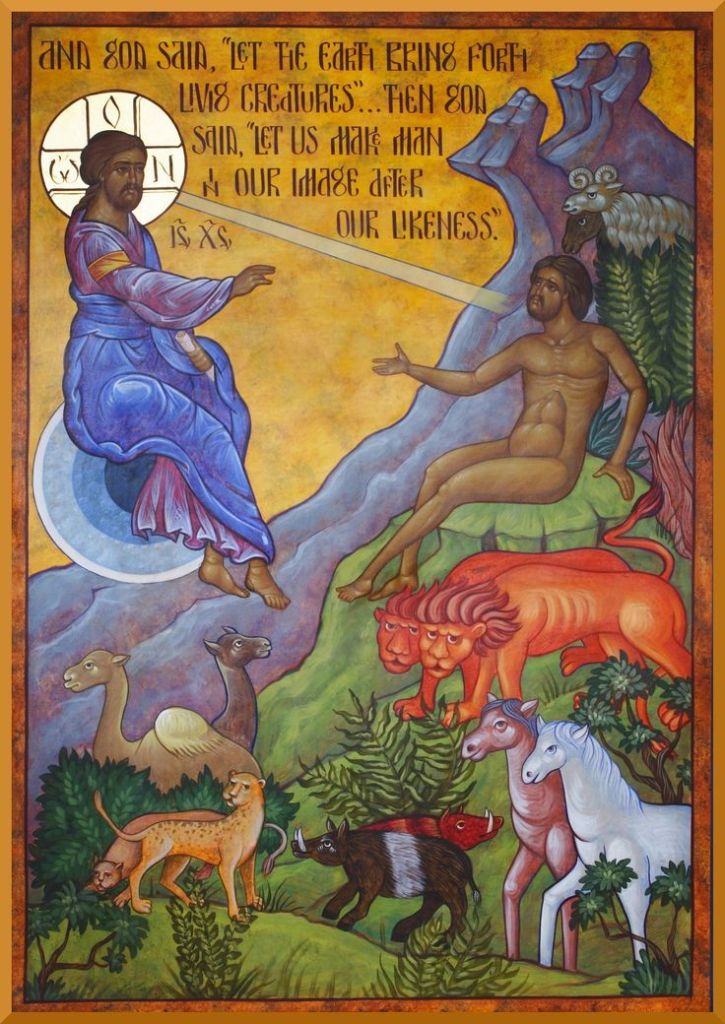
“What is man that You are mindful of him,
And the son of man that You visit him?
For You have made him a little lower than the angels,
And You have crowned him with glory and honor” (Ps. 8:4-5 LXX).
The real Flat-Earth is the flattened worldview of our nominal, secular age.
It is not just about my distrust of NASA—or even SpaceX—that makes me skeptical of their claims. My skepticism is directed toward the scientific materialism they embody. That is the real dome enclosing us, breeding the nihilism of our times. Because under the scientific lens of scientific materialism, space is fake: not in the sense that there’s nothing up there, but in that it is a cold, uncaring, void of meaning. It’s not real because it’s no longer a mystery, it’s become a resource to be seized. A territory to be claimed.
Met. John Zizoulas writes that man’s sin is rooted in individuality, being the ultimate reference point of existence (to be God) and “the refusal to make being dependent on communion.”[6] This refusal creates an atomized, relative truth, leading only to death.
I see this in both the spherical and the Flat-Earth camps. The globe-believers may be right (they may be wrong), but is their disposition toward the earth, regardless of shape, one of gratitude and reverence, or of objectification? Likewise, the Flat-Earthers may be right (they may be wrong), but is their “awakening” to reality grounded in humility, or in a kind of Gnostic superiority?
I bought a book (or two—or three; don’t tell my wife) on the Flat-Earth. So, I doubt this’ll be the last time I bring it up. But after listening to some early thoughts from people like Eddie Bravo, I realized something:
The question isn’t whether the earth is flat or round, or whether the solar system is geocentric or heliocentric.
The question is: What does space reveal?
What does space tell us about ourselves, about God, and about our heart?
Space is fake!
Not because there’s nothing out there, but because we’ve lost the symbolic imagination to see what’s really there. Instead of treating space as scientific “fact,” we need to recover space as icon—a symbolic reality that invites us to deeper contemplation.
Cosmology’s purpose is not to map matter, but to reveal a pattern of meaning.
The vast expanse of space doesn’t need to empirically real to be theologically true. If space doesn’t evoke awe-inspired silence, wonder, or repentance—if it doesn’t point us to what we’re doing here then, for all intents and purposes, it’s unreal.
If the world, whether it is flat or a sphere, does not engender in us gratitude for this life and an orientation toward the transcendent than its shape really is not a matter of consequence.
Space, whether literal or symbolic, is an icon of the infinite God Who created the universe and everything in it. Everyone in it.
The seeming expanse of the cosmos, whether the stars are only a few kilometers or even millions of kilometers away is an image of the everlasting process of theosis, man’s journey into God as a person made in His image, a journey into the Triune God, undivided and united communion of Persons. The vast, unknowable reaches of space image one’s own heart and its unfathomable depths, known only to God (I Sam. 16:7; Jer. 17:10; Jn. 2:24-25). Our ambition to seize space by ascending the heights of heaven is a displaced longing to descend into the innermost depths of one’s own heart, the embrace “the hidden man of the heart” (I Pet. 3:4). Jesus Christ.
Without Christ, man becomes the ultimate reference point of existence and begins asserting himself over others. The problem, then, isn’t epistemological—whether the Earth is flat or round nor whether space is fact or fiction; the problem is doxological.
Are we living eucharistically? Is our worldview iconographic or idolatrous?
The Flattening of Modernity
The universe, according to St. Maximus the Confessor, is the mirror of the soul:
“The entire universe… was brought forth from God… and divided into the intelligible realm… the realm that is sensible and bodily… For the whole intelligible realm, which is impressed mystically in symbolic forms in the sensible realm, appears for those who are able to see, and the whole sensible realm, which is intellectually simplified into its principles according to the mind, exists in the whole intelligible realm… the one universe is composed of both realms, just as one man is composed of soul and body.”[7]
For St. Maximus, this is not simply cosmology, it is liturgy.
He elaborates on this liturgical vision of the cosmos reflecting Pabst Overdrive’s own metaphysical cosmological structure: Man as microcosm and the universe as, in a sense, a human being by developing the liturgical vision of the Orthodox Church wherein man, and the entire cosmos, ascends to God through participation in sacramental worship. In the Divine Liturgy, we ascend the heights of heaven, not in a spaceship, but through Christ. The Church is the real rocket ship.
The luminaries, as an example, that God forms in the beginning (cf. Gen. 1:14) are both corporeal and noetic; visible and invisible. The sun, moon and stars point beyond themselves to the angelic hosts who in turn point beyond themselves to the Father. Not to a cold, dark void, but the uncreated, inexpressible Light.
To partake of the divine nature (cf. II Pet. 1:4) in the Mysteries of the Church is to enter this cosmic liturgy—the vast expanse of space is but the Court of the Gentiles leading to deeper spiritual encounter, a “more perfect tabernacle, not made with hands” (Heb. 9:11).
The Earth is therefore “flat” when it is taken as a thing-in-itself and not as directing us to ascend, by God’s grace, glory to glory in the eternal process of theosis. Symbolic realism is the proper lens for the cosmos: it allows us to engage reality as a mystery to inhabit, not data to capture or land to conquer.
St. Gregory of Nyssa, in The Life of Moses, writes:
“We should show great diligence not to fall away from the perfection which is attainable but to acquire as much as is possible” To that extent let us make progress within the realm of what we seek. For the perfection of human nature consists perhaps in its very growth in goodness.”[8]
St. Gregory’s theology of epektasis is here, the soul’s eternal stretching and straining toward God. This is the true meaning of space. There is no destination, because there can be no destination or center of the infinite, unfathomable Triune God. St. Gregory’s theology emphasizes the perfection of God, man’s inability to attain that perfection (especially by nature) therefore it is the straining of one’s soul toward this unattainable perfection that engenders the soul’s ascent into the heavens, the highest heavens, and into the depths of God with meaning.
Jonathan Pageau writes that modern scientific tools, while useful, orient us toward the natural world in a way that flattens it. Instead of seeing reality as sacramental, we now experience it through screens. The cosmos, reality itself, becomes pixelated.
This isn’t just a philosophical flattening. It’s a spiritual one.
A common polemic used against Flat-Earthers movement is that they are anti-scientific. I disagree. They may, in fact, be making a critique of scientism—of modernity’s disenchantment and screen-mediated synthetic-reality. While not trying to detract from their core message, they may be reacting to the loss of sacred space.
Our screens are the new shadows of Plato’s cave. No longer are we dazzled by the flickers on the wall but enamored with our glowing black mirrors. This may not seem explicitly anti-scientific, but when the screens replace the shadows in shaping consensus-reality and becoming a means for us to offload not even critical-thinking but casual thought then we are simply assenting to a digital matrix where genuine, contemplative thought becomes a rare commodity underneath the nauseating hum of information and discourse online.
T.J. Hegland’s Quantum Earth Simulation claims that scientists have detected a cosmic noise, or hum, that is coming from the edge of the universe supposedly substantiating that there is equipment that is generating the simulation we’re living in. I’d argue that this “hum” is not a machine at the edge of the universe, but the dull roar of Wi-Fi, 5G (I’m the neighbor), and social media notifications.
The internet is the cave.

It’s not about whether we hold right beliefs in relation to the materialism and scientism of the modern world. It’s about whether we’re still in the cave. Flat or round, it doesn’t matter if we’re still bound to the algorithm.
[At least the Flat-Earthers have conventions where they meet up in real life. I’d love it if they came to Church, but I digress]
The noise and hum of the simulation is not just disorienting. The hum of the simulation distracts from the hidden man of the heart. From His Word spoken in silence. The deception of our age is a calculated distraction moving us away from our heart to assert our mind over others. Modern scientific advancement toward exploring the expanse of space is a distraction; it is a substitute for repentance.
But repentance—metanoia—is the real ascent. It is climbing out of the cave and descending into the heart.
For the heart is deep (cf. Ps. 64:6 LXX).
There are some Flat-Earth thinkers that intuit this like Eric DuBay and Edward Hendrie. I confess that their chapters on the conspiracy against Christian thought, doctrine, and Scripture garnered more of my interest than their in-depth and well-researched science supporting their views. They argue that spiritual forces are at work deceiving men—and offer significant evidence demonstrating a calculated campaign against Christianity.[9]
According to some Flat-Earth theorists, whether Zionists, Communists, or Freemasons, human institutions serve as agents of darker forces leading men to forget their Creator. Regardless of the broader conspiracy sweeping across the plane of existence, there is, deep down, a desire in man to usurp God, displacing Him and becoming the Most High without His grace, indeed, without Him at all.
This same temptation goes back to the Garden of Eden with the serpent, cunningly leading man to forget who he is, declaring rather, “that in the day ye eat thereof, then your eyes shall be opened, and ye shall be as gods, knowing good and evil” (Gen. 3:5). The same desire to be as gods infamously constructed the edifice of Babel (cf. Gen. 11) and continues to this day.
While the Flat-Earthers may be wrong in detail, perhaps their instinct is correct: There is something—or someone—that is trying to keep us from the truth. There is a war going on for our minds and our hearts. There is a battle to sever the cosmos from their Creator, to separate heaven from earth.
T.J. Hegland’s Quantum Earth Simulation further claims that we are living on a prison planet, and it is by awakening to the illusion of this world that one can escape and ascend by and to a higher consciousness. I reject this assertion, not only because it is Gnostic, but because we do not need to escape through gnosis—what we need is healing of the heart.
St. Isaac the Syrian wonderfully articulates the Orthodox position:
“This life has been given to you for repentance; do not waste it in vain pursuits.
“Woe to us! We neither realize just how valuable our soul is, nor comprehend the type of life we have been called to lead. We place great significance on this present life, on illnesses, on the state of society, and on the sorrows, evils, and comforts of this world.”[10]
What if then, the point of life not to escape the simulation, but to endure it in love and self-giving? What if the real deception is not the shape of the world, but the loss of the heart?
The spiritual war that Flat-Earth thinkers map is not the territory. The heart is the battleground, and the greatest lie on Earth is not the fact that its an immovable plane, but of our interior misalignment.[11] The conspiracy isn’t modern astronomy’s misinformation; it is our hollow heart. Bereft of the grace of God and His Divine Light we wander astray of the life we are called to lead: That is the life of the Cross. Transformation and sanctification. The Flat-Earthers impulse to “awaken” to the truth is a very real impulse echoing through the psalmist:
“My heart is ready, O God, my heart is ready.
I will sing and sing psalms.
Awake, O my glory! Awake, harp and lyre.
I will awake at dawn” (Ps. 56:8-9; 107:2-3 LXX).
Mapping Beauty on the Heart
Declaring space is fake is a clarion call from the far reaches of the cosmos to all of us, prodigal sons, wandering a far off to a distant country, forgetting our Father’s house, that is, our hearts. To repent of our riotous living, worshipping and serving the creature rather than the Creator (cf. Rom 1:25). To let go of the externalities that lull us into our spiritual slumber, living a life as dead, walking in the flesh of the sensible world, separating us from worshipping in spirit and in truth (cf. Jn. 4:24).
Christ came, fulfilling the prophecy of Isaiah, “to preach the gospel to the poor; he hath sent me to heal the brokenhearted, to preach deliverance to the captives, and recovering of sight to the blind, to set at liberty them that are bruised” (Lk. 4:18; Is. 61:1).
St. Kyril of Alexandria, writes:
“He proclaims deliverance to the captives, having bound the strong one Satan. Those also, whose heart was of old obscured by the darkness of the devil, He has illuminated by rising as Sun of Righteousness.”[12]
Jesus Christ our Lord came to us, as the light shining forth in the darkness, shining in our hearts (Cf. II Cor. 4:6), reflecting the eucharistic assembly wherein God’s Word reaches man and creation not from outside, as in the Old Testament, but as ‘flesh’—from inside our existence, as part of creation… as communion within a community… Christ Himself becomes revealed as truth not in a community, but as a community.”[13] Therefore, cosmology is not a map of matter, but a revealed pattern, hearkening to Creation when Beauty shone forth over the darkness, compelling non-being to renounce itself and self-enclosure, moving—in ecstasy—toward Being.
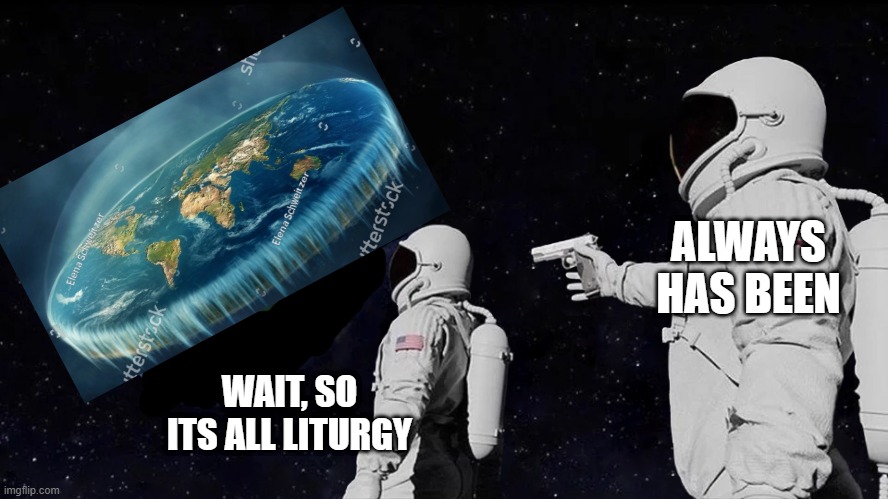
Returning to the loss of sacred space and yearning for re-enchantment, by looking at the Church we might see that Beauty is the map as well as the destination. And if Beauty is the map, then the Earth is flat, liturgically. The Church is Beautiful and iconographic, drawing men to “an house not made with hands,” on a flat plane but nevertheless ascending ever more “eternal in the heavens” (II Cor. 5:1). The Earth: the nations therein meet in the nave, surrounded by so great a cloud of witnesses (cf. Heb. 12:1)—is flat.
The Church is square with a dome encasing its members, overshadowing and beckoning us deeper still is the icon of the eternal God, the Pantocrator. The circle, in ancient philosophy, typically represented eternity, unchanging, and incorruption. Here it becomes an invitation to epektasis, to become incorruption in and through union with Jesus Christ. The semi-circle of the dome, representing the firmament over the earth, meets the flat plane imaging the intersection of heaven and earth, of the union between God and man.
The key is the Cross. The Cross is the axis mundi. The Church is a meeting place of God and man wherein this union, the mystical Body of Christ, reveals the Way. The Church is the visible pattern of the invisible heart of man; the semi-circle enclosing the flat earth of the Church represents true, loving union in Beauty and becoming Beautiful. The revelation of the iconographic architecture reveals true, loving union.
Man becomes more like God, but as we become like Beauty our inner essences become realized, true. We are unique and unrepeatable; God does not call us to dissolve but become persons in and through Him. The Church’s flat topography and the firmament over it becomes an icon of the eternal call into God, becoming like the burning bush—aflame but not consumed. And this is the work of the heart, our internal furnace and altar where we move, out of love, toward He Who is incorruption.
The Flat-Earthers are right that we’ve been lied to; whether this means that NASA is pulling the wool over our eyes is notwithstanding, because no matter what the shape of the Earth, it is not our home. Christ’s Incarnation was a Beautiful Theophany reminding us of who we are, who we belong to, and a deliverance from the prince of the power of the air (cf. Eph. 2:2). St. Isaac the Syrian’s call to repentance is a reminder that this world is a vale of tears, “the valley of weeping” (Ps. 83:7 LXX), pointing us toward the incorruptible. Hegland’s premise is, in a way, correct, but his prescriptions are not: We are pilgrims here.
“Yet,” Archimandrite Zacharias writes, “as long as we are held captive by our passions, which distract our mind from our heart and lure it into the ever-changing and vain world of natural and created things, thus depriving us of all spiritual strength, we will not know the new birth on High that makes children of God and gods by grace.”[14]
We are living in exile here, chasing after the noise that surrounds us like an endless void. This hum doesn’t simply exile us from knowledge of God but exiles us from our heart. But see, this isn’t about a hidden knowledge or an individual, mystical experience. This is about communion and becoming whole, which is done as a community. Modernity leads us away from repentance and self-renunciation rather it is the low hum behind individualism leading us, all, to identify with what is temporal and vilify those who do not share our identity. We place such great significance on this life, its sorrows and its comforts that we dare never answer the call to lead the life we are here to lead.[15]
The Flat-Earthers sense there is a deception at work, and they’re not wrong. There are forces at work which want our spiritual disorientation and to argue with one another about angels, principalities, heights and depths all to distract us from epektasis. The true journey we are meant to start. Man’s primordial vocation of uniting, eternally, with God.
That begins here and now, on this world—flat or round—here.
St. Macarius the Great writes:
“Within the heart are unfathomable depths… In it is the workshop of righteousness and of wickedness. In it is death; in it is life… The heart is Christ’s palace… with the angels and spirits of the saints, and he dwells there, walking within it and placing his Kingdom there… The heart is but a small vessel: and yet dragons and lions are there, and there likewise are poisonous creatures and all the treasures of wickedness; rough, uneven paths are there, and gaping chasms. There also is God, there are the angels, there life and the Kingdom, there light and the apostles, the heavenly cities and the treasures of grace: all things are there.”
Space may be fake. It may even be real. But what if it’s more than either?
What if it’s a parable—a mystery meant to challenge who receives it to deeper dialogue with God?
The mysterious vastness is an invitation to strain toward the eternal reality that is God, to fix our eyes on the unfathomable Father, Son, and Holy Spirit Who call us to become in and through the Word of God that pierces the tapestry of the cosmos, rending it in twain like the veil of the Temple (cf. Matt. 27:51) and becoming the very intersection of eternity and temporality. The vast reaches of the cosmos images the noetic altar of our heart where we unite to the hidden man, in that which is not corruptible.
Space really is a trumpet beckoning man to ascend the Holy Mountain, purging our hearts in and through repentance, “beholding as in a glass the glory of the Lord, [being] changed into the same image from glory to glory, even as by the Spirit of the Lord” (II Cor. 3:18).
Flat or sphere, we must forsake this world’s illusions, abandoning not creation, but the passions that estrange us from it. Setting our sights on our true home and hope, “And truly our Father’s house is our heart, the place where ‘the spirit of glory and of God’ would find repose, that Christ may be ‘formed in us’. Indeed, only then can we be made whole, and become hypostases in the image of the true and perfect Hypostasis, the Son and Word of God.”[16]
Ο ΧΡΙΣΤΟΣ ΕΝ ΤΩ ΜΕΣΩ ΗΜΩΝ! ΚΑΙ ΗΝ ΚΑΙ ΕΣΤΙ ΚΑΙ ΕΣΤΑΙ
[1] Bruno Latour and Steve Woolgar, Laboratory Life: The Social Construction of Scientific Facts, intro. by Jonas Salk (Beverly Hills: Sage Publications, 1979), 180.
[2] David Bloor, Knowledge and Social Imagery, 2nd ed. (Chicago: University of Chicago Press, 1991), 36–37.
[3] Ray Zammit, “Physics, Technology, and Theology in Pavel Florensky,” Melita Theologica 69, no. 1 (2019): 35–46, https://www.um.edu.mt/library/oar/bitstream/123456789/58411/1/MT_69_1_06_Physics%2C_Technology_and_Theology_in_Pavel_Florensky.pdf.
[4] Jonathan Pageau, “Where Is Heaven?” Orthodox Arts Journal, September 2, 2014, https://orthodoxartsjournal.org/where-is-heaven/.
[5] John D. Zizioulas, Being as Communion: Studies in Personhood and the Church (Crestwood, NY: St Vladimir’s Seminary Press, 1985), 106.
[6] Ibid. 102.
[7] Maximus the Confessor, On the Ecclesiastical Mystagogy: A Theological Vision of the Liturgy, trans. Jonathan J. Armstrong (Yonkers, NY: St Vladimir’s Seminary Press, 2019), 56-57, 70.
[8] Gregory of Nyssa, The Life of Moses, trans. Abraham J. Malherbe and Everett Ferguson (New York: Paulist Press, 1978), 31.
[9] This isn’t far from the reality we see in the propagandizing of Darwinism through the Huxley family, the connections between Jet Propulsion Labs, L. Ron Hubbard, and Aleister Crowley, or even the Trojan Horse of nihilistic philosophy through media and New Age spirituality.
[10] The Ascetical Homilies of St. Isaac the Syrian.
[11] Stillness is a precious thing; it is the epitome of space, yet often we find ourselves—me most of all—jumping from book, to article, to video, to theory in a circle… Avoiding that stillness at all costs.
[12] Homily 12, Commentary on the Gospel According to St. Luke, Ch. 4, 92, 93.
[13] Zizioulas, Being as Communion, 115.
[14] Archimandrite Zacharias, The Hidden Man of the Heart (I Peter 3:4): The Cultivation of the Heart in Orthodox Christian Anthropology, 2nd ed. (Essex: Stavropegic Monastery of St John the Baptist, 2023), 13.
[15] It’s often easier to hold resentments and regrets than it is to forgive; likewise, it is more exhilarating following rabbit holes than Christ.
[16] Zacharias, The Hidden Man of the Heart, 12.
 Witness, NM