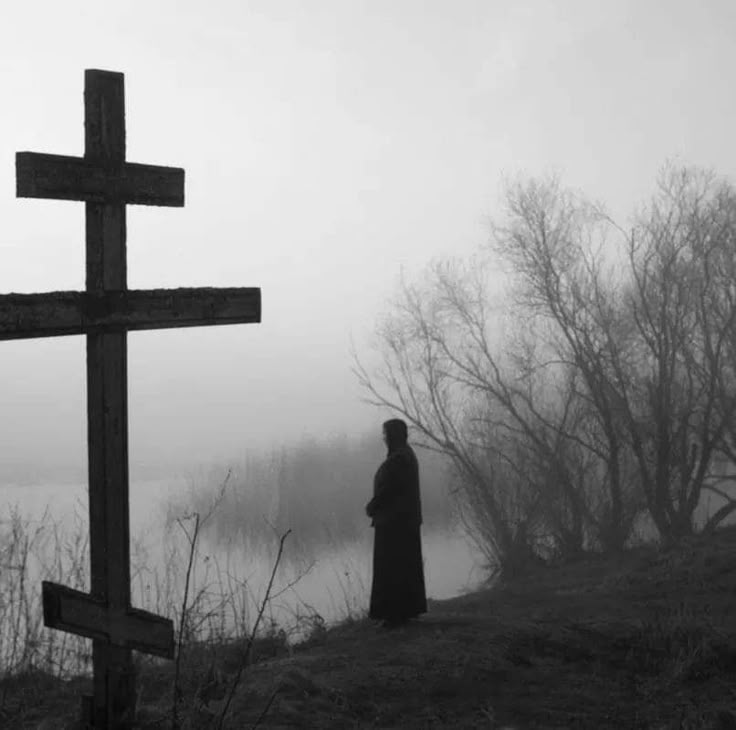
The Light, Calling from the Dark
Liturgy brings people together where each participates in a mutual self-offering, every joy and sorrow of the week recapitulated in the eternal self-giving of Christ, caught up in His Cross and Resurrection—eros and agape—glorifying Him glorified, and partaking of His glory by the Mysteries of the Church.
In the Liturgy’s mutual self-offering, we mirror the love of the Holy Trinity, where each person exists in and through another. This is the healing of identity. Truly and mystically uniting everyone to Christ, becoming truly “His Body, the fullness of Him, Who fills all in all” (Eph. 1:23).
Becoming, then—and being itself—is a communal actuality. The Eucharist is the ontological mooring rope that holds together God and man, divine and corporal reality, through which we are realized as persons in relationship. Met. John Zizioulas, in “Being as Communion,” wrote of the ecclesial personhood stating that man’s hypostasis is fully realized through the Mysteries of the Church, becoming a new man in Baptism and the union of himself with Christ.[1] He links man’s historical reality with his ecclesial personhood, further demonstrating that life in the Church is True life as it is established in True Man–Christ Himself.
The modern man, however, steeped in relativism, existentialism, moral nihilism, and philosophical pessimism of media and entertainment, lives a self-negating individualism. He sees himself as the accidental byproduct of mutations, misfires, and cognitive distortions. Of course, even this betrays what Jesse Bering describes as the “naturalist fallacy”—a conceptual error confusing what is natural as inherently good or right. Bering concludes that while no created thing was made intentionally, there are no accidents, either. To say so still implies a purpose, instead Bering insists that we simply are.
Contrasting Bering’s naturalism, Met. John continues: “The essential thing about a person lies precisely in his being a revelation of truth, not as ‘substance’ or ‘nature’ but as a ‘mode of existence’… true knowledge is not the knowledge of the essence or the nature of things but of how they are connected within the communion-event.”[2]
The affirmation of others’ uniqueness is a principal aspect of communion. It stands in stark contrasts to the Vedic dissolution of self into the vast sea of maya, to Schopenhauer’s world-as-appearance, and to modernity’s anti-liturgical fragmentation—the reduction of the person by dissection and comprehension, entombed in escapism and existential despair. This is the very epitome of Tartarus itself. St. Nektarios, writing of hopelessness said it “is accompanied by a dense and dreary darkness that enshrouds everything in black vapors.”[3]
Philosophical pessimism stares into the abyss of black vapors and mistakes it for redemption. The dense, dreary darkness crawling from the depths of Hades seduces modern man to retreat into her bosom—forsaking not only desire, but even his very personhood. For Schopenhauer, Christ the Incarnate Word does not descend into death to trample down the gates of Hades but becomes a representative of world-denial—a prototype of his negation of the will, the very denial of life itself and the embrace of nothingness. His reading of the Gospels, heavily influenced by the Vedic tradition, reshapes the Passion as resignation. The kenotic love of Christ is recast through Schopenhauer’s crucible of pessimism as the tragic futility of being.[4]
Yet Schopenhauer shares a common fault of Enlightenment thinkers: parasitically smuggling Christian imagery into their own rejection of it—imitating Christ, even in negation.
This misreading is downstream of Kant, whose dichotomy between phenomena and noumena walls off the world of things-in-themselves from any real access. Space and time become mere conditions of perception, and the mind can no longer encounter reality as it is—only as it appears. Experience is not shaped by encounter, but by the constraints of reason and sensibility. Under such metaphysics, the Eucharist and the Mysteries of the Church are rendered unintelligible. Communion with the divine—partaking of the divine nature—becomes inconceivable. Participation collapses into projection; personhood is reduced to a sensible object, constructed and consumed by the self.
This epistemic lens, by denying the revelatory nature of creation and of being itself, replaces presence with mental representation. Not only the will, but the very notion of theosis is lost. There is no real transformation, only appearance and interpretation—imprisoned within the mind.
Kant’s scaffolding is draped in Schopenhauer’s black, vaporous despair. As St. Nektarios writes:
“There is nothing worse than despair… The despairing man feels his life getting heavier and heavier… He hides his passion and is silent about the pains it causes him. The despairing man has lost hope in God, the secure anchor of life, and is tossed about like a ship in the midst of a raging sea, which rises and threatens to sink it with its heaving, frothing waves… The despairing man, while living, has already died.”[5]
Thus, the human person, having lost the noetic awareness that perceives creation as God’s Beautiful self-revelation, is no longer a realized hypostasis, but a ghost wandering unto death.
The consequences of this worldview—this creeping desolation from the depths of Hades—are evident on a global scale. Tartarus seeks to engulf the world, taking pessimism as its bedmate: Doom-scrolling, loveless promiscuity, the weaponized compassion of euthanasia, and the anti-woman, anti-person rites of abortion. Secular humanism, nihilism, and pessimism have led us away from the necessity of the Cross and the reality of the Resurrection—destroying love and thereby abolishing knowledge.
This logic of despair finds intellectual expression in figures like David Benatar, who ponders questions that betray a terrifying assumption: “How many people should there be?” and “May we bring new people into the world if it will reduce harm to those already existing.”[6] These questions do not suppose that God must be abolished—they presume He already is. But why bring new people into the world? So that God’s glory may overflow and be realized in and through all existence, that He may fill all in all and that we might become united with Him. Why on earth would we begin gatekeeping love, life, and union with God?
“But woe to you, scribes and Pharisees, hypocrites! For you shut up the kingdom of heaven against men; for you neither go in yourselves, nor do you allow those who are entering to go in” (Matt. 23:13).
It may be easy—even fun—to refute pessimism and nihilism. But this often drags us worldly debates that become a form of moral licensing or virtue signaling, allowing us to outsource repentance while leaving our own cross uncarried.
The Apostle speaks against this delegated righteousness, “But you have not so learned Christ, if indeed you have heard Him and have been taught by Him, as the truth is in Jesus: that you put off, concerning your former conduct, the old man which grows corrupt according to the deceitful lusts, and be renewed in the spirit of your mind, and that you put on the new man which was created according to God, in true righteousness and holiness” (Eph. 4:20-24).
We must be the repentance we want to see in the world. We must live the Resurrection by living the Crucifixion, that we might say along with the Apostle,
“It is no longer I who live, but Christ lives in me” (Gal. 2:20).
For “those who are Christ’s have crucified the flesh with its passions and desires” (Gal. 5:24). We are called to embrace agape—true, self-emptying and sacrificial love—not hiding nor withholding ourselves, but denying ourselves and moving toward Beauty, that is Christ, Who unifies us all by His eros and agape.
St. Porphyrios once said, “You don’t become holy by fighting evil. Let evil be. Look towards Christ and that will save you. What makes a person saintly is love.”[7] We are not called to war against the modern age, for in doing so we risk becoming like it. We are called instead to respond to the Cross and face ourselves.
Fr. Dumitru Stăniloae, writing on the Cross and its rejection, offers this:
“No one can escape the cross on this earth. But he who wishes to avoid it, he who does not see or does not wish to see God through it, will be lost by it… He finally loses the gift itself because he does not see it as the gift of God who reveals his own reality as greater than the gift… The cross is given to all of us to lead us towards the life of the spirit and as means of re-establishing the dialogue of man with God.”[8]
The outer darkness of rejecting the Cross is antithetical to the very reality of the person and their relationship with God. It denies God and thereby denies the Resurrection of man. In so doing, the modern man is cut off from communion with God, with his neighbor, and even with himself. Modernity’s low hum of pessimistic anxiety is not the byproduct of an evolutionary misfire, but the emergent condition born of refusing the Cross and denying the Resurrection.
Pessimism is a cul-de-sac; nihilism is a walled alleyway. There is no hope in them—not because they present valid but bleak truths, but because they are incoherent assertions. Suffering is not optional—it is the very door of transformation. To avoid it is to remain transfigured by the love of God, untouched by the joy of the Resurrection.
By refusing the Cross, modern man refuses to be. Non-existence is not preferable to being—it is nothing. Love transfigures something, not nothing. And yet modernity does not acknowledge the Beautiful self-revelation of God. Instead of allowing this Theophany to draw him into life and communion, man falls prey to the pseudo-reality of the outer darkness. And in that darkness, nothing can become like God. Nothing can know God. Nothing can become.
For nothing is not. It has no being, no power to become. But God—who commanded light to shine out of darkness—has shone in our hearts, to give the light of the knowledge of the glory of God in the face of Jesus Christ (II Cor. 4:6).
[1] John D. Zizioulas, Being as Communion: Studies in Personhood and the Church (Crestwood, NY: St. Vladimir’s Seminary Press, 1985), 53, 55.
[2] Ibid. 106.
[3] St. Nektarios of Aegina, Know Thyself, vol. 7 of Collected Works, trans. from the original Greek (Melbourne: Virgin Mary Monastery of Australia and Oceania, 2022), 52.
[4] Schopenhauer, The World as Will and Representation, 355.
[5] Ibid. 53.
[6] Benatar, Better Never to Have Been, 182, 187.
[7] Wounded by Love: The Life and Wisdom of Saint Porphyrios, ed. Sisters of the Holy Convent of Chrysopigi, trans. Fr. John Raffan (Limni, Evia, Greece: Denise Harvey, 2005), 156.
[8] Stăniloae, The Victory of the Cross, 17.
 Witness, NM