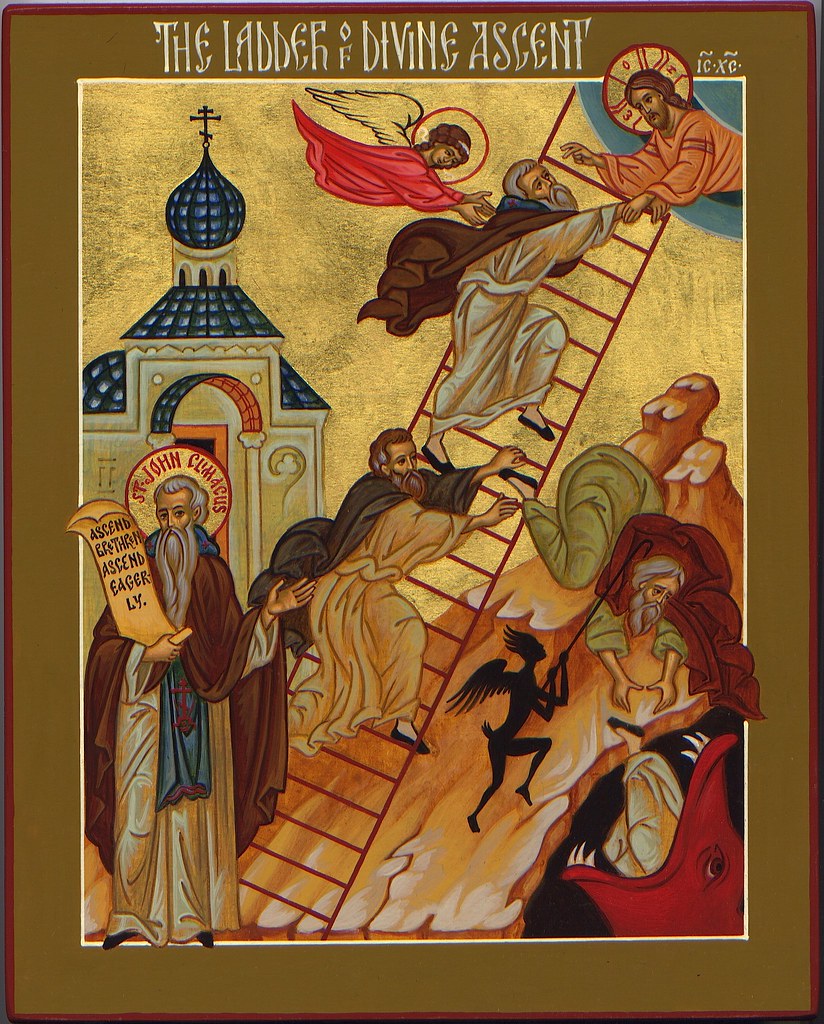
The Sunday of St. John of the Ladder
“Above nature are chastity, freedom from anger, humility, prayer, vigil, fasting, constant compunction. Some of them men teach us, others angels, and of others the Teacher and Giver is God the Word Himself” – St. John Climacus, the Ladder
My Theories of Religion course had us analyze and critique the micro-theory of E.E. Evans-Pritchard observing the Azande peoples in North Central Africa which made me think about how we, in the West, deliberately step out of story to engage with it from a scientific and rational perspective. Evans-Pritchard’s anthropological lens argues against the leading theories of religion in his day, pointing out that anthropologists cannot truly embody the mindset of those they are studying thus not adequately understanding the culture they are examining.
Evans-Pritchard remarks that instead of meeting the cultures where they are and grounding into their worldview, the anthropologist rather is projecting their own worldview onto the culture under observation and from there, positing hypotheses and conjecture regarding their beliefs and practices based on the anthropologist’s cultural outlook. Thereby, ascribing meaning that does not necessarily exist within that culture.
We in the West do this because our minds are entrenched in analytical thinking. To understand why someone does something, to understand why a culture practices A and another culture believes B, we project our own understanding of why someone might practice A or believe B based on why we might.
This is not science; it is hardly philosophy; this is an evaluation of participatory practices and beliefs based on abstract thought. Evans-Pritchard finally offered the idea that theories of religion are not sufficient for a rounded explanation of religion, et large. In fact, theories of religion, thus far, have merely reduced religion to its basic components while neglecting the diversity of theory and praxis that is found in religious traditions.
Religions do not do the same thing, nor is any one religion on par with another. The metaphor of religions as different paths up the same mountain is inaccurate; they’re diverse mountains with unique paths and distinct summits. Christianity is an example of neither being a monolith culturally nor being the same mountain for all that profess to be Christian believers. There are many Christian mountains and some of them truly lead to the kingdom and others simply lead to a God made in my image.
The Western philosophical mindset often implicitly follows in step with E.B. Tyler’s social development theory, which states that institutional religion is a social evolutionary step before civilization reaches the final stage of science and materialism. Freud and Marx echo this sentiment in their own theories, though Marx is more sympathetic to religion than Freud.
Regardless, these thinkers are incorrect in their assumption that religion is merely an aspect of human development, as if we are in an adolescent stage of growth, clinging to the comfortable notion of our earlier, premature animism and polytheism.
Theories of religion posed by Western intellectuals often seek to assert control over another culture in their effort to know why it functions in the way it does while intentionally demystifying the cultural practices and beliefs and disenchanting the world. The want to reduce religious traditions and spiritual phenomenology to social functions (i.e. Durkheim), obsessional neuroses (i.e. Freud), socio-economic control agents (i.e. Marx), and misogynistic hierarchies (i.e. Mary Daly) disconnects us from the cosmos and the Divine classifying religion as an aspect of human ingenuity.
Where once people beheld a world with meaning—where the stars sang the glory of God and the trees danced in the wind of the spirit, soaring toward the firmament, catching us up to the third heaven—now they only see resources to manage and matter to be categorized.
The West’s over-reliance on analytical pontificating, rationalism, and intellectualism are emergent factors from secular humanism that has been subtly shaping Western Christianity as a, according to Fr. Alexander Schmemann, tragic product of Christendom. “It is a tragedy because having tasted a good wine, man preferred and still prefers to return to plain water; having seen the true light, he has chosen the light of his own logic.”[1]
From man’s own logic not only does Western philosophy reduce religion to a uniformity and man-inspired wrestling with the world he finds himself in, but also a reductionist view of the Gospel: The so-called “Social Gospel” movement of the early 20th century and the liberal theology of the latter half. Under the guise of secular humanism and Western reductionist philosophy, the church offers only what the world abundantly provides.
Western philosophy and the ethics it produces simply cannot do, despite mirroring Christian humanism, what Christian ethics are meant to do: “Christian ethics intends to bring the Kingdom of God to earth, making the inhabitants of earth into citizens of heaven… Therefore, it follows that ethics must have divine validity; its laws must flow from God Himself Who speaks to man’s heart … Thus, the ethics of the Gospel is the only ethical teaching which can shape and reshape man, make him the image and likeness of God, and bring the Kingdom of Heaven to the earth.”[2]
What ethics have divine validity, but the virtues themselves? “For our Lord Jesus Christ himself is the substance of all virtues.”[3] Therefore, “we are describing not ourselves when we describe the virtues, but Christ. ‘Virtue Ethics’ should be mostly Christology.”[4]
Christ is patience. He is obedience. He is humility. And He is love itself. The saints do not merely admire the virtues as abstract ideals; instead, they embody them, like a sword plunged into fire, until they are wholly transformed. In so doing, they re-enter faith as a lived reality. The virtues are not mere guidelines, they are the very means in which we participate in Christ’s life, restoring what philosophical rationalism has stripped away.
The Church grounds its prescribed remedy for the Western philosophical tradition of abstract thought and ideal humanism in Christ’s exhortation: “If anyone would come after me, let him deny himself and take up his cross and follow me” (Matt. 16:24). In our time, knowledge is often mistaken for wisdom, and speculation is mistaken for faith. We read, we argue, and we consume mindless content, but intellect alone cannot grasp the mysteries of God.
They must be lived, prayed, and fasted. The uncreated God is not an idea or an abstraction to be studied—He is a Person to be encountered. The Church prescribes askesis for her children not to be a burden nor to distract us from asking difficult questions, but as medicine to heal us—to bring us back to reality, to train our hearts to seek Christ above all else.
And yet, prayer and fasting are not just exercises in self-discipline. They are the very pattern of life in Christ. We are not called to moral perfection in the Church but union with Christ; moralism, an aspect of our Puritanical Western ethos, drives one to self-obsession and self-reliance not competing, but agreeing, with the secular humanism of our age.
This severance between belief and lived participation is not just an anthropological observation but a spiritual crisis. We see its consequences even in the Gospel, where a father, desperate for his child’s healing, reveals the tension between doubt and true belief.
Leaving His heavenly throne Christ descends into our messy lives, offering healing if we could only open our eyes and ears to see Him. Christ meets the pain-stricken father who wants his boy, possessed by a dumb spirit—that means unable to see and hear—to be healed of his torment.
The spirit “casteth him both into fire and into water, in order that it might destroy him” (Mk. 9:22). The Lord responds to father’s pleading for compassion and help, “’If you can believe, all things are possible to him who believes.’ Immediately the father of the child cried out and said with tears, ‘Lord, I believe; help my unbelief!’” (Mk. 9:23-24).
The Western worldview hinders the father and many others like him from fully exercising their faith, even though they call upon God. Often, we offer such prayers to precede our own efforts, excluding God. This form of therapeutic moral deism is certainly as much of a product of the Western disenchantment as it is of unbelief itself.
“‘To live in the world as if there were no God!’—but honesty to the gospel, to the whole Christian tradition, to the experience of every saint and every word of Christian liturgy demands exactly the opposite: to live in the world seeing everything in it as a revelation of God, a sign of his presence, the joy of his coming, the call to communion with him, the hope for fulfillment in him.”[5]
This Gospel passage is more than another healing performed by Christ—it is an encounter with God Himself and a call to us to practice this presence of God in our own lives. While our Lord truly healed the father and the son, they symbolize the inert philosophy of the Western intellectual tradition, producing fundamental secular moral standards like autonomy and utilitarian ethics with the shifting sands of deontological value judgements. Ultimately, this is in continuity with the 19th and 20th century religious theorists degrading religious paradigms while disenchanting the ethics and morality of said religious traditions.
Secular humanism has sought and has plundered the Christian framework and positioned itself as the arbiter of these values, forgetting that Virtue Ethics are Christological. This is why it is so important for us Christian to put into practice the presence of God by uniting ourselves to Christ through the virtues.
St. John of Karpathos writes, “Some hold that the practice of the virtues constitutes the truest form of spiritual knowledge. In that case, we should make every effort to manifest our faith and knowledge through our actions.”[6]
It is by putting our faith into action that we move toward Him and allow Him to heal our son, or the products of our thoughts, “For when we are united to Christ through our chaste eros [virtues] for Him, we begin to more resemble Him. We have ‘put on Christ,’ because He has given us a share in his very life and being.”[7] Faith is not simply believing in a set of propositions: That is for the secular humanists and the anthropologists and everyone who wants to divorce themselves from story.
“Salvation in the Church comes not from moral perfection but rather from union with Christ.”[8] “Lord, I believe! Help my unbelief!” cries the father. The father’s words resonate across time with our own struggle. We want to believe, but our hearts are divided. We waver, torn between the call of Christ and the grip of the world.
This is why we pray. This is why we fast. We do not embrace these practices as legalistic forms of currying God’s favor, nor are they meant to set us apart as spiritual dynamos; we fast, and we pray to abide in Him, that He may abide in us (cf. Jn. 6:56).
We do this in response to His call, as we know the voice of the Good Shepherd Who layeth His life down for His flock (cf. Jn. 10:14, 11). The Lord, in His eternal love, His chaste eros, gives Himself for the life of the world (cf. Jn. 6:51) and we fast and pray that we might enter this kenotic relationship of self-giving love; Christianity does not value autonomy because we are saved in relationship with others!
Christ descends from the mountain of His glorious Transfiguration to enter the suffering of this father who represents all of us in our struggle to break free from the bondage of sin and the over-analytical inertia of the disenchanting secular worldview (whether we realize it or not). This descent is not simply an event recorded in the Gospel of Mark, but an event that happens eternally and always. Liturgy is a theophany, revealing God Who eternally calls creation into existence, from darkness to light—from unbelief to faith and from the slavery of the passions to the freedom of sonship.
We must, therefore, move toward Him by daring to tread upon the path of His commandments, cultivating the virtues in living sacramentally in Christ; in putting on Christ we are putting off the old man who casts us “into the fire of anger and desire, and into water, meaning, into the pounding surf of world cares.”[9]
In this way, we are not embodying a stale and collegiate philosophy and anthropological detachment from reality, but are becoming rational creatures, lights in the darkness, and candles before the icon of Christ. And in our deepening union with Christ self-discipline and chaste eros becomes like oil in our lamp and heat in our hearts.
This passage reminds us that it is not enough to simply know about virtue and ethics; prayer and fasting, they must be put into practice for us to gain understanding, for us to enter reality as it has been lived for thousands of years so that, there, at the foot of the mountain, God can enter our lives and raise us up to share in His. Selah.
Ο ΧΡΙΣΤΟΣ ΕΝ ΤΩ ΜΕΣΩ ΗΜΩΝ! ΚΑΙ ΗΝ ΚΑΙ ΕΣΤΙ ΚΑΙ ΕΣΤΑΙ
[1] Alexander Schmemann, For the Life of the World: Sacraments and Orthodoxy (Yonkers, NY: St. Vladimir’s Seminary Press, 2018), 136.
[2] St. Nektarios of Aegina, Christian Ethics, trans. Josef Candelario (Australia: Virgin Mary of Australia and Oceania, 2021), 31.
[3] St. Maximus the Confessor, On the Cosmic Mystery of Jesus Christ, trans. Paul M. Bowers and Robert Louis Wilken (Crestwood, NY: St. Vladimir’s Seminary Press, 2003), 58.
[4] Timothy G. Patitsas, The Ethics of Beauty (Maysville, MO: St. Nicholas Press, 2019), 116.
[5] Alexander Schmemann, For the Life of the World,135-136.
[6] St. John of Karpathos, The Philokalia, Vol. 1, 302, St. Nikodimos of the Holy Mountain and St. Makarious of Corinth, eds., trans. G.E.H. Palmer, Philip Sherrard, and Kallistos Ware (New York: Faber and Faber, 1979).
[7] Timothy G. Patitsas, The Ethics of Beauty, 115.
[8] Ibid.
[9] Theophylact, The Explanation of the Holy Gospel According to St. Mark, trans. Fr. Christopher Stade (Platina, CA: St. Herman of Alaska Brotherhood, 2020), 77.
 Witness, NM