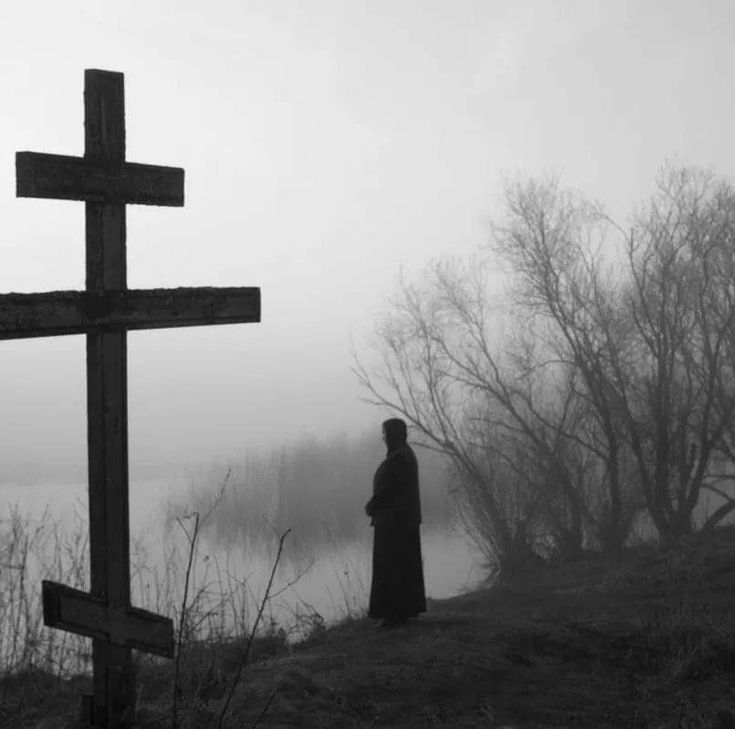
The Sunday of the Veneration of the Holy Cross
Epistle—Hebrews 4:14-16; 5:1-6
Gospel—Mark 8: 34-38; 9:1
In addition to the Gospel readings for the Lenten Fast, I have been reflecting on the Gospel of St. John. This week’s Gospel passages naturally intersect with those reflections. After a weeklong break from screens, as a form of modern-day asceticism, I am posting today rather than on Monday as usual. Now I am also finding myself considering a flip hone and a typewriter, but I digress.
St. Maximos the Confessor writes, “Suffering cleanses the soul infected with the filth of sensual pleasure and detaches it completely from material things by showing it the penalty incurred as a result of its affection for them. This is why God in His justice allows the devil to afflict man with torments.”[1]
This is precisely what Christ was trying to reveal to the Jews: their sufferings were not in vain but a means of escape from the coming wrath of God (cf. Rom. 2:3) that would visit them in 70 A.D. The Lord exhorts His would-be disciples in the Temple, saying, “If we abide in My word, truly ye are My disciples; and ye shall know the truth, and the truth shall set you free” (Jn. 8:31-32). Christ is the Truth, and our knowledge is grounded in Him.
James B. Jordan, a Reformed pastor, notes that Christ taught in parables to instruct the righteous and to confound the wicked. This, he argues, “is utterly opposed to the Greek rationalistic tradition in Western thought, which assumes unaided ‘reason’ is able to apprehend truth.” Instead, Christ declares that truth is comprehensible only to those who abide in Him. “It is a fundamental aspect of Christian epistemology.”[2]
Thus, knowledge and wisdom are predicated on communion with Christ, a faith that responds to His love with action. This is encapsulated in His words: “I am the light of the world; the one who followeth Me in no wise shall walk in darkness, but shall have the light of life” (Jn. 8:12).
St. John Chrysostom reminds us darkness signifies error and death[3]: “For if ye do not come to believe that I am, ye shall die in your sins” (Jn. 8:24). This is not a divine punishment but the natural consequence of rejecting the Truth. Christ offers Himself freely; those who refuse Him embrace their own destruction.
Thus, Christ declares in this week’s Gospel:
“Whosoever will come after me, let him deny himself, and take up his cross, and follow me. For whosoever will save his life shall lose it; but whosoever shall lose his life for my sake and the gospel’s, the same shall save it. For what shall it profit a man, if he shall gain the whole world, and lose his own soul? Or what shall a man give in exchange for his soul?” (Mk. 8:34-37).
The Cross reveals Christ’s eternal self-giving and the life of the Holy Trinity is one of self-emptying love which is the foundation of the Christian epistemic tradition: communion with God. Christian knowledge is grounded in self-renunciation. To follow Christ is to imitate Him and to take up the Cross is our path from non-being to being, from darkness to light (cf. Jn. 8:12).
The Jewish leaders in St. John’s Gospel are called sons of the devil; similarly, in St. Mark’s Gospel, Christ rebukes St. Peter as “Satan” when he opposes the way of the Cross. St. Peter’s resistance reveals the carnal mind’s inability to grasp the necessity of suffering. The devil tempts us to indulge our passions rather than endure the struggle of the Fast and the Christian life—which is, at its heart, a life of the Cross.
St. Theophan the Recluse states that there is no Christian without a Cross. Healing requires pain; transformation demands struggle. To carry the Cross means embracing inconvenience, constraint, and self-denial[4]
The Jewish leaders, by rejecting Christ, rejected life itself. Fr. Schmemann observes, “This world rejected Christ, refused to see in him its own life and fulfillment. And since it has no other life but Christ, by rejecting and killing Christ the world condemned itself to death.”[5]
The Jewish leaders made their traditions self-sufficient, and by doing so severed themselves from the Source of Life. Christ alone is reality; apart from Him, existence becomes meaningless. Christ warns the Jewish leaders of this self-imposed exile from truth: “Ye are of your father, the devil, and the desires of your father ye wish to do” (Jn. 8:44).
Fr. Schmemann offers us the antidote: “It is only when we give up freely, totally, unconditionally, the self-sufficiency of our own life, when we put all its meaning in Christ, that the ‘newness of life’—which means a new possession of the world—is given to us.”[6] It is in imitating Him Whom we adore that, by renouncing our chaos and self-sufficiency, we step into true being.
The Cross is not merely a burden but the blueprint for a new creation. Christ calls us to take it up willingly, to unite our sufferings with His, so that we may be transformed through repentance. His (kenotic) self-giving love calls us to do likewise: We experience Christ’s love for the world in experiencing the Cross that we, too, might offer that love toward others.
St. Gregory of Sinai writes, “To suffer for Christ’s sake is to patiently endure whatever happens to us. For the envy in which the innocent provoke is for their benefit, while the Lord’s schooling tests us so as to bring about our conversion, since it opens our ears when we are guilty. That is why the Lord has promised an eternal crown to them who endure in this manner… Willingly to experience what Christ experienced is to crucify crucifixion and to put to death to death.”[7]
Self-renunciation is at the heart of the Christian life. The Cross crosses the I of self and through it, we overcome the tyranny of self-love and become true persons in relationship with God and neighbor. To take up the Cross is to accept suffering, not as an end in itself, but as a means to glorify God and be glorified with Him.
St. Symeon the New Theologian writes, “We cannot glorify God in any other way than that which He was glorified by the Son… Let us, then, diligently use the same means to glorify Him… These means are the cross, or death to the whole world, the afflictions, the trials and other sufferings, undergone by Christ. If we endure them with great patience, we imitate Christ’s sufferings; and through them we glorify our Father and God.”[8]
To be a Christian is to be crucified with Christ. In embracing the Cross, we are conformed to His likeness, experiencing His love for the world so that we, too, may offer that love to others.
This is the essence of the Christian epistemic tradition: it is not in seeking knowledge for the sake of knowledge, but for love—of God and of neighbor. The Cross is our epistemic lens through which “the world then truly becomes a sacrament of Christ’s presence.”[9] This is reality, for Christ tells us “I am with you always, even unto the end of the world” (Matt. 28:20) and while the world passes away Christ is forever (cf. Heb. 13:8). He is Truth, and through the Cross, we become partakers of His Truth and life (cf. II Pet. 1:4).
Ο ΧΡΙΣΤΟΣ ΕΝ ΤΩ ΜΕΣΩ ΗΜΩΝ! ΚΑΙ ΗΝ ΚΑΙ ΕΣΤΙ ΚΑΙ ΕΣΤΑΙ
[1] St. Maximos the Confessor, The Philokalia, Vol. 2, 178, St. Nikodimos of the Holy Mountain and St. Makarious of Corinth, eds., trans. G.E.H. Palmer, Philip Sherrard, and Kallistos Ware (New York: Faber and Faber, 1981).
[2] James B. Jordan, Through New Eyes: Developing a Biblical Worldview (Brentwood, TN: Wolgemuth & Hyatt, 1988), 263, https://www.ntslibrary.com/PDF%20Books/Through%20New%20Eyes.pdf
[3] Hom. 5, P.G. 59:39, 40 (col. 58).
[4] St. Theophan the Recluse, Thoughts for Each Day of the Year, trans. Lisa Marie Baranov (Platina, CA: St. Herman of Alaska Brotherhood, 2022), 69.
[5] Alexander Schmemann, For the Life of the World: Sacraments and Orthodoxy (Yonkers, NY: St. Vladimir’s Seminary Press, 2018), 90.
[6] Ibid. 90-91.
[7] St. Gregory of Sinai, The Philokalia, Vol. 4, 253, St. Nikodimos of the Holy Mountain and St. Makarious of Corinth, eds., trans. G.E.H. Palmer, Philip Sherrard, and Kallistos Ware (New York: Faber and Faber, 1995).
[8] St. Symeon the New Theologian, The Philokalia, Vol. 4, 46, St. Nikodimos of the Holy Mountain and St. Makarious of Corinth, eds., trans. G.E.H. Palmer, Philip Sherrard, and Kallistos Ware (New York: Faber and Faber, 1995).
[9] Alexander Schmemann, For the Life of the World: Sacraments and Orthodoxy, 91.
 Witness, NM