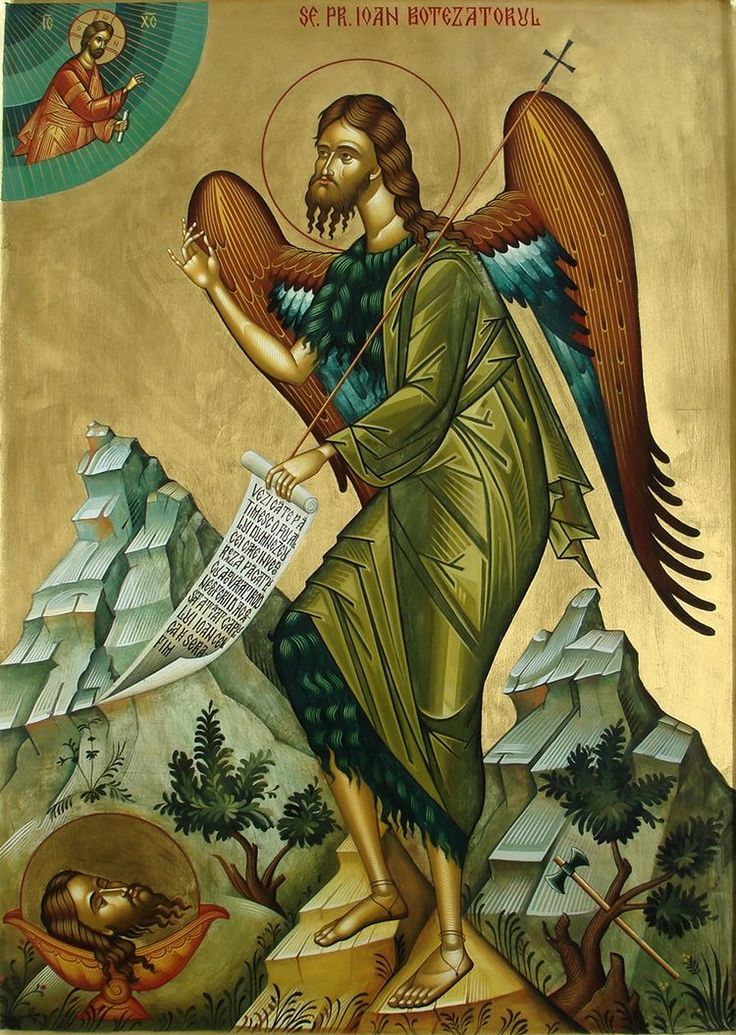
Reflections on Luke 3:7-8
“O offspring of vipers, who warned you to flee from the coming wrath? Produce therefore fruits worthy of repentance and begin not to say within yourselves, ‘We have Abraham for a father’; for I say to you that God is able from these stones to raise up children to Abraham” (Lk. 3:7-8).
St. John the Forerunner’s call to produce fruits worthy of repentance invites us to examine what this means in practice.
To produce fruits worthy of repentance means to align our lives with God’s will, bearing witness to our faith through love and good works.
St. Paisios of Mount Athos offers a profound answer, urging us to pray continually for “repentance and let every spiritual edifice be built upon it and let us continually seek repentance from God and nothing else except that.
We should not ask for lights or miracles, or prophecies, or gifts of the Spirit, only for repentance.”[1]
This singular focus on repentance is not unique to St. Paisios. St. Kyril of Alexandria elaborates further:
“The fruit of repentance is, in the highest degree, faith in Christ; and next to it, the evangelic mode of life, and in general terms the works of righteousness in contradistinction to sin, which the penitent must bring forth as fruits worthy of repentance.”[2]
St. John’s rebuke of the Pharisees as a brood of vipers warns against relying on external assurances, whether ancestry or outward works, for salvation. Instead, he calls to a deeper transformation, one that makes us living stones raised up to Abraham, by responding to God’s calling us out of the world to become a part of the Body of Christ: “You also, as living stones, are being built up as a spiritual house, a holy priesthood. In order to offer up spiritual sacrifices that are acceptable to God through Jesus Christ (I Pet. 2:5).
Repentance is therefore a sacrifice, a turning away from what we put over God, what we cling to, and what we believe—wrongfully—is our salvation. Repentance unveils the divine pattern underlying our spiritual yearning. It is a liturgical mystery: as living stones, we unite in repentance, becoming a sacrifice acceptable to God through Jesus Christ.
We are, mystically, becoming that which we praise.
We bless God and in turn God blesses us with His kingdom. This is the calling of all Christians, our telos.
Fr. Alexander Schmemann’s describes the kingdom as our goal and a declaration of what we move toward out of love and acceptance,
“From the beginning [of Divine Liturgy] the destination is announced: the journey is to the Kingdom. This is where we are going—and not symbolically, but really. In the language of the Bible, which is the language of the Church, to bless the Kingdom is not simply to acclaim it. It is to declare it to be the goal, the end of all our desires and interests… To bless is to accept in love, and to move toward what is loved and accepted.”[3]
Acceptance is a great part of repentance, because acceptance implies one is foregoing their own will and vision for another, and that is God’s. And in so doing, one is stepping into that will with love and gratitude. Such is a sign of the truly penitent. Living eucharistically is the way that we deepen our love for God, deepen our repentance, and acceptance of God’s will, which—being made in the image of God—is embedded in our hearts:
“Providence has implanted a divine standard our law in created beings, in accordance with this law when we are ungrateful for spiritual blessings we are schooled in gratitude by adversity, and brought to recognize through this experience that all such blessings are produced through the workings of divine power. This is to prevent us from becoming irrepressibly conceited, and from thinking in our own arrogance that we posses virtue and spiritual knowledge by nature and not by grace.”[4]
Fr. Schmemann’s vision of the kingdom as the culmination of our desires aligns with St. Maximos’ teaching on gratitude. Repentance, rooted in love and humility, leads us to accept God’s will, which transforms adversity into a means of grace.
Repentance is much more than turning away from former habits and behavior that diverts us off-course away from God; repentance is the very means in which we bless God and thus reorient toward Him as the consummation of our faith. Repentance is the remembrance of God, a liturgical act; the fruits of repentance beginning with the faith in Christ which produces good works being grounded in our love for Him. “If anyone love Me, he will keep My word; and My Father will love him, and We will come to him and make an abode with him” (Jn. 14:23).
Repentance is coming back to oneself and realizing that we as persons derive our identity from God not from what we do, nor from our titles and honors in this world, nor what we are adorned in, but fundamentally we are God’s children.
When we come back to ourselves and to our Father in repentance, we are becoming open to healing and, by God’s grace, being made a temple of God (cf. I Cor. 6:19), continuing in our repentance is treating our bodies, our minds, and our hearts as they are—dwelling places of our Lord. We are the living stones, becoming children of God through repentance in our Lord Jesus Christ.
Ultimately, the fruits of repentance are revealed in a life of faith, love, and alignment with God’s will. As we turn back to Him in repentance, we are not only healed but also transformed into living stones, proclaiming the kingdom in every thought, word, and deed.
Ο ΧΡΙΣΤΟΣ ΕΝ ΤΩ ΜΕΣΩ ΗΜΩΝ! ΚΑΙ ΗΝ ΚΑΙ ΕΣΤΙ ΚΑΙ ΕΣΤΑΙ
[1] Father Paisios the Athonite, “Guidance about the Jesus Prayer,” excerpt from With Elder Porphyrios: A Spiritual Child Remembers, Orthodox Info, January 15, 2025, http://orthodoxinfo.com/praxis/blessed-father-paisios-guidance-about-the-jesus-prayer.aspx.
[2] St. Kyril of Alexandria. Homily 7, Commentary, Ch. 3, 71.
[3] Alexander Schmemann, For the Life of the World: Sacraments and Orthodoxy (Yonkers, NY: St. Vladimir’s Seminary Press, 2018), 38.
[4] St. Maximos the Confessor, The Philokalia, Vol. 2, 212, St. Nikodimos of the Holy Mountain and St. Makarious of Corinth, eds., trans. G.E.H. Palmer, Philip Sherrard, and Kallistos Ware (New York: Faber and Faber, 1981).
 Witness, NM