The Mystery of being in the world
“A householder is one who practices his or her religion, not apart like a monk in a cloister, but in the real world. Raising a family. Practicing a profession. Engaged actively in community” (Pressfield, The Artist’s Journey 173)
“‘For this cause a man will leave his father and mother, and will be joined to his wife. Then the two will become one flesh.’ This is a great mystery, but I speak concerning Christ and the church” (Ephesians 5:31-32)
There is an overlooked spiritual practice that I believe holds the future of Orthodoxy within it. This practice is not merely a rule of prayer, but a path to walk in this life, working out our salvation with fear and trembling. The Royal Path of Orthodoxy is not meant to be walked alone, though no one can walk it for another. It is a concerted effort, certainly represented fully by Monasticism.
I want to look at another road to the Kingdom of God, that is the path of Householding salvation. Householding salvation is path of Marriage within the sacramental lens of Orthodox theology. To explain, let’s briefly look at where the term Householder comes from.
In Buddhism there are those who go forth as renunciants, ascetics living in a cloistered setting or wandering mendicants. These monastics live outside the world, doing the spadework for humanity through meditation, prayer, and asceticism. The Householder, on the other hand, lives in the world: They work a job, they raise a family, and they keep a house while taking refuge in the Three Jewels of Buddhism. The Buddha, the Dharma, and the Sangha.
They hold to and practice the Five Precepts of Buddhism:
- Abandoning and refraining from killing living beings
- Abandoning and refraining from taking what is not given
- Abandoning and refraining from engaging in sexual misconduct
- Abandoning and refraining from lying
- Abandoning and refraining from intoxicants
While they are not like the strict renunciants, the monastics who “go forth”, leaving their homes behind, the Householder takes vows as a lay disciple (or upasaka and upasika) and give alms to those travelling monastics, working in a complementary way with the ascetics who pursue freedom and Enlightenment detaching from the things of this world.
The Householder, in Buddhism, is an honorable vocation, and for my money I see it as a difficult path for those who seek refuge in the Triune Gem of Buddhism in the world, precisely because it falls to the individual’s will and fortitude to adhere to the Middle Way.
But what of the Orthodox Royal Path?
I feel it is an unfortunate reality that Christianity does not have a similar explicit path for our laity: The Householder. However, within Orthodoxy there are two paths that are typically associated with a common effort and struggle toward perfection. That is Monasticism and Marriage. These are two Mysteries (or Sacraments) of the Church, and both of them are difficult and both of them sanctify, purifying the one walking the path by God’s grace.
I have, for many years, thought of Monasticism as the end-all, be-all for spiritual perfection, and in many ways, it really is: The Mystery of Monasticism is the furnace through which men and women become angels, replacing the angelic order that fell in Genesis (led by the devil).
This is why I idealized it and for a long time had considered this my path. Recently, I have begun reevaluating this because Orthodoxy’s Sacramental theology makes it plain that within the Mystery of Marriage something is actually happening between two people; they are uniting together in Christ, not simply metaphorically, but actually becoming one in and through God and by the power of the Holy Spirit their union is energized and sustained by the energies of God which are actualized through the Mystery of Marriage.
The two, becoming one, are united and become different, something more whole, holy, and develop a single telos, meaning that divorce is not to be treated lightly, there is no break-up, there is rupture, repair, and the two—as one—struggling together to enter Paradise. In Christianity, the household becomes a sacramental entrance into His Presence, through the union of two souls and bodies the home is salvation wherein they become sanctified and transformed by God.
Therefore, this is not simply a marriage endowed with blessings from above during a wedding ceremony; Marriage is about love first and foremost, and because love is not inherently a holy thing love is brought into the Church via the procession into the Kingdom of God, that is bringing their love into obedience under God.
Obedience in love; not obedience and love, but the wholeness of the one as the totality of the other. Obedience, taken in itself, is not a “virtue”; it is blind submission—and there is no light in blindness. Only love for God, the absolute object of all love, frees obedience from blindness and makes it the joyful acceptance of that alone which is worthy of being accepted… Only obedience to God, the only Lord of Creation, gives love its true direction, makes it fully love (Schmemann, For the Life of the World 103).
Love without guidance is destruction; love disobedient to God is hate. The Mystery of Marriage is reconciling a couple’s love with God, bringing it into His Church, thereby His Kingdom and cosmically altering it by bringing love into obedience under God.
In Buddhism, the Householder walks the Middle Way, grounded in the Dharma, and balancing spiritual practices with worldly duties. In Orthodoxy, Marriage is the Royal Path to Householding salvation, where the couple’s love is perfected in Christ, balancing divine and human responsibility.
The prayer of St. Ioannikios the Great reflects this similarity between the Buddhist Householder taking refuge in the Three Jewels and the Christian Householder relying on the Trinity: “My hope is the Father, my refuge is the Son, my shelter is the Holy Ghost, O Holy Trinity, Glory to You.”
The Dharma is the commandments and teachings of our Lord, found most explicitly in the Sermon on the Mount, the Sangha of Orthodoxy is the Body of Christ and His Church which is reflected in the Mystery of Marriage, where husband and wife, become a living icon of Christ and His Church. We take refuge in His Ark, the Church and by participating in His energies via the Eucharist and Confession.
We become, together, more and more united to God.
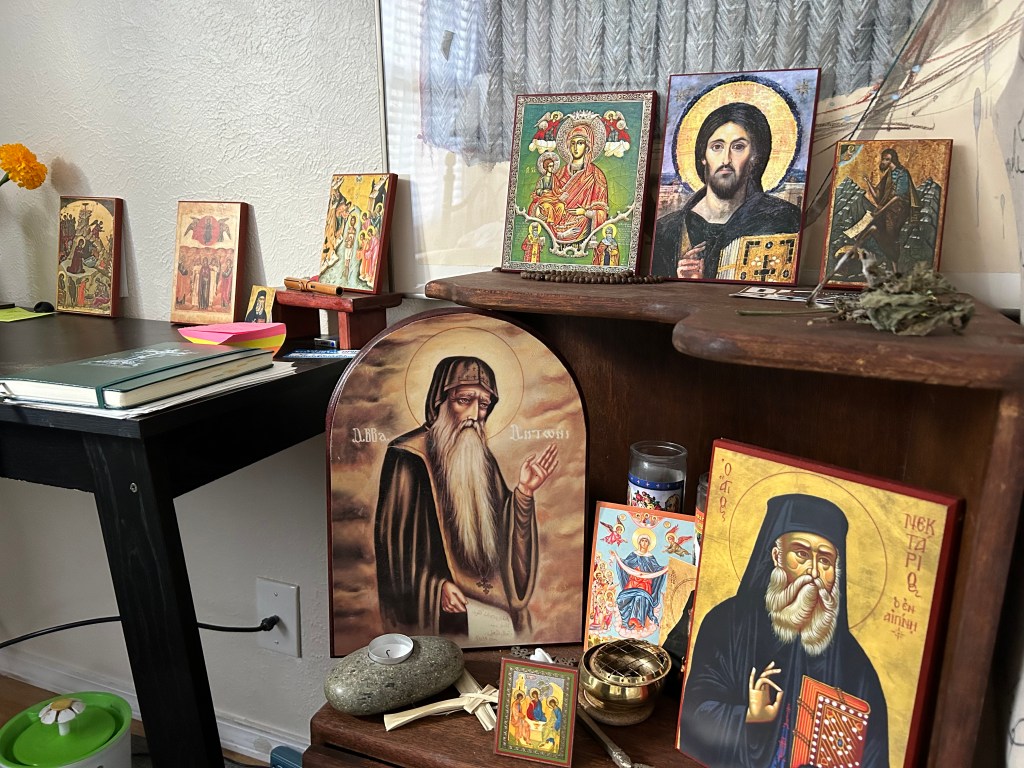
Householding salvation is the manifestation of divine love in the world. It transforms ordinary space into sacred space, just like the love we have for each other is brought into the Kingdom through the wedding procession. Our love, our Marriage, our House is brought into a cosmic order, turning our homes into altars and our relationships into means of attaining grace. Through Marriage one is called, like in Monasticism, to bear witness to Christ as martyrs, “And this means crucifixion and suffering. A marriage which does not constantly crucify its own selfishness and self-sufficiency, which does not ‘die to the self’ that it may point beyond itself, is not a Christian marriage” (Schmemann 110).
This is way of the Householding salvation.
We have forgotten, as a culture, that Marriage is a martyrdom. True love is not about the pursuit of happiness, it is about bearing the cross and witness to Christ. It is about becoming fully man and fully woman, together, on the Royal Path. This is the mystery of Marriage: Transformation in Christ, going from darkness to light in love under God. It is a Paschal mystery, revealing the eternal Truth that underlies all temporal reality, Who is Christ.
I believe, in this contemporary world, it is more difficult than the path of the monastic, because the Householder path requires a personal dedication of will and a daily choice to die to the self for the sake of one’s union with another. This particular calling has become more and more difficult in our post-WWII period with the introduction of tube television, smart phones, and a society that loves “human glory more than the glory that comes from God” (John 12:43). It is easier to forget about God in the world and even easier to forget that He is in control.
This is the call of the Householder: To Remember God, to pray ceaselessly, to invoke the Name of Christ constantly, to pray as a family, to stay strong and united in the face of adversity; to extend to empty ourselves and be filled with the love of God and extend that love, mercy, and compassion to our neighbors.
This is the direct answer to the Buddhist Householder path, because by adhering to the Royal Path of Orthodoxy within the mystery of Marriage in the world one is how the altered state of love extends into community through our work, our service, and neighborly acts of kindness. We are called to the universal priesthood as Christians and as such everything we do becomes a means to point beyond the mundane toward the transcendent Triune God. Householding salvation unveils the possibility of the Kingdom within the home, revealing the potentiality between two people to realize God between them, their family, and by extension through their interactions with the world.
The path of the Christian Householder is the definitive means through which the possibility of God’s Kingdom materializes in a real, profound way.
The Buddhist path of Householder reflects to the Christian world the need for a realized universal priesthood. That means, we need more laity—that means people—who work a job and raise a family following the commandments of our Lord, being transformed by His love, grace, and mercy. The Householder path is for the mechanic, the doctor, the counselor, the forest ranger. The butcher, the baker, and the candlestick maker.
The Royal Path, opened to us by Jesus Christ, is for all, and one need not be an ascetical master to enter the salvific life of the Householder.
And so, this is the next step for me. There may not be vows to undertake when deciding on the Householder path in Christianity, but, again, our answer to this Buddhist discipline is the Mystery of Marriage. And yes, that means a whole lot more than merely taking vows to live out the Buddhist precepts in the world. It is a call to become something more, in Christ, with your chosen spouse, to be in the world and not of it.
It is also (in my opinion) a more challenging enterprise than the ascetics and mendicants who devote themselves completely to the Monastic way of life. Steven Pressfield writes of this Householder status, “In India, the calling of the householder is thought of as higher than that of the ascetic or renunciant because it’s harder. It requires greater strength of mind and dedication of will” (Pressfield 173).
I believe him and see the Householding salvation of Marriage as a higher calling than that of the ascetic because it’s harder. It requires greater strength and courage to deepen one’s connection with their spouse daily and, together, grow more and more united to God in and through Christ. It takes dedication of will, a willingness to crucify the self to become actualized as the self Christ has called us to be.
Householding is an art unto itself, because real art—the kind of art that does not rake in fame and fortune—reveals to us who we are, whether we like what we see or not. The path of Householding salvation is prayer in action. It is the daily crucifixion of the self. It is transformation in love. It is the path through which salvation reaches into every room of the house, and by extension every part of our lives.
We are most fully realized when we lay down our individual lives for another, as our own life. “Wives, be subject to your own husbands, as to the Lord… Even so husbands also ought to love their own wives as their own bodies. He who loves his own wife loves himself” (Ephesians 5:22/28). We become whole by offering ourselves as sacrifice for another, becoming one with them in Christ. Marriage is a martyrdom, wherein we become obedient unto death, revealing the eternal love of Christ through our union of self-giving.
Householding salvation is the balance of walking the Royal Path in the world, submitting our love under obedience to God. Abandoning the things of this world, humbling ourselves, and renouncing self-sufficiency by taking refuge in Christ, together as one.
Ο ΧΡΙΣΤΟΣ ΕΝ ΤΩ ΜΕΣΩ ΗΜΩΝ! ΚΑΙ ΗΝ ΚΑΙ ΕΣΤΙ ΚΑΙ ΕΣΤΑΙ
 Witness, NM