Pascha Reflections
Bless, O spirits and souls of the righteous, the Lord;
praise and exalt him exceedingly into the eternities!
Bless, O holy and low ones in your heart, the Lord;
sing a hymn exalt him exceedingly into the eternities!
Bless, O Hananiah, Azariah, and Mishael, the Lord;
praise and exalt him exceedingly into the eternities!
For he has taken us out of Hades,
and has saved us from the hand of death,
and has rescued us from the middle of the raging flame,
and from the fire he delivered us” (Daniel 3:86-88, LXX).
Recently, I was told by a Roman Catholic monk that Judas handed over Jesus Christ because he was a true believer. He saw the Man that they called Jesus Christ as not living up to his, and clearly others’, expectations of the Jewish Messiah. The sect that was waiting for the coming Messiah expected him to be a military leader of some sort, overturning the Roman occupation of Judaea by force.
Yet, here the Messiah was, not leading a coup, but teaching His people how to live, and to die…
Judas handed Jesus over to be executed and so He was, but this was also a part of the divine plan, as chanted during the Paschal liturgy: “Hell received a body, and encountered God; it received mortal dust, and met Heaven face to face.”
I wonder if our own expectations of God get in the way of our ability to see Him. That is a central point in the Passion, that these people were so consumed by their own assumptions that they put to death God Incarnate.
How do we put to death reality because of our misplaced confidences?
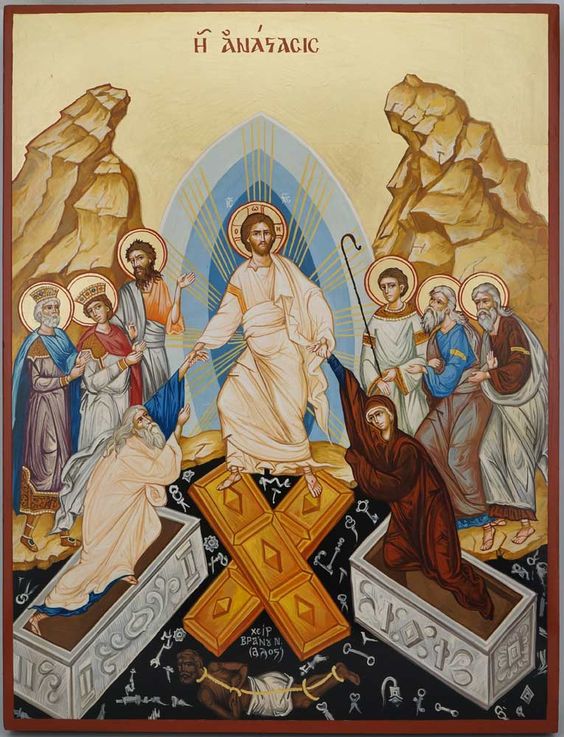
But as we see with the Paschal liturgy, Jesus Christ descend into the land of the dead. Here, He is the prophesied conquering Messiah, trampling down the doors of Hades and plundering the land of the dead for the souls residing there since Adam. He broke down the doors of Hades, bound the devil, and looted it. Then, He arose victorious.
What we often miss about the Resurrection is that in the ancient world it was tradition that when a king or emperor took a foreign kingdom, they plundered it and then circled it for a period of time to solidify their victory and to show the ransacked kingdom who was now in charge.
Jesus does a similar thing, conquering death and arising from the grave, bringing those souls in Hades with Him, but they go ahead of Him as He circles the kingdom that once belonged to death.
He comes to the disciples adorned with His crown and His trophies. Yet, they are not jeweled crown or golden trophies. He bears for His disciples His wounds, the stigmata on His hands and feet, and the spear-pierced side He shows to them.
These are Jesus’ trophies, bearing them proudly having arisen victorious from the land of the dead. Jesus demonstrates that woundedness is an essential quality to the spiritual life.
His wounds are laid bare for all to see that we might know that it is through His wounds and through our wounds that we can become united to each other.
This is θέωσις.
The rest of the Lord on the seventh day of Creation was a type of Sabbath, yes, it was a type of stillness of Creation experienced by the world during those three days of Christ’s plundering Hades. The rest of the Lord, through the lens of Resurrection is, now, an invitation to sit with Him in our woundedness, to weep with Him, to feel His embrace for He is love.
This is where we heal.
We cannot do anything to heal ourselves, no amount of prayer, almsgiving, or fasting can actually enter into our wounds and sanctify them but by the power of the Holy Spirit.
For me, this has been a slow-motion prodigal son moment of not simply repenting of my many sins and prodigal living, but by returning to home, some of us may be returning to the very place that began wounding us, be it from childhood trauma or patterned behavior influenced by the broken people that raised us.
I doubt I am alone in saying this, but the house that raised me was unstable on its best day and it is really, really difficult to feel those memories that are locked in the skin like shrapnel. I know that there are people who grew up in a proverbial war zone as children and those scars fester. We grow up without having a proper reflection of the love of God the Father, a compassionate parent, or supportive family structure.
It kind of sucks to have to go into our past but for a lot of us that is where our bondage began and remains. New life in Christ awaits us all and liberation in Him is free. That does not mean, however, that everything we’ve suppressed or even forgotten is shed by the baptismal waters. Some of it, sure, but in my experience, it is the illumination of Christ that helps us—or forces us—to shine a light on that which still binds us.
He is going into our Egypt and pulling us out. And like the Hebrews it may seem better to stay in a familiar slavery than walk into an uncertain (eternal) reality.
It is by God’s grace that I have been digging into my past as of late. Entering into the events that scarred me, the wounding traumas, and the voices in my head convincing me I am unworthy. These voices are from without but sound exactly like me! See, I have identified with these voices and traumas so much that new creation means that I have to die…
These parts of me have to be crucified otherwise I will be serving an unconscious master.
A master who is always disappointed in my efforts.
A master who loves in exchange for service.
A master who is angry, inattentive, and acts like my problems are my own to solve.
It hurts to look back and realize you were made to feel bad for not being able to do your caretaker’s job. It stings and is like a lance piercing your side. What’s worse is that a lot of don’t even recognize that we’re serving this master. We can trick ourselves into believing we are living our own life, self-determined with a little spite.
You can run on spite for a long time, but it is like filling your gas tank with nails.
The only way out of this is using those nails to crucify the self.
It… is… really… really… difficult to do this. We’ve been hurt for so long. Sometimes we don’t even know the source of our trauma or wounds. We don’t realize we’re unconsciously becoming the very people who neglected and hurt us. It’s by God’s mercy we’re shown even a little bit of that, and it is God’s grace that it doesn’t just destroy us to recognize that the reason we are becoming the people that hurt us is because we’re serving them, voluntarily or involuntarily.
They’re in our hearts, our minds, and our bodies.
They’re in our very souls.
Spiritual perfection, θέωσις, is accomplished through the cleansing of our souls; our hearts, minds, and our bodies. We ask for God’s mercy in helping us do this, because it is God Who purifies us, for it is He Who we are becoming united.
We become united to Him by likening to Christ in submitting to God. The synergy of surrendering our will to His and taking the walk to Golgotha. There, we are crucified with our Lord.
I’ve been wondering what this looks like for years now. I love the idea of dying to self, the remembrance of death, self-denial, everyday martyrdom. What I have not understood for some time was that this is much more difficult, and mundane, than one might think.
When I think of crucifying the self I think of this grandiose ritual where I say particular prayers and am covered in a sack and beaten with socks filled with batteries then made to carry a cross around the church seven times and finally symbolically crucified in front of everyone like I’m on display in a stockade.
That would be so much easier than what dying to the self and resurrection really requires.
The master who neglected and hurt us is not supposed to be our master anymore. Because Christ is our Master. “No one can serve two masters. Either he will hate the one and love the other; or else he will be devoted to one and despise the other” (Matthew 6:24). We cannot serve both God and our unconscious influences that enslave us through bitterness and resentment (or Mammon, if you’re into the whole brevity thing).
So, how do we put to death the old man?
How do we serve Christ as our Master?
Well, think about it… if we are unconsciously becoming like the people who hurt us by serving them, then we die to self by intentionally becoming like Christ. Who told us to love our enemies; Who told us that this is the Way to perfection, the perfection of the Father.
It’d be nice if the path to perfection involved being beaten by batteries, but it doesn’t. Dying to self involves a radical change of heart where we begin forgiving those who have wronged us. Forgiving our caretakers for not doing their job. Forgiving our friends for betraying our trust. Forgiving our loved ones for not catching us when we were falling.
And forgiving ourselves for the wrong that we’ve done, the wrong we’ve done to others and the wrong that we’ve done to our own minds, bodies, and hearts.
The wrong we’ve done to our souls.
But we forgive what we’ve done precisely so that we can continue forgiving others. When we forgive others, we are slowly building the strength (and it takes a lot) to begin interceding on their behalf. Honestly, sometimes intercession can lead to forgiveness if it’s too difficult!
Praying that God has mercy on those who have hurt us, those who we resent… those we hate.
It’s a transformative experience that is a part of the process of θέωσις, wherein we soften our hearts to reflecting the mercy that God grants us. Spiritual perfection is in embodying the mercy and compassion God has for everyone.
The kind of love that is exemplified in His greatest sacrifice: death on the Cross.
That sacrifice we are called to make as well as His followers!
We are not dying in the same way, because “we have been sanctified through the offering of the body of Jesus Christ, once for all” (Hebrews 10:10). The sacrifice that Christ made is nothing that can ever happen again. Death is defeated and so there is no need to defeat death. Nor is there need to fear death. We fear death, though, if we didn’t fear death then we’d forgive those hate and wrong us.
We’d pray that God forgive them, that God has mercy on them, and that God saves them.
That’s what we’d do if we didn’t fear death. But we do. We do and this is why we have trouble confronting death through forgiveness. Even with the promise of new life, eternal well-being, lying on the other side of death we fear it.
“You of little faith, why [do] you doubt?” (Matthew 14:31).
“Whoever has died has been freed from sin! But if we have died with Christ, we believe that we will also live with him; knowing that Christ, being raised from the dead, dies no more. Death no longer has dominion over him! For the death that he died, he died to sin one time; but the life that he lives, he lives to God. Thus, consider yourselves to be dead as regards sin, but alive to God in Christ Jesus our Lord” (Romans 6:7-11).
Pascha is a celebration of Christ’s resurrection from the dead. Pascha is the celebration that we are no longer under the dominion of death nor are we enslaved to sin. In Christ we are able to see clearly. That means not always seeing what we want to see, but what we need to see,
“For with you is the fountain of life;
in your light we see light” (Psalms 36:9).
In the light of the glory of God we are called to life by allowing His light to shine on our enemies, the just and the unjust alike. God does not need our permission for the sun to rise on the unrighteous, but by conforming our will to His: extending His mercy through forgiveness and bestowing compassion on those who have hurt us then we are becoming like Him.
We are dying to the self and being likened to Christ in our Resurrection.
Ο ΧΡΙΣΤΟΣ ΕΝ ΤΩ ΜΕΣΩ ΗΜΩΝ! ΚΑΙ ΗΝ ΚΑΙ ΕΣΤΙ ΚΑΙ ΕΣΤΑΙ
 Witness, NM