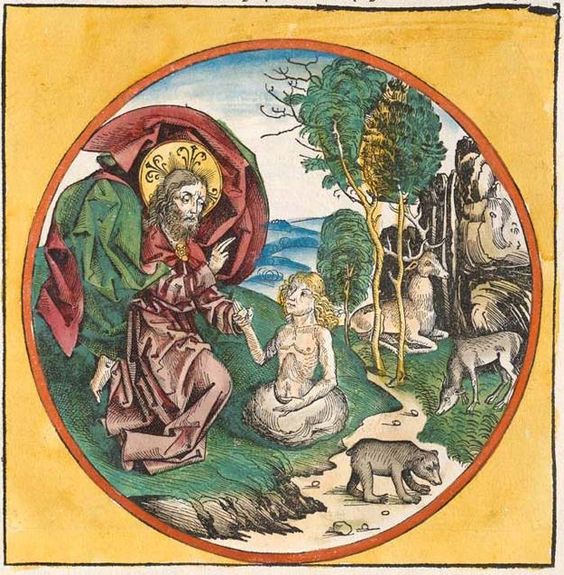
Paschal Reflections on Creation
“And God said, ‘Let the earth bring forth a living creature according to kind, quadrupeds, and creeping things and wild animals of the earth according to kind.’ And so it happened. And God made the wild animals of the earth according to kind and the livestock according to kind and all the creeping things of the earth according to kind and. And God saw that it was good.
And God said, ‘Let us make humankind according to our image and according to our likeness, and let them rule over the fish of the sea and the birds of heaven and the livestock and all the earth and all the creeping things that creep upon the earth.’ And God made humankind; he made him according to the image of God; he made them male and female.
And God blessed them, saying, ‘Increase and multiply, and fill the earth, and gain dominion over it, and rule over the fish of the sea and the birds of the heavens and all the livestock and all the earth and all the creeping things that creep upon the earth.’
And God said, ‘Look, I have given to you every herb that has sowable seed that is upon all the earth, and every tree that has sowable seed in its fruit will become food for you, and for all the wild animals of the earth and for all the birds of the heavens and for every creeping thing that creeps upon the earth that has life in itself. And all green fodder will be for food.’
And so it happened.
And God saw everything that he made, and look, it was very good! And there was evening, and there was morning, the sixth day” (Genesis 1:24-31).
The ontology of man is revealed on the sixth day. We are made after the creatures of the earth, which are made by the Word of God.
What sticks out for me is that man is given dominion over the earth, the birds, the fish, the wild animals, and the livestock. I was once speaking to a monk about this, and he explained to me that this dominion is to be understood as a stewardship. Man is not lord of the earth, for we believe that God is the Lord and Creator of all things, as demonstrated through the Creation narrative, but man is given a special place in God’s work.
We are to be stewards, much like the parable of the talents, man is given a responsibility to take care of all creatures. We are to use the herbs and the trees to feed the ensouled creatures that are not made in God’s image.
Immediately, we see that there is something different about man, being made in the image and likeness of God. Man is therefore a triune being, spiritual, physcial, and ensouled.
We are mind, body, and spirit in reflection of the Trinity.
Father, Son, and Holy Spirit.
This imaging inherently sets us apart from other created beings, as shown in the Scripture, and the order of Creation continues to play a part in our understanding of the structure of God’s providence. Man was made to attend to the earth and the things in it; man was made to serve, “Whoever wants to become great among you shall be your servant. Whoever wants to become first shall be slave of all. For the Son of Man did not come to be served, but to serve, and to give his life as a ransom for many” (Mark 10:43-45).
The same monk who explained man’s role as steward in Creation went onto to say that we abused this role through the Fall, pitting Creation against itself and ultimately believing that the world serves man, rather than the natural institution of God. I want to suggest that by declaring that we are descended from a common ancestor of the ape family then we are implicitly shirking our duties and further corrupting the likeness of God within us. By declaring ourselves one with the animals then we are rejecting the responsibility humankind was given by God.
Why is this important?
Well, we have been looking at Creation in relation to Pascha, the passage from darkness to illumination; from ignorance to knowledge; from slavery to freedom.
As such, salvation is tied to our anthropology.
The Greek saint, Nectarios of Aegina, alive during the mass-propaganda of the Darwinian theory of evolution, sought to refute this erroneous way of thinking writing the book, “Sketch Concerning Man.” The anthropological Christian work is particularly critical of nineteenth century theory as well as considerable familiarity with the evolutionary sciences.
St. Nectarios writes, “The followers of [the derivation of man from apes] are ignorant of man and of his lofty destiny, because they have denied him his soul and Divine revelation. They have rejected the Spirit, and the Spirit has abandoned them. They withdrew from God, and God withdrew from them; for, thinking that they were wise, they became fools…
“If they acted with knowledge, they would not have lowered themselves so much, nor would they have taken pride in tracing the origin of the human race to the most shameless of animals. Rightly did the Prophet say of them: ‘Man, while in honor did not understand, but joined the beats and became like them’” (Sketch Concerning Man).
The saint continues, “The harmony that exists between man’s body and his rational soul is so perfect that the careful observer will magnify in astonishment the extreme wisdom of the divine Creator, Who made all the bodily members compatible with and capable of fulfilling the demands of the soul. What purpose would man’s brilliant intellectual thoughts have if they could not be externalized through the body? What would be the purpose of man’s intellect, mind, spiritual powers, feelings, emotions, and the entire ensemble of spiritual qualities that distinguishes him from all the irrational animals, if man was just another animal?
“Man advances toward perfection daily. Man not only looks after himself, he is concerned for the well being of all of humanity in general, and he improves both himself as well as animals…
“Man, this mysterious being, was created by God as the pinnacle of creation, in order for him to acquire knowledge of his Creator. In accordance to his great destiny, man was formed analogously. He received the honor of being fashioned in an entirely extraordinary and unique manner and was brought to life through God’s Divine breath. While all creation was brought into existence from nothing by a single phrase—‘let there be’—that externalized God’s volition, man alone had his body formed by the hands of the Divine Creator, only he received a living soul created through God’s inbreathing., and only he is made in the image and likeness of his Creator. What a marvelous creation indeed! What an honor for man! What a great destiny! Truly, his destiny is great, and honor is sublime; however, more marvelous is the manner in which his body and soul were created. Because he became the image and likeness of God and was created in order to live eternally and dwell in the same place as the heavenly angels” (Ibid.)
It is only by accepting our role in Creation that we are able to transcend this fallen world and follow Christ to eternal life. When we categorically reject the stewardship that we were given then all becomes relative. The intricate design of Creation, balanced and patterned after the Triune Creator, is seen as something from the Dark Ages.
This disposition, ironically, grants man the excuse to treat the world according to kind, becoming “vain in [our] reasoning, and [our] senseless heart darkened. Thinking [ourselves] wise, [we] became fools! (Romans 1:21-22). Without this pattern, which is imaged in our hearts because of our ontology, we are rudderless and give in to every kind of vile passion.
If we emerged from the animal kingdom rather than being placed atop it then all things are merely relative, the saint concludes, “Unfortunately, they who pride themselves on their resemblance to the animals seek to recruit new followers… they are looking for new diggers to help undermine the foundations of society and deprave mankind. Behold the unethical moral principles that they constitute their ‘civilized’ mission: ‘Pleasure,’ they say, ‘debauchery, and love are good; but so is hatred. The truth is good as long as it provides us with some enjoyment; however, deception, hypocrisy, and deceit are also good if they can help us increase our assets. Faith is good as long as there is something to gain from it; however, treachery is also good if it can secure for us greater profit. Marriage is good as long as it makes us happy; however, adultery is just as good when marriage no longer satisfies our desires. Life is good as long as it remains an enigma; however, suicide is also acceptable when this puzzle has been solved” (Ibid.).
The dignity and nobility of humankind is lost in the waves of relativism wherein we lose sight of our natural place in Creation.
How do we take care of the earth? Or do we simply mine it for resources based on our wants and desires?
Do we take care of animals, or do we farm them and hunt them into extinction?
Do we take care of each other, or do we use each other as depraved objects of our own self-satisfying whims?
Do we see the world?
Do we see its creatures?
Do we see each other?
It is important that we recognize God in Creation that we might recognize the spiritual process in which we pass from a state of darkness to more and more enlightened states of mind, body, and soul. We were made to live eternally and dwell in the same place as the heavenly angels. This is an affirmation of what our Creator made possible through His death and Resurrection. What was accomplished on the Cross was a restoration of man to our anthropological, eternal, being.
This would not be possible if our ontological origin was not in the image and likeness of God. For in Christ’s death, we are not simply justified by an imputed righteousness. If Christ’s death covers our sins with His blood, then a theistic evolution model would suffice for an anthropological perspective. However, this is not what is going on through His death.
Hades encountered Heaven by the descent of Christ into the land of the dead, and by His death He destroyed death. He rose from the grave, victorious over death, and all life was liberated from the tyranny of Hades.
Pascha is the celebration of moving from the slavery of death to the freedom of eternal life, which was possible by the Incarnation! Man had become deprived of the grace of God that was his by his creation; humankind abandoned God through the Fall, yet we were no less made in God’s image.
It was the likeness that became distorted, but our nature was not affected. We did not become naturally sinful; we came under the dominion of sin. We became at odds with the world. We left our post as stewards of Creation to become our own God, without God. And in so doing, we became mortal.
God’s sacrifice, dying on the Cross for us, reconciles man to God by delivering man from our mortality; His death broke down the obstacles that were keeping man from living eternally, dwelling with the angels. His death was eschatologically restorative, not innovative in the sense that we were fashioned for eternity. Therefore, when we reject the image of God, we are rejecting eternity.
Like the first man.
So, what is demonstrated to us through man’s creation and the new creation in Christ, is that to follow God, to become united to Him, and to pattern our life after the Triune Maker of the Universe is to sacrifice. We are to sacrifice ourselves for the good of others, and the creatures that were crafted before us, for children of God were not fashioned to be served, but to serve, and give our lives for others.
In our own lives there is ample opportunity to embody the true humanity that is imaged in our hearts, our minds, body, and souls. We must be willing to step outside what and who we think we are that we may come face to face with the Truth, and that is we are human, made in His image and likeness, destined for eternity and advancing toward perfection daily.
Perfection is exemplified by Christ on the Cross and commanded to us by Him, to be perfect as our Father in heaven is perfect: to love even our enemies.
We are not simply animals or somehow descendants of a common ancestor, because we are called and have the capability of being much more than how our beastial instincts manifest in selfishness, pleasure-seeking, hatred, and hypocrisy that the ‘civilized’ world tells us is good.
We are called to love one another and in this we find a true sacrifice. Love: setting aside our desires, discomfort, and even our plans to actively and joyfully take up the work of caring for those around us.
We are called, as we enter Holy Week in the Orthodox Church, to become like Jesus Christ, entering Jerusalem as a humble servant, and humbly serve.
We are not animals, chosen by chance to emerge from the grasslands and develop spiritual systems to uphold when it is convenient or until we deplete the pleasures found in them. We are made in the image and likeness of God.
We were given a special place in Creation as its stewards. We were given a special place in Paradise as, naturally, walking with God, because we are His own. And even in our abandonment of our special place with God in His Creation, we were worth saving, pulling from darkness to light, we were worth the ultimate sacrifice of God dying so we could be with Him, eternally.
We were created for eternal life.
We were created to commune with God.
His Passion was utterly and totally for us. His Passion was for us because we are His children, His friends, and His stewards.
He came not to be served, but to serve, and give His life as a ransom for His own.
We were created not to be served, but to serve, and give our own life to be re-made in His likeness, icons of the Father’s love, mercy, and compassion that He has for all Creation, for all Creation is His, and all Creation is His revelation.
So, let us take from the Scripture and the Spirit’s call to re-embody our natural dignity and nobility. Let this be for us a motivator to stop using the world according to our whims and desires, self-seeking and destroying others by our greed, deceit, and lust. May the Spirit lead us to spiritual perfection as a matter of course, leaving behind the darkness of the wilderness that we falsely believe bore us. May we leave the wilderness and, likened to Christ, enter Paradise. To serve. Selah.
The sixth day.
Ο ΧΡΙΣΤΟΣ ΕΝ ΤΩ ΜΕΣΩ ΗΜΩΝ! ΚΑΙ ΗΝ ΚΑΙ ΕΣΤΙ ΚΑΙ ΕΣΤΑΙ
 Witness, NM