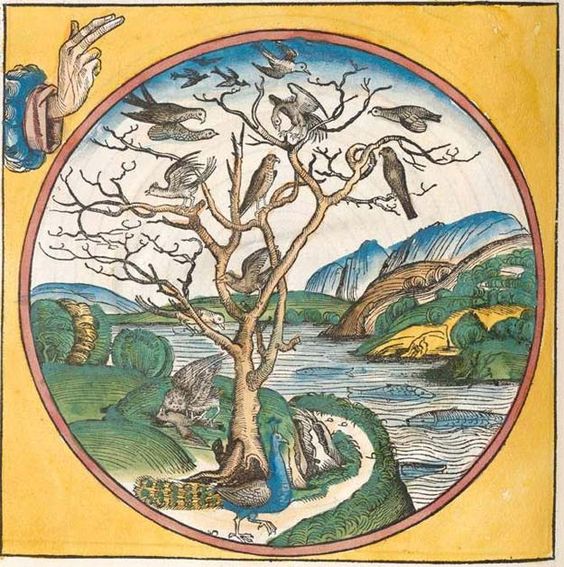
Paschal Reflections on Creation
“And God said, ‘Let the water bring forth living, creeping things and birds flying above the earth in relation to the firmament of the heavens.’ And so it happened. And God made the very large fish and every life of living creeping things that the water brought forth according to their kind and every bird with wings according to kind. And God saw that it was good. And God blessed them, saying, ‘Increase and multiply upon the earth.’ And there was evening, and there was morning, the fifth day” (Genesis 1:20-23).
The waters have been divided and nourish the earth, bringing the greenery of herbs and trees to fruition, each seeding according to their kind. The waters and the sky, having once taken up the same space, now resting as mirrors to each other as well as reflecting the heavens and the earth. The flowers of the earth, in turn, reflect the garden of the sky. The blooming luminaries setting the darkest corners of the firmament ablaze with the light of God.
Yet, even with the angelic choirs ruling over the luminaries in the heavens the heavens and the earth are still bereft of the life of the living. Yes, the trees and herbs are alive, but not in the same way that ensouled creatures are alive. Thus, the gathering of the waters forming the Seas and the unveiling of the dry land called earth are filled with creatures by God’s Word.
We see that, with the hanging of the stars in heaven, God has radically changed Day and Night, revealing to us that there is nowhere on earth that is not filled with His glory nor is there anywhere we can go that is not illumined by the receptacles of His light in the heavens. Even in our darkest moments there are constellations populating the firmament that draw us to Him, for what we see in them is His light.
By the fifth day of Creation, God reveals to us that there is nowhere we can go that is not in His Presence, nor is there anywhere He won’t go to be with us. As the earth turns from morning to evening to night, His luminaries rejoice in His Presence, drawing our attention to Him by the His light that they reflect.
While the birds of the air have an internal mechanism that guides them from the cold seasons to the warm seasons, flying North and South, following His light, naturally, we have lost that homing beacon through the Fall. This natural, seasonal migration, is reminiscent of the Paschal mystery, passing from darkness to light and in light, following that light further and further.
Man has lost this natural capacity, so to energize that aspect of ourselves, we turn to His firmament, the very expanse called heaven that the birds, naturally, point our attention to. The birds, we might see, are fixed in the air as a reminder of God’s covenantal relationship with man. Though, man has not been formed, the birds demonstrate God’s promise is eternal, and as such, covers time and space, backwards and forwards.
The birds are so set in the sky as like angels, messengers to earth, symbolizing the promise God makes to man from Noah on to the waters of the Jordan.
The birds, in a way, are pointing to the Spirit, as they now pass over the waters of the deep.
The Trinity is patterned in Creation and thus always points to God, specifically, the Second Person of the Trinity, His Word. The hypostases of the Father and the Spirit, in action, reveal the Son.
So, when we talk about divine energies we are, in fact, talking about one energy, or divine action. This is because there is a single Divine essence: The Trinity. However, reflecting the διαίρεσις (diaíresis), or counting by division, as we have discussed previously, this one action is diversified through its relationship with and in Creation.
It is in this way that the Spirit is managing the οἰκονομία (oikonomia), or divine economy, by His action. The οἰκονομία is seen in the gathering of the Waters, the greenery of herbs and tress, the luminaries of heaven, and now seen in the blessed creatures of the earth, being commanded to go forth and multiply.
This is not to say that the fish and the birds are ontologically the same, only that they have the same ontological origin. The Trinity is Three Persons, unified, therefore in Creation we see a similar pattern of realized distinctions within it yet inseparable in relation to their origins. This may seem like we are skipping ahead, but man’s natural state is to be in communion with God, to be in Christ.
Man is a microcosm of Creation, being both the heavens and the earth: body and soul, physcial and spiritual. Man is made in God’s Image which is why the heights of heaven, and the birds and luminaries that draw our attention to them; and the depths of the Seas and the fish that draw our attention to them, are working in tandem illustrating the covenantal relationship of man and God that is the foundation, or the firmament, of our salvation.
Therefore, we must acknowledge that not only are the birds and the fish good, but they are also created beings revealing something about God, the benevolent Creator Who has an indescribable essence. But if they become distractions or obstacles, much like the sun, moon, and stars become for some of us, this is what we must overcome. If we look at this in relation to our salvation then we are tasked with plunging into the depths of our being, essentially unfathomable as we are created in God’s image.
It can be quite disconcerting to dive into our inner worlds and be plagued by the litany of creatures within, traumas and unconscious mental patterns emerging similar to fish, unable to be held or tamed. There is a want to become distracted by them, or a temptation to identify with them rather than seeing them as created things. Things done to us and done by us, lying beneath our conscious awareness, darkened by our refusing to bring them to the light.
When things are really confused then we may feel the need to allow these fish to lead us to parts unknown rather than allowing these fish to be and diving deeper into our own depths that they may be touched by the light of God’s glory. The thing is, our depths have been touched by the glory of God by the passing over of the baptismal waters by His Spirit, again there is nowhere we can go that is not lit by His Presence.
We are to dive into the depths of our being reminded by the fish that are there that we are good. That we are created by God, in His image, and while we are complex creatures, we need not confuse our identity with the things that we hide, involuntarily or voluntarily, but to be fully realized in God is to brings these things to the surface.
God creates the fish, turning our eyes to the depths of the earth then to the firmament He calls our attention by speaking birds of the air. These creatures, too, and we see it with the whole glass of the firmament tempts us to evade God’s brilliance by worshipping created things.
I think this has to do with our fallen state, that it is easier to gaze upon His created works and worship them rather than allowing them to draw us closer to Him. This is because we are so far away from Him by our hiding things in the darkness, by our rejection of Truth and that which is true within us, by our continued defiling of the image of God within us we are eager to worship that which is created rather than the Creator Himself.
The visible instead of the visible.
The limited rather than the limitless.
The created over the uncreated.
Ironically, that is precisely the purpose of the created world, to draw us closer to the Creator of the world, because, to quote Fr. John Meyendorff, “The Church is not simply a society of human beings, associated with each other by common beliefs and goals; it is a koinonia in God and with God. And if God Himself were not a Trinitarian koinonia, if He were not three Persons, the Church would never be an association of persons, irreducible to each other in their personal identity. Participation in divine life would be nothing more than a Neoplatonic or Buddhist integration into an impersonal ‘One’” (Meyendorff 174, Byzantine Theology).
We are called to a higher communion than with the created things of this world, if we are drawn naturally to God by the beauty of the world: the Seas, the mountains, the stars, and the birds then that is a proper disposition, however I believe that man is rather afraid of a close relationship with God and because of this fear man would rather commune with created things.
There is nothing wrong with an appropriate appreciation of created things, but if we approach created things with our own purposes and drives then we are falling into idolatry. This is how things lose their God-given texture and become sinful: lust, greed, wrath, etc. emerge from a similar idolatrous placement of created things within our mind and desire.
Idolatry does two things, primarily.
First, when we focus on created things so much that we obfuscate the rest of Creation we are either deifying the created thing, such as the sun or the moon, or deifying ourselves in a form of pride. Second, focusing our minds, bodies, and souls on a particular object of Creation corrupts our vision in that we are unable to bear witness to the intricate, complex mechanics of the οἰκονομία.
God is revealing Himself to us through Creation. He reveals Himself through the pattern of the Trinity: The Father does all things by the Word in the Holy Spirit. One God, three Persons, united in essence and hypostatically distinct.
The Trinity reveals the Son in Creation by Word letting opposites be with their tensions being held by the management of the οἰκονομία in the Spirit.
We’ve seen this every day so far in Creation: the making of the heavens and the earth; the division of the waters by the firmament; the gathering of the waters, dry land, and trees; the fish and birds.
This created order is pointing us to the Eternally-Begotten Son, Who is eternally Incarnate by the (the Spirit) and the Theotokos. Creation is a pattern, revealing the hypostatic union of Christ.
Unified and unconfused.
The Word of God is the ontological origin for all things, visible and invisible. That which is visible is inherently pointing to the lover of Man, Who is the Incarnate Word. Recapitulation in Christ is the subtle goal implicitly defined in Creation; we are all moving toward Him, to be with Him and in Him. The days of Creation slowly unveil this Paschal mystery of passing from darkness to light, from ignorance to knowledge, from confusion to Wisdom, from relativism to Truth.
Just as the birds of the air and fish of the sea migrate according to their kind, traveling long distances for more suitable environments we Who trust in Christ are moving into more suitable environments, deeper understanding of self, and more subtle heights of ascendant reality. We are witnessing the revealed mystery of Pascha before us as well as moving from the first creation to the new creation, as God brings Creation into Himself by assuming flesh.
Christ’s Passion, His kenotic love for mankind, is more and more defined by this process of διαίρεσις. He divides the waters, the earth, the plants, the fish, the birds. All of them originate from the Father by His Word and all of them being unified, yet unconfused, in the Spirit.
The fish of the waters and the birds of the air deepen our understanding of God’s Word and the salvific nature of His Incarnation. They are brought forth and blessed by His Word, ‘increase and multiply on the earth.’ The seeds of the fish and the birds all go forth according to their kind, counting by division, in reflection of the Trinity Who spoke life into them. The ensoulment of these creatures demonstrates a foreseen and foreordination of the dynamic orientation of creation toward its teleological goal: The Incarnate Logos.
The fifth day.
Tomorrow, we will continue our exploration of man and our burgeoning place in Creation on the sixth day.
Ο ΧΡΙΣΤΟΣ ΕΝ ΤΩ ΜΕΣΩ ΗΜΩΝ! ΚΑΙ ΗΝ ΚΑΙ ΕΣΤΙ ΚΑΙ ΕΣΤΑΙ
 Witness, NM