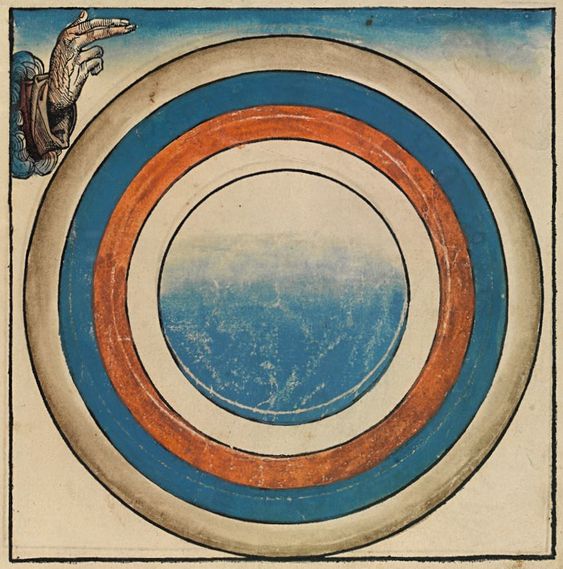
Paschal Reflections on Creation
“And God said, ‘Let the water that is under the heavens be gathered together into one assembly, and let the dryness appear.’ And so it happened. And the water under the heavens was brought together into their assembly, and the dryness appeared. And God named the dryness earth, and the assemblies of the waters he named seas. And God saw that is was good. And God said, ‘Let the earth sprout fodder plants, sowing seed according to kind and according to likeness, and fruit-bearing tree making fruit whose seed is itself in the tree, according to kind in regard to likeness upon the earth.’ And so it happened. And the earth brought forth fodder plants, sowing seed according to kind and according to likeness, and the fruit-bearing tree making fruit whose seed is itself in the tree, corresponding to its kind upon the earth. And God saw that it was good. And there was evening, and there was morning, the third day” (Genesis 1:9-13).
The third day of creation has been this obstacle for me, conceptually, because I believe that what is written is true.
Now, we can state that claim without necessarily believing that it is real for the simple fact that in sacred texts what is true is often not historically accurate. It doesn’t need to be. However, what I find difficult to do is comprehend this Creation narrative solely allegorically because that approach can become subjective and ungrounded. I think that if we are to comprehend the profundity of Creation, and by extension God, then we need to trust God.
That means taking the days of Creation like steps where we are walking with God as established with the firmament’s royal road, and choosing to allow our faith, our enumah, to convict us enough to keep walking. I believe that it is within this dialogue between us and God that transformation occurs. We are not automatons who believe because it is written, we believe out a love grounded in the reality of His revelation.
It is difficult to grasp the idea that plants are sprouting without the Sun, or the waters are moving without the moon; not only that but it seems we are dealing with a sola-geo model of the cosmos (for now).
What are we to make of this, really?
What this is meant for us is to become like the waters on the third day, drawing us into a deeper relationship with God as He reveals Himself to us as the source of all life.
To begin inserting our worldview and contemporary understanding, I believe, is going obfuscate this grand revelation. And this will obfuscate our ability to know God and to be known by God. That being said, it is likely that on the third day one might find themselves wrestling with God (I know I did), because His miracles are more pronounced and tangible than they are on the first two days of Creation.
It is interesting that when God made Himself known to us through the Incarnation it was the miracles and healings that He performed that hardened the hearts of those who witnessed Him (Mark 5; Luke 4; John 7; Matthew 12; etc., etc.).
The revelation of the third day stops us in our tracks like Jacob, and to wrestle with God is to—exemplified by Jacob’s story—come face to face with Him. I would suggest that it is in those moments that we stand before Him that we have two options: to die to the self and be reborn through faith by His grace or to die to Him, hardening our hearts and turning away from His glory.
Though He led us from the land of darkness, giving shape to our depths and fashioning from our void, we are still tempted to become like God without God, turning from light to darkness.
We see His gathering the waters into a firmament then gathering the waters to reveal dry land, making way for the greenery of the earth to sprout forth without the Sun, without the seasons, just because His Word made it so.
Do we allow His Word to make it so?
Do we allow His Word to make us so?
Or do we turn away from struggling to come face to face with God, content to craft the world in our own image, suitable to our own imaginings and the traditions of men?
The third day of Creation, if we allow it to, draws us deeper into relationship with God, bearing witness to His divine energies at work in everything.
Thus, the Paschal mystery unveils itself further like the waters reveal the dry land from the deep.
Salvation is a process in which we are likening our image to God, precisely because we are made in His image, and we might see a profound type of salvific patterning unfold on the third day: the waters on the earth reflected Night and they reflected Day.
The Spirit passed over the dark waters, interpenetrating them with His Presence and preparing them for God’s glory through the Son. And now, the baptismal waters are gathered by God, just as the baptismal waters dry on our skin, yet they have entered into us just as they gather on the earth and interpenetrate its soil energizing the coming green herb, grasses, and trees.
If we look at the waters that covered the earth as a mirror, then perhaps we can see them reflecting the essence of God by His energies at work in Creation. It is the same with baptism, the Spirit passes over the water, interpenetrating the faithful, and they arise from the font newly-illumined and instead of having a film of the saving waters cast around them, the waters are gathered and by faith the believer brings forth good works by God.
It is the relationship that is patterned in Creation. The heavens and the earth, the meeting place of the firmament between them; the waters gathered, and the dry land appears, the fruit of the earth sprouts by their synergy.
This pattern is covenantal.
And we enter into the covenant by faith, and our faith is energized by God which produces works and our works energize our faith. These are the seeds yielding according to their kind.
This is the point of salvation, we are in relationship with Christ, being unified to Him and thereby being likened to His Image. Meaning we are becoming icons of Christ.
The seeds therefore are yet another indication of counting by division which we saw on the second day.
The philosophy of the counting by division, in Greek the word is διαίρεσις (diaresis) which we can understand properly as a means of identifying, classifying, and defining broad concepts by dividing them into two sub-categories and so on and so forth until a proper, or desired, definition can be acquired. In the theological sense, this form of logic is espoused by the great Apostle, in his letter to the Corinthians,
“Now there are various kinds of gifts, but it is the same Spirit. There are various kinds of service, and the same Lord. There are various kinds of works, but it is the same God who works all things in all” (1 Corinthians 12:4-6).
“Διαιρέσεις δὲ χαρισμάτων εἰσίν, τὸ δὲ αὐτὸ Πνεῦμα; καὶ διαιρέσεις διακονιῶν εἰσιν, καὶ ὁ αὐτὸς Κύριος; καὶ διαιρέσεις ἐνεργημάτων εἰσίν, ὁ δὲ αὐτὸς Θεός ὁ ἐνεργῶν τὰ πάντα ἐν πᾶσιν.”
St. Paul is illustrating what is demonstrated on the third day of Creation through his epistle to the Church at Corinth. Διαιρέσεις of the waters, gathered together, by the Word of God energizing the formless deep with movement. This is the Greek ἐνεργῶν or ἐνέργεια (energeia), the energies of God; His activity—His efficiency give movement to the waters.
The dark waters covered the earth and by God’s word divided and descended (you can’t kick water uphill), flowing into the concave depths of the earth. The waters become the Seas, the waters become the brooks, the streams, and the rivers of the earth mingling with the roots and nourishing the God-given herbs and trees.
The waters flow downwards, never overfilling, all being gathered in one body. Whether they evaporate and ascend to the waters of the sky, meet in lakes, mingle with other rivers, or find their way to the ocean.
It is a display of His divine energies becoming the undercurrent of His οἰκονομία (oikonomia). The divine economy of God encompasses all His dealings and interactions with the world through His energies.
To paraphrase the Apostle, there are a various kind of Seas, but it is the same Spirit that gathers them, drawing them into Himself, typifying the union between the people of Israel and the Gentiles becoming united in Jesus Christ through His Crucifixion.
Furthermore, it is the very waters that become a sort of reflection of His energies, becoming the undercurrent flowing into the trees, which are life.
It is in the meeting place of the waters and the burgeoning trees that we see what is to become of the unity of these people “baptized into Christ [who] have put on Christ. There is neither Jew nor Greek, there is neither slave nor free, there is neither male nor female; for [all are] one in Christ Jesus. If you are Christ’s, then you are Abraham’s seed and heirs according to the promise” (Galatians 3:27-29).
And this very promise is typified on the third day, “Let the earth sprout fodder plants, sowing seed according to kind and according to likeness, and fruit-bearing tree making fruit whose seed is itself in the tree, according to kind in regard to likeness upon the earth.”
It is upon the Cross that the new Israel was formed and Creation was restored through Christ and in Christ and by Christ we all take part in the promise that is eternal life, being brought from the land of darkness into light—ascending the heights of heaven by His glory and deepening our understanding of ourselves by the knowledge of He Who is Truth.
By taking part in that promise, we are truly Abraham’s seed, singular, Who is Christ thereby the seed of the Cross accords to its kind. We who follow Christ, merging into His death and Resurrection from the diverse waters of our unique lives, are reborn likened to His image and by continuing to liken that image to His we become the seeds of His tree of Life manifesting in the world. Reborn and sent out for our seeds to actualize; the uncreated energies of grace become manifest by our participation in God and being in the world.
So, we can see how the Seas are flowing into Christ’s death, all gathering into a single event, and then changing. They are passing through this eternal intersection and then, mirroring how they flowed into Christ, they bloom out of His death, Resurrected through the tree of Life.
The third day.
I believe this is quite possibly our introduction into the energies-essence distinction where we are shown how Creation, being created, cannot become like God in nature yet can become like God by His grace.
Creation begins as like a darkened mirror, reflecting the void, before God passes over it. Creation is begun as a face to face with God, knowing only in part, but knowing more and more as Creation is known by its coming to fruition.
Creation is a reflection of the essence of the Trinity, becoming realized through His energies flowing through and giving birth to new life in it.
In the heavens and on earth.
The divine economy begins its cosmic dance with the waters flowing and energizing the unveiled earth, the trees blowing in the breeze of the Spirit beneath the heavens, encased in the firmament. We are being brought out of darkness by God’s grace, moving from glory to glory, illumined and likened to His image. By faith we will continue our Paschal journey into the fourth day where our newly illumined and sprouting faith will be joined together with the luminous powers of the firmament.
Ο ΧΡΙΣΤΟΣ ΕΝ ΤΩ ΜΕΣΩ ΗΜΩΝ! ΚΑΙ ΗΝ ΚΑΙ ΕΣΤΙ ΚΑΙ ΕΣΤΑΙ
 Witness, NM