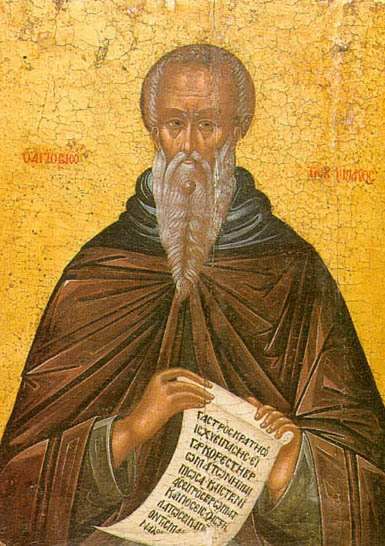
The Sunday of St. John Climacus
“Then one of the crowd answered and said, ‘Teacher, I brought You my son, who has a mute spirit. And wherever it seizes him, it throws him down; he foams at the mouth, gnashes his teeth, and becomes rigid. So I spoke to Your disciples, that they should cast it out, but they could not.’
He answered him and said, ‘O faithless generation, how long shall I be with you? How long shall I bear with you? Bring him to Me.’ Then they brought him to Him. And when he saw Him, immediately the spirit convulsed him, and he fell on the ground and wallowed, foaming at the mouth.
So He asked his father, ‘How long has this been happening to him?’
And he said, ‘From childhood. And often he has thrown him both into the fire and into the water to destroy him. But if You can do anything, have compassion on us and help us.’
Jesus said to him, ‘If you can believe, all things are possible to him who believes.’
Immediately the father of the child cried out and said with tears, ‘Lord, I believe; help my unbelief!’
When Jesus saw that the people came running together, He rebuked the unclean spirit, saying to it, ‘Deaf and dumb spirit, I command you, come out of him and enter him no more!’ Then the spirit cried out, convulsed him greatly, and came out of him. And he became as one dead, so that many said, ‘He is dead.’ But Jesus took him by the hand and lifted him up, and he arose.
And when He had come into the house, His disciples asked Him privately, ‘Why could we not cast it out?’
So He said to them, ‘This kind can come out by nothing but prayer and fasting.’
Then they departed from there and passed through Galilee, and He did not want anyone to know it. For He taught His disciples and said to them, ‘The Son of Man is being betrayed into the hands of men, and they will kill Him. And after He is killed, He will rise the third day’” (The Gospel According to St. Mark 9:17-31).
The Scripture reading for today brings us to the foot of God’s Holy Mountain, where moments previous Jesus had revealed His glory to the three disciples Sts. Peter, James, and John. This profound theophany rendered St. Peter dumbfounded in the Presence of God. The revelation that Jesus is the mooring rope between the heavens and the earth as well as Jesus’ own allusion to the Resurrection, not only His but our own.
This earth-shattering event revealed both Jesus as the Son of God, the second person of the Trinity and the Incarnation’s restorative mission, to reconcile man back to God and grant life-everlasting.
This Gospel reading is a microcosm of the Gospel itself: Jesus revealed in glory (con)descends from the top of the Holy Mountain at Tabor and walks in the midst of humans, He is met by believers and unbelievers alike, not thwarted in His ministry of reconciliation, salvation, and healing.
This event is typified by the prophet Moses descending from Sinai, his countenance shining with the glory of God, striking fear into the Israelites at the foot of the mountain. Jesus descends from Mount Tabor and is met by the crowd overcome with amazement, spellbound in awe reflecting St. Peter only moments ago.
They ran to Him to greet Him.
What is interesting is that Jesus may have still glimmered with a shadow of His revealed glory which filled the crowd with awe, but His Presence alone inspired the multitude to react, as if they were waiting for Him.
And so, they were.
The scribes, the enemies of Jesus, His disciples, and ministry are standing there arguing with His disciples. They stand amidst the crowd probably pretty satisfied with what has occurred.
Jesus approaches the scribes, first, asking them what they are arguing over.
Of course, He knows, and I wonder if we can allow this address to the scribes, which goes unanswered, to sit with us for a moment.
The scribes and disciples are discussing the latter’s inability to exorcise the demonically-possessed child who was brought by his father to be healed, surely because of the news that had spread of Jesus and His ministry.
Why I think this is worth pausing to reflect is because this is the profundity of the Gospel and the compassion of God exemplified.
Jesus had just revealed to three of His most close disciples that He is the New Adam, here to restore humanity to its rightful place in Paradise, eternal life. He reveals this cosmic mystery and tells the three to say nothing about this to anyone. God then descends the mountain, rebukes the unbelieving scribes into silence, and heals the boy.
The child represents our fallen human condition, living under the tyranny of death from birth; terrorized by the evil one seeking all the ways in which he can destroy us. The father explains that the child, mankind, has been living in the shadow of sin from childhood, alluding to man’s created nature not being evil, but how our nature was corrupted by the serpent. Thus, the father symbolizes the souls of all believers who suffer the world that God might save all.
The father’s love for his child is embodied in all believers who trust in God’s gift of salvation, the Truth of the Gospel, and the freedom that lies in Jesus Christ—praying for the souls of everyone that all might be saved. And so, Jesus allows the demon to convulse the boy in His Presence, to allow the evil one to reveal himself to all those who can see his cruelty and to reveal the faith of the father.
The father asks Jesus to have compassion on him and his son, to take mercy and Jesus tells him,
If you are able! All things can be done for the one who believes.
Immediately the father of the child cried out, I believe; help my unbelief!
I believe; help my unbelief.
If we can place ourselves in the role of the child, totally enslaved by the demonic world: deaf, dumb, and blind. The Serbian Saint Theophylactus writes,
“The evil one has no mercy for a child or an old man; for man or woman, but is eager to push all into the fire of lusts, or to draw them into the whirlpools of the world to destroy them. He always fights us with contradictories, like water and fire; if we escape a trap, he sets up another.” The fire of the passions rule us: anger and lust inflaming the flesh like hot iron and then the crushing seas of the world beat against us, the waters of anxiety and despondency. These enslave all of us if we are able to, with humility, evaluate ourselves.
And from childhood, too.
Not only did man, in humanity’s early maturation become corrupted by sin, but all of us have developed ways of seeing the world and modes of being formed in our childhood. It is a difficult reality to accept, but we become addicted and enslaved to sin as children and through this childhood development it becomes increasingly difficult to uproot the passions later in life. It is harder still, to even be aware of them.
And this is why we must rely on Jesus Christ, Who is Truth.
I wonder though, how many others out there are like me? How many believe that God can do anything, of course, for He is God after all… but perhaps He cannot heal me. He can certainly heal others, He can make the deaf to hear, the blind to see, the dead to rise, but can He bring me out of my addictions? Can He uproot my passions that inflame me, and can He calm the seas of dejection?
The conscious answer to this is, again, of course!
But it is a difficult task to believe it, fully, with the totality of our being. This is why we look at this father as beacon of a humble faith. I believe; help my unbelief!
Can we ask the same of God? Can we be brave enough to trust that God can truly heal us?
That is faith. And faith is cultivated, because faith can be lost.
His disciples asked Him privately, Why could we not cast it out?
So He said to them, This kind can come out by nothing but prayer and fasting.
The disciples themselves had lost faith. The disciples had been given this authority over unclean spirits and the power to heal as a free gift of God, yet they need to strengthen it, they need to nourish it by living piously. The disciples show us why we must be alert, be disciplined (1 Peter 5:8).
The Spirit can be grieved (Ephesians 4:30), the Spirit can be extinguished (1 Thessalonians 5:19), therefore we have a duty to cultivate the Spirit, growing in faith, by prayer and fasting.
On this Sunday of the Fourth Week of Great Lent, the Church commemorates St. John of the Ladder, who renounced the world at age sixteen and went to Mount Sinai, the very mountain where God’s glory shone upon the face of the prophet Moses. He set a course from this young age to ascend God’s Holy Mountain, abandoning vainglory and self-trust, surrendering his mind, body, and soul to God alone.
He put to death greed by his living a life of solitude; he subdued the flesh through fasting while not giving into the insidious temptation of vainglory. He remembered death, his own mortal flesh and therefore destroyed the temptation of acedia. He was freed from the sadness that leads to despair (2 Corinthians 7:10) and filled with the godly sadness that leads to repentance, the very sadness that arises in the self the single-minded remembrance of God.
He vanquished anger through obedience, following in the footsteps of the very Theotokos and St. Joseph, obediently submitting to God’s will.
It is written of St. John Climacus that from all his toil in his worldly sojourn he was granted by God the greatest of the virtues: humility.
St. John was rewarded for his longsuffering patience, obedience, and care. He was rewarded with precisely the virtue that the father of the possessed son demonstrated at the foot of the mountain toward Jesus, for He said to him, If you can believe, all things are possible to him who believes.
Our faith can wane, our belief can flicker, but Christ is the same yesterday, today, and tomorrow therefore St. John Climacus is an inspiring light, like the father in the Gospel, for all believers who seek to walk the narrow road that leads to eternal life. St. John Climacus points us toward the salvation of Jesus Christ attained through Christian ascesis. This is not to say that eternal life is won by the law, but our faith must be made unshakable through the mortification of our flesh.
St. John Climacus reveals to us, through his life, the fruit of ascesis and the crown of the virtues, which is humility.
We have this hope, a sure and steadfast anchor of the soul, a hope that enters the inner shrine of our hearts through the indwelling Holy Spirit and by this hope we are assured of the reward that lies ahead, the reward that comes from taking up the Christian ascetical practice on the Way.
Can we believe that God will heal us? That God will bring us out of our passions and instill in us the virtues that lead to eternity?
Can we ask God to help our unbelief?
We are all sinners; we are all addicts… We are all enflamed by the hot iron of passions and crushed by the tempestuous seas of the world. We are all sinners and that means we can all be saved. Everyone of us. That is the promise. So, we continue the great Paschal fast emboldened in our faith by prayer, taking up our cross and carrying it to Golgotha with our Lord, prepared to lay our life down for the love of God, letting go of who we think we are and the insidious sins that have sought to destroy us since childhood.
We can be freed from the passions that seek our life, by entrusting it to God.
We can be healed by God; we can be healed by believing we can be healed. For all things are possible to those who believe. Selah.
“With the rivers of your tears, you have made the barren desert fertile. Through sighs of sorrow from deep within you, your labors have borne fruit a hundred-fold. By your miracles you have become a light, shining upon the world. O John, our Holy Father, pray to Christ our God, to save our souls” (Apolytikion of the Sunday of St. John Climacus).
Si comprehendis, non est Deus
 Witness, NM