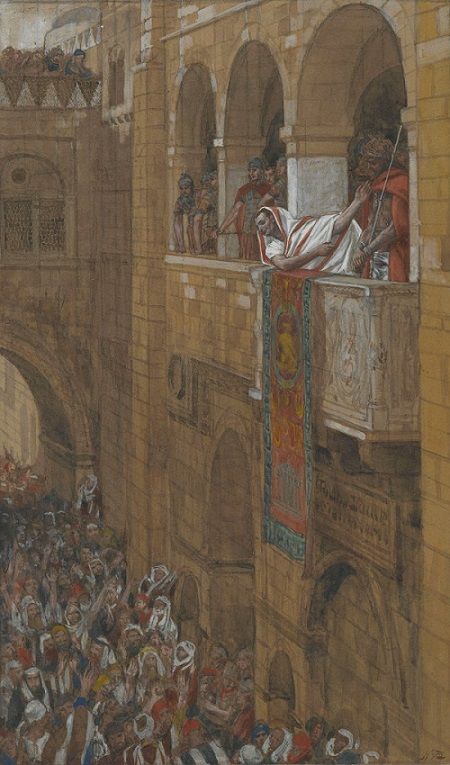
The Sunday of the Passion
“In the day that the Lord God made the earth and the heavens… And the Lord God planted a garden in Eden, in the east, and there he put the man whom he had formed. Out of the ground the Lord God made to grow every tree that is pleasant to the sight and good for food, the tree of life also in the midst of the garden, and the tree of the knowledge of good and evil.
A river flows out of Eden to water the garden, and from there it divides and becomes four branches. The name of the first is Pishon; it is the one that flows around the whole land of Havilah, where there is gold, and the gold of that land is good; bdellium and onyx stone are there. The name of the second river is Gihon; it is the one that flows around the whole land of Cush. The name of the third river is Tigris, which flows east of Assyria. And the fourth river is the Euphrates” (Genesis 2:4/8-14).
This, to me, encapsulates the entirety of the Biblical narrative: The Lord planted Eden in the east, and there He put man. Out of Eden there flowed four rivers, rivers can only flow downhill.
This is Paradise, God’s Holy Mountain, where the heavens and the earth meet. And it is where God put man. It is interesting that Eden was formed before man was placed in it by God; Paradise was awaiting Adam.
God created Paradise for man just as man was created for God.
The rivers flowed in four directions, out into the world below, prefiguring the Water of Life Who is Jesus as well as the four evangelists spreading the Word via His Gospel throughout the world.
We can also see the waters, branching and parting, massaging the soil making a path for the Word to condescend and enter into temporal reality. This water is doing the work of the Holy Spirit, nourishing and tilling the fertile soil of the earth, making straight the path for God, in this manner it prefigures St. John the Forerunner and Baptist.
The Life that descends from the Holy Mountain is foregone by Man’s disobedience to God and eating of the fruit of the tree of the knowledge of good and evil. Man falls, death enters the world, and death begets more death through the sons of Cain, but what of the other tree in Paradise?
What of the Tree of Life?
We’ll come back to that most sacred tree.
The Fall was an inevitable happening whereby Man’s nature is corrupted and we become mortal creatures. Death becomes our enemy and the ancestral sin passes down through the progeny of Adam and Eve; we are not tied to their sin; we are tied to the consequential corrupted nature of the Fall.
God saw Man’s choice to disobey and had compassion, for Man knew not what he was doing when he took from the tree. I wonder how many of us can relate to this sin, committed in ignorance of the consequences. I wonder how many of us have committed a sin, maybe even knowing it was a sin, but could never have imagined the fallout of such a decision.
God in His mercy allowed death to corrupt our nature, so that we do not have to live in this fallen state. We do not become crystallized in sin with no way to return to Him. He made garments of skin for Man (Genesis 3:20), because it is only through this mortal body that we are capable of repenting. This is what sets us apart from the fallen angels, because they were aware of the consequences of their disobedience and yet rebelled from God anyway. Man, on the other hand, had no idea of the cosmic ramifications of our sin, so God made garments of skin for us thereby providing a means for us to return to Him.
And so, Man is expelled from Paradise, [interestingly it is an angelic being called a Cherubim that is placed at the entrance of Eden with a flaming sword to guard the Tree of Life. The cherubim is the second highest ranking angelic order in the angelic hierarchy, and their function is to, basically, carry the throne of God adding emphasis to Paradise being atop a mountain and physically being close to God.] sent away from the Garden to toil for his food, to till the earth unto death, and like the Holy Spirit, this tilling would be preparing the coming of Life.
The spadework of humanity’s salvation passes down through the generations begotten by the First Man, through Seth, down through Noah, through Abraham, Isaac, Jacob, through David, through Joseph to the very Incarnation of God in the θεάνθρωπος and second Adam, Jesus, Who completes the work begun on the Holy Mountain through His Passion and restoring man’s nature through His very death.
It is crucial to recognize that Jesus’ ministry is completely focused on restoring man, to redeeming humanity. His miracles, exorcisms, and healing typify this main mission of liberation that Jesus takes flesh to realize through His Incarnation. Jesus does not take flesh to liberate a race or community from the Roman occupation or even the Pharisaical dominion of this period of Judaism. Jesus dons a garment of skin to liberate humanity from the works of the devil and the tyranny of death:
“It was fitting that God, for whom and through whom all things exist, in bringing many children to glory, should make the pioneer of their salvation perfect through sufferings…
Since, therefore, the children share flesh and blood, he himself likewise shared the same things, so that through death he might destroy the one who has the power of death, that is, the devil, and free those who all their lives were held in slavery by the fear of death” (Hebrews 2:10/14-15).
Here lies the mystery of this cosmic event, that Christ was both human and Divine, being born by the power of the Holy Spirit and the Virgin, the most blessed Theotokos, He emerged from her womb like everyone else. The difference between us is that He came into this world unlike anyone else, because another consequence of the Fall is that humans had to procreate (you don’t worry about that so much if you are immortal) and so we are all conceived in sin (Psalm 50:5), but He was not.
The death that we face, therefore, is a part of this corrupted nature that we are born into by no fault of our own, yet His death qualifies neither as just, satisfactory, or appropriate according to His nature, being both very God and very Man. He is never pitted against God the Father nor is He a substitute for our sins, but rather through this unconfused union, His being put to death by the Cross means that His nature interpenetrating death just as death had interpenetrated human nature, destroying once and for all the tyranny of humanity.
According to the Scriptures and tradition Jesus dies and, without losing His divinity, descends to Hades and breaks down the doors of the devil’s fortress, freeing those who had fallen asleep under the curse of Adam.
It is for this reason C.S. Lewis wrote that if anyone is in Hell it is because they chose to be there.
It is an early Christian tradition that states Golgotha, the site of the Crucifixion, was the burial site of Adam. When we see the Calvary Cross with a skull beneath Jesus crucified, it can be fairly assumed this symbolizes Adam.
Christ is lifted up on the Tree of Life atop the Mountain of Golgotha, the Cross beams, through the power of the Incarnation’s cosmic death, draw the four corners of the world into His Life. It is, in this moment, on the Cross, that we witness the redemption of the world; a reversal of the waters flowing from the meeting place of the heavens and the earth in Paradise, to the waters drawing into Life Himself, before flowing out from Him, once again.
The totality of Paradise is restored by the Tree of Life and the Incarnation’s death thereupon.
The Cross is the Tree of Life in the midst of the Holy Mountain, drawing us all near to God in communion and repentance. The Tree of Life abolishes the consequences of the Fall, it restores human nature to its original state, by the power of the Incarnation taking flesh.
So, we see that His death was unwarranted by His life, but by donning the garments of skin and abolishing the punishment of sin He opened the Way for us to Paradise. He did this through not only His suffering during these last days of His terrestrial life, but throughout His life He suffered the pains and humiliation of God taking the form of a creature, confronted with temptations and antagonized by His creation’s doubts and betrayals. He suffered for us, His whole ministry being the Passion bringing us to the Holy Mountain and giving up Himself that we may be united with God once again.
This is why it is dangerous for us to look at Him with too much emphasis on His humanity. In Christian thought, we must hold the tensions between two opposing forces lest we fall into heresy by overemphasizing the one to the degradation or undermining of the other. Jesus was not a revolutionary Who arose to prominence in the late period of Second Temple Judaism, a rabbi, exorcist, and prophet amongst other rabbis, exorcists, and prophets.
To look at Him as if He came to usurp an earthly throne for Himself would be accusing Him of just the same that the Jewish leaders put against Him at the Sanhedrin. To look at Him and see merely a man and a rebel, is to see Barabbas and call him Jesus. Jesus is a King, Who entered into this human occupation, humbling Himself, out of love, compassion, and mercy for mankind.
He emptied Himself to do the will of the Father; to become the work of God, and the Apostle calls for us to put on the same mind and do the same:
“Let the same mind be in you that was in Christ Jesus,
who, though he existed in the form of God,
did not regard equality with God
as something to be grasped,
but emptied himself,
taking the form of a slave,
assuming human likeness.
And being found in appearance as a human,
he humbled himself
and became obedient to the point of death—
even death on a cross.
Therefore God exalted him even more highly
and gave him the name
that is above every other name,
so that at the name given to Jesus
every knee should bend,
in heaven and on earth and under the earth,
and every tongue should confess
that Jesus Christ is Lord,
to the glory of God the Father” (Philippians 2:5-11).
The children of God are revealed in this way, that we exalt God by doing His will, we glorify His Name by coming to the foot of the cross, drawing near to Him on that Holy Mountain where His death destroys death. Every knee shall bend to the Lord, Who is the pioneer of our salvation, the salutary cure to our corrupted, fallen nature. For in bending the knee to Him we rise to glory with Him, just as He did not regard equality with God as something to be grasped neither do we grasp for equality with God as Adam once did.
We do this by letting go of our need to relate Jesus the man to our humanity, but rather relating our humanity to Jesus the Godman, Who took flesh and became like us that we might become like God. We have this one life and one body to repent, to turn away from the world, from the passions, and from disobedience to return home to God. We have this life to become, truly, His children by choosing to put to death Barabbas in our souls, self-emptying to become the work of God, crucifying the self on the Tree of Life to become united with God’s Holy Mountain, which was meant for us before time, now and ever, and unto ages of ages. Selah.
“Almighty and everliving God, in your tender love for the human race you sent your Son our Savior Jesus Christ to take upon him our nature, and to suffer death upon the cross, giving us the example of his great humility: Mercifully grant that we may walk in the way of his suffering, and also share in his resurrection; through Jesus Christ our Lord, who lives and reigns with you and the Holy Spirit, one God, for ever and ever. Amen.”
Si comprehendis, non est Deus
 Witness, NM