The Fourth Sunday of Lent
“And just as Moses lifted up the serpent in the wilderness, so must the Son of Man be lifted up, that whoever believes in him may have eternal life.
“For God so loved the world that he gave his only Son, so that everyone who believes in him may not perish but may have eternal life.
“Indeed, God did not send the Son into the world to condemn the world but in order that the world might be saved through him. Those who believe in him are not condemned, but those who do not believe are condemned already because they have not believed in the name of the only Son of God. And this is the judgment, that the light has come into the world, and people loved darkness rather than light because their deeds were evil. For all who do evil hate the light and do not come to the light, so that their deeds may not be exposed. But those who do what is true come to the light, so that it may be clearly seen that their deeds have been done in God” (The Gospel According to St. John 3:14-21).
None of us will find Paradise upon our repose if we continue habituating our heart, soul, and mind on Hades in this life. How much better off we would all be if we examined ourselves as if we were approaching the Chalice every day. How many of us are out there who can honestly say they have peace in their hearts and not a war between them and God?
What is that rules us?
If it is not God Who is our highest authority, then there shall be no peace to be found within or without.
For whatever rules us is our god and by being ruled by it we are conformed to its wishes.
Can we take time to see ourselves as God might see us? Can we confront what rules us with the light of eternity?
Can we look upon the bronze serpent in the wilderness and confront what rules us? Can we examine ourselves?
The Lenten season mirrors Christ in the wilderness, being tempted by Satan thereby purifying Israel, which He brings into Himself. The reading for this Sunday shows Jesus talking to a Pharisee named Nicodemus, who tries genuinely to understand the teachings of the Messiah. What Jesus illustrates by His own wondering of Nicodemus’ knowledge of the Torah is that these teachings have been with the Israelites since the beginning, even before the beginning. As Moses lifted up the serpent so must the Son of Man be lifted.
Jesus references the story in the Torah while speaking with Nicodemus, found in the first reading of this Sunday:
“From Mount Hor they set out by the way to the Red Sea, to go around the land of Edom, but the people became discouraged on the way. The people spoke against God and against Moses, ‘Why have you brought us up out of Egypt to die in the wilderness? For there is no food and no water, and we detest this miserable food.’ Then the Lord sent poisonous serpents among the people, and they bit the people, so that many Israelites died. The people came to Moses and said, ‘We have sinned by speaking against the Lord and against you; pray to the Lord to take away the serpents from us.’ So Moses prayed for the people. And the Lord said to Moses, ‘Make a poisonous serpent, and set it on a pole, and everyone who is bitten shall look at it and live.’ So Moses made a serpent of bronze and put it upon a pole, and whenever a serpent bit someone, that person would look at the serpent of bronze and live” (Numbers 21:4-9).
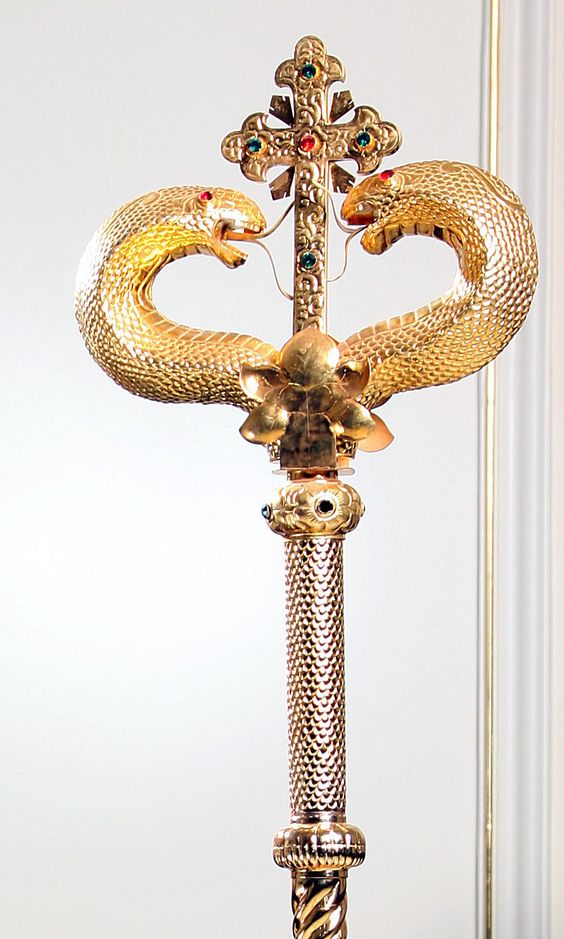
What does immediately come to mind is, well for me at least, the caduceus staff of Hermes: the god of travelers, merchants, thieves and eventually becoming the basis for the syncretic figure of Hermes Trismegistus, a conflation of the Greek Hermes and the Egyptian Thoth. This deity became associated with wisdom, commerce, and magic. A legendary figure in the world of Hermeticism, Gnosticism, and Renaissance magic. The caduceus staff is Hermes’ staff that is entwined with two serpents.
It is often confused with the staff of Asclepius which has only one serpent entwined around a rod, which is the symbol for the medical world.
This staff, however, is associated with commerce, or to put it a different way this staff symbolizes the balanced scales of exchange and reciprocity.
What this all points to is an inherent duality of the serpent in Biblical symbolism. Moses’ life is a populated with the serpent’s dual nature. Jesus Himself teaches His disciples to be wise as serpents and gentle as doves (Matthew 10:16).
Going back to the image of the staff, Moses is given the power by God to turn his staff into a snake before Pharoah to prove the might of the God of the Hebrews. While the magicians could also perform this feat, yet the serpents that emerged from the staves of Moses and Aaron ate the sorcerer’s snakes (Exodus 7:12).
Furthermore, going back to Eden how do we usually think of the serpent who tempts Eve?
I cannot speak for everyone, but this serpent is typically associated with twisting around the tree, descending from the top to the ground, symbolizing Man’s inevitable Fall as well as Satan’s own fall from grace which took place before time. The serpent then descends into time and brings death to humanity. It is not incorrect for us to associate this being with the devil, but what does the devil mean for humans other than death?
The cosmic serpent, or the ouroboros is another symbol that is used quite often in magical circles. The figure known as Hermes Trismegistus is one of the conveyers of esoteric knowledge meant to help humanity escape from the ouroboros, to break the cosmic serpent’s stranglehold on our cycles of death and re-birth. This is the Biblical Leviathan which swallows time, making man’s life but vanity, everything that has ever been done is swallowed by Leviathan to perpetuate itself, vanity of vanities.
This is death.
We Christians do not believe in reincarnation; however, the concept is applicable to this one life that we have, that can be spent aimlessly wandering. We habituate ourselves to the cycle of death and re-birth, being born again to worldly passions, being born again to what rules us in the wilderness of our hearts. This is death, this is Hades, and we cultivate the presence of death in our lives by doing what is evil. By either loving evil, hating the light, or being unaware of what we do we further the kingdom of darkness by remaining ignorant of the light.
This ignorance of the light is the same ignorance that some of the Israelites must have shown at the time Moses lifted the serpent up in the wilderness, symbolically, turning death, the very poison that was afflicting the Israelites, into life. Yet, to some this would have been strictly foolishness, and they would have rather succumbed to their poisonous bites than to look upon the brazen serpent.
The symbolism of the brazen serpent is important, too, because not only does God instruct Moses to turn the symbol of death into life, but bronze is meant to symbolize cleansing and judgement. An example of this is the molten sea in Solomon’s Temple, described in 1 Kings 7 and 2 Chronicles 4, this bronze basin was meant for the priests to ritually cleanse themselves before entering deeper into the holy of holies.
So, bronze symbolizes the outer temple, where one would purify themselves before approaching God and the serpent represents death and being lifted up the duality of being the poison and the cure. We might see how this is the Gospel. This is the Gospel of Jesus Christ, crucified, for through His death He defeated death. The Cross, like in the desert with the Israelites, was a symbol of death that became a symbol of Life.
Christ’s death tore the veil in the temple; we saw last week that through His death He was grafting the Gentiles into the kingdom of Israel. Tearing the veil in the Temple effectively rendered the separation of Man and God void.
Because of the Cross, Christ is in our midst!
The power of the precious and life-giving cross is that, by faith, we now have no reason to fear the serpent. Death has no more power over us, but we must look at the cross. We must bear witness to the light, crucified. When we are in the wilderness, the cure is the poison, we must confront what rules us that the light might render it void. Thereby we are brought into the light, unified with God. Otherwise, we will perish like the Israelites who refused to look at the brazen serpent because it was all foolishness to them, letting the poison overwhelm us and succumbing to the Leviathan.
Often, the above Gospel reading is boiled down to the one verse, “For God so loved the world that he gave his only Son, so that everyone who believes in him may not perish but may have eternal life” (John 3:16).
God’s love for the Israelites is illustrated by His giving them the cure in the poison; God’s love for the world is just the same, giving us the cure by His taking on the poison, “For our sake God made the one who knew no sin to be sin, so that in him we might become the righteousness of God” (2 Corinthians 5:21).
The serpent descended bringing death to humanity, marrying death with human nature. God, on the other hand, in His limitless love and mercy, condescended through the Incarnation of Christ to marry the unknowable nature of God with humanity so that humanity, by the Incarnation’s being lifted up on the Cross, could be saved from its own nature, which is death. This is the meaning of kenosis, that God so loved the world that He became Incarnate, piercing the veil of time and space, to save us from our vanity.
It was a choice God gave to the Israelites to look upon the brazen serpent, and so it is left to us to believe, to look to the Cross’ life-giving properties, and let our vain existence die. We are to look upon the brazen serpent in our wilderness by lifting up our vanities, our passions, and what rules us–crucifying them in the light of God.
Is there something that has come up for you this Lenten season?
Is there something that has come up that you feel you cannot possibly bring to the foot of the Cross and offer up to He Who saves us?
I know that I have, yet I also realize that looking at it is the only way I can give it to God. The only way I can be saved is to confront what has been poisoning me as I wander aimlessly in the desert like the Israelites who only knew how to grumble against their spiritual leaders and God Himself. Who loved them despite their faults, Who condescended—emptying Himself—to serve us, delivering us from sin and death. The Apostle writes in this week’s epistle to Corinth:
“And you were dead in the trespasses and sins in which you once walked, following the course of this world, following the prince of the power of the air, the spirit that is now at work in the sons of disobedience—among whom we all once lived in the passions of our flesh, carrying out the desires of the body and the mind, and were by nature children of wrath, like the rest of mankind.
But God, being rich in mercy, because of the great love with which he loved us, even when we were dead in our trespasses, made us alive together with Christ—by grace you have been saved—and raised us up with him and seated us with him in the heavenly places in Christ Jesus, so that in the coming ages he might show the immeasurable riches of his grace in kindness toward us in Christ Jesus.
For by grace you have been saved through faith. And this is not your own doing; it is the gift of God, not a result of works, so that no one may boast. For we are his workmanship, created in Christ Jesus for good works, which God prepared beforehand, that we should walk in them” (Ephesians 2:1-10).
Trusting God is believing in Him, yes, but an act of faith is seen in our want to bring ourselves, the totality of our self: heart, soul, and mind, to Him.
We are, as an act of love, leaving behind disobedience, passions of the flesh, desires of the mind, and wrath to enter into His rich and all-powerful mercy. We do this out of love, because love is faith, and this is how we approach God. None of our works will justify us, especially because without love our works are dead, but it is Christ Who works in us.
The veil of the Temple, therefore, must be rent by our coming to God in love; the separation of the self and God is an obstacle that we put up between us through following what rules us rather than coming to the light of His love.
Can we spend the next few weeks of Lent confronting what it is that is separating us from God? Can we spend time sitting with rules us, that power of the prince of the air that poisons us.
I would offer to everyone that, if they are anything like me, there is something that is habitually inclining all of our hearts, our souls, and our minds to conform to death. To live each day in vanity, feeding into the leviathan of sinful loops of passion and desires that emerge from the untamed, restless heart. What I would also offer is that God wants to come into those loops and redeem the fallen time we are so naturally inclined to live out.
God is no longer in the annals of the Temple, only to be approached by purified priests, but is in our very midst, waiting to enter into us and purifying our nature by His mercy. And by His love.
“Gracious Father, whose blessed Son Jesus Christ came down from heaven to be the true bread which gives life to the world: Evermore give us this bread, that he may live in us, and we in him; who lives and reigns with you and the Holy Spirit, one God, now and for ever. Amen.”
Si comprehendis, non est Deus
 Witness, NM