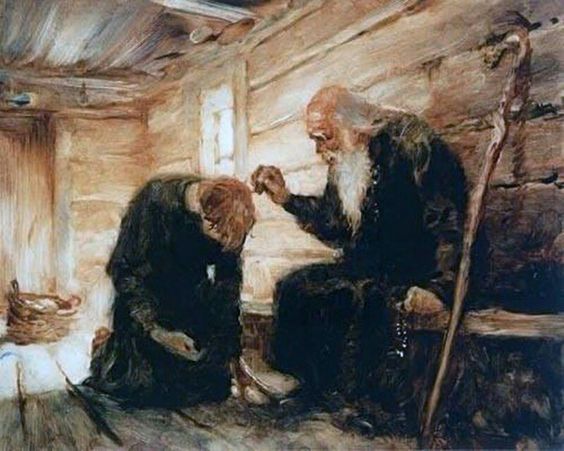
The Sunday of the Prodigal Son
“Those conflicts and disputes among you, where do they come from? Do they not come from your cravings that are at war within you? You want something and do not have it, so you commit murder. And you covet something and cannot obtain it, so you engage in disputes and conflicts. You do not have because you do not ask. You ask and do not receive because you ask wrongly, in order to spend what you get on your pleasures. Adulterers!
“Do you not know that friendship with the world is enmity with God? Therefore whoever wishes to be a friend of the world becomes an enemy of God. Or do you suppose that the scripture speaks to no purpose? Does the spirit that God caused to dwell in us desire envy? But God gives all the more grace; therefore it says,
‘God opposes the proud
but gives grace to the humble.’
Submit yourselves therefore to God. Resist the devil, and he will flee from you. Draw near to God, and he will draw near to you. Cleanse your hands, you sinners, and purify your hearts, you double-minded. Lament and mourn and weep. Let your laughter be turned into mourning and your joy into dejection. Humble yourselves before the Lord, and he will exalt you” (James 4:1-10).
Humility is confronting the sin that we believe is us through the light of God, drawing closer to Him through prayer like returning to our father’s house and him running out to meet us and kiss us.
It is beautiful. And it hurts. But this is humility, and it is the Way.
There is something that I have realized in the past few months that I knew when I was discerning Orthodoxy, originally, and something I knew ten years ago when I was doing stand-up. That is, I hate the world.
A pretty consistent through-line in my comedy was a caustic view of everything this world has to offer. This world is a vanity of vanities. Everything in it is either evil or merely a type and shadow of what awaits us on the other side of our repose. I hate this world, because it is not my home. It is not home to any of us. The prodigal son coming to his senses, literally coming to himself, illustrates the true meaning of repentance and compunction: realizing how far away we are and have been from God. From home. I have found that when one realizes how far away, they are from God the want is to double down and hide themselves in the world and the things in it. We hide behind our sins by claiming that our sins are our identity.
I did, too. I was a drinker—that’s who I was, others stick their flag in other mole hills, but the result is the same. We hide, like the First Fallen Man and Woman. We hide from God and, seeing how far we are from home, we dig our heels and lust more fervently after swine pods.
I hate the world.
I hate the blithe way that everyone participates in the world as if nothing that we do has consequence, the inherent nihilism and hedonism gone rampant. It disgusts me. I hate the world.
I hate this world. Any anger I have carried my whole life has been a manifestation of this hatred and points to a deeper frustration toward this exile. I hate the world and have been trying to distance myself from it since I started stand-up.
The epistle for this week goes,
“All things are lawful for me, but all things are not helpful. All things are lawful for me, but I will not be brought under the power of any. Foods for the stomach and the stomach for foods, but God will destroy both it and them. Now the body is not for sexual immorality but for the Lord, and the Lord for the body. And God both raised up the Lord and will also raise us up by His power.
“Do you not know that your bodies are members of Christ? Shall I then take the members of Christ and make them members of a harlot? Certainly not! Or do you not know that he who is joined to a harlot is one body with her? For ‘the two,’ He says, ‘shall become one flesh.’ But he who is joined to the Lord is one spirit with Him.
“Flee sexual immorality. Every sin that a man does is outside the body, but he who commits sexual immorality sins against his own body. Or do you not know that your body is the temple of the Holy Spirit who is in you, whom you have from God, and you are not your own? For you were bought at a price; therefore glorify God in your body and in your spirit, which are God’s” (1 Corinthians 6:12-20).
We are not our own; ontologically-speaking we belong to God and any sojourning through this life and the things of the world will not satisfy our exile. They will only fracture us; they will only lead us to consume more and more trying to fill the God-shaped hole in our heart. All we want is to go home, but we do not know the Way.
The parable of the Prodigal Son illustrates the love that God has for us all, His open arms ready to receive us and that there is nowhere we can go, no amount of (spiritual) miles that can keep us away from being welcomed back by His embrace. While the parable begins with the son taking and squandering his father’s inheritance.
An important, implicit, aspect of this parable, however, is seen through the son’s repentance. He leaves the world; he, in the same way, squanders his worldly life—he forsakes it to return home, to turn away from the temptations and wickedness of being so far from his father. True compunction is accompanied by renunciation, forsaking the things of this world and returning to our father’s house with humility,
“For a day in thy courts is better than a thousand. I had rather be a doorkeeper in the house of my God, than to dwell in the tents of wickedness” (Psalm 84:10).
So, with Orthodoxy… This is not me saying that my path is a one-size fits all adventure, nor am I saying that outside the Orthodox Church is all wickedness. What I am saying is that outside the walls of the Ecclesia there are many thorns and briars that suffocate the rose that is our hearts. We must all decide the path in which our hearts will not enfold on themselves and from there oppose all that which strangles them. The spiritual path is not meant to be a journey toward happiness or peace. The spiritual path is meant to unite us to God, if there be any other aim let it be anathema.
Christianity, as well as other religions that have been co-opted by the Western world, too often become tools to which one spiritually bypasses their life. It’s the same thing found with people who identify with their sins, because there is no transmutation of the raw materials of our sins. We remain dormant and our hearts harden. Can we all take some time to reflect on how we treat our spiritual practices?
Are they a means to confront the self that lies beneath the shroud of untruth or are they used to reinforce that worldly mantle?
Transformation is a product of repentance which can only occur when we start confronting our untruth.
I have a Buddhist friend who was telling me that when he began practicing meditation that all these anxieties and anger were coming to the surface during his sitting sessions. He went to his teacher, saying that he must be doing something wrong since all of these feelings were coming up and his mind was louder than ever. The Buddhist teacher explained that these are the feelings that he is unaware of and not confronting within himself. He was subconsciously suppressing these thoughts and in meditation there was nowhere to run.
We must, all of us, face ourselves one way or another or we will never come back to ourselves the way the prodigal son does, remaining in the fields starving and lusting after swine pods. God does not want this for us, because this is not real life. God wants us to be real human beings, true persons.
I realize that by pursuing God’s grace by my own standards and wants was doing exactly what the prodigal son did in his leaving home, unable to see that he was rejecting was what he was looking for. He wanted his father to bow to him, to give him his inheritance so that he could be, in some way, his own father. He became something different, entirely.
I believe that, maybe like a lot of people, I have had a very narrow-minded idea of what God is, or Who God is, rather. No matter what tradition of Christianity calls us home, no matter what spiritual or religious tradition we call home, I think we could all do well to consider our idea of God is not as narrow as the Way to Him is. The path is not so straightforward as we want it to be. Sometimes there is backtracking, sometimes there is paradigm shifting, and sometimes it feels like months or years have been wasted. But there is nothing wasted in repentance. There is nothing without value in repentance. God redeems the totality of our being.
I would challenge anyone reading this to reconsider that their comprehension of God’s love is far too narrow due to our fallen limitations. I would also challenge that if God’s unfathomable love does not provide us a want to change, to be transformed, then it is still too narrow. This is but a demiurgic projection of God that will sustain us with our sins, not transmute them.
So, it is out of love for God the Father that I choose to forsake everything and follow Christ. It is out of love for the Holy Trinity that I renounce the world and, finally, let it hate me. Let it not understand what I am doing; let myself not need to justify myself to the world, for it cannot comprehend my love for God.
Let my false self cleave to the world and abandon them both.
This is truly dying.
This is humility. It is beautiful and it hurts. But it is the Way forward, or the Way back home. He is waiting to embrace us as persons, complete, whole, and true persons. Repentance is not simply being overcome by guilt for committing some wrong, transgression, or sin then confessing. Real contrition is coming back to ourselves and seeing that we have defiled our spiritual beauty; repentance is clearly seeing that we are not living a real life, we are living in a fractured, broken reality that stems from the deepest recesses of our alien souls. “Deep calls to deep” (Psalm 42:7), and beckons us to come home, repentance is therefore the deep desire, in the ground of our being, which yearns to recover that spiritual beauty. Repentance is the love of God calling us home. For God awaits us all.
If not in this life, then the next. Selah.
“When I disobeyed in ignorance Thy fatherly glory, I wasted in iniquities the riches that Thou gavest me. Wherefore, I cry to Thee with the voice of the prodigal son, saying, I have sinned before Thee, O compassionate Father, receive me repentant, and make me as one of Thy hired servants” (Kontakion of the Sunday of the Prodigal Son).
Si comprehendis, non est Deus
 Witness, NM