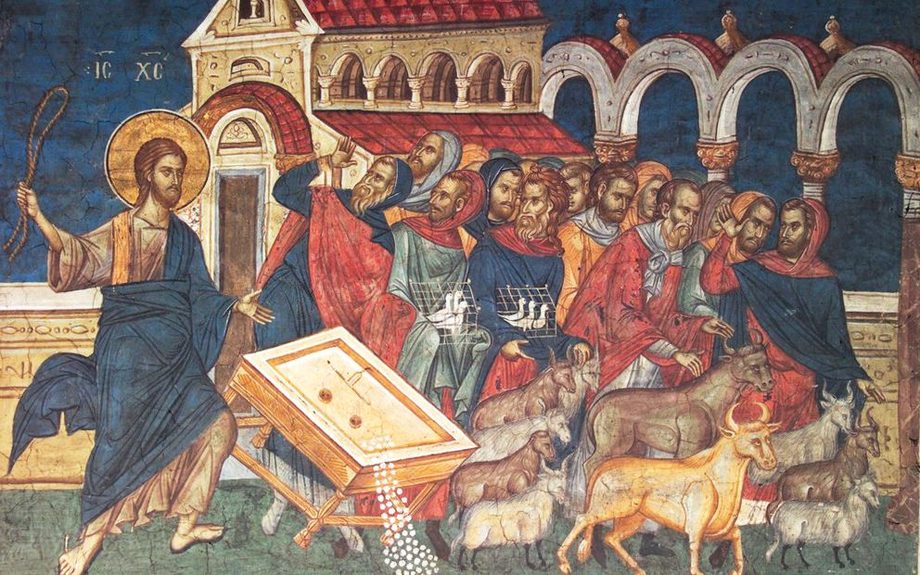
The Third Sunday in Lent
“The Passover of the Jews was near, and Jesus went up to Jerusalem. In the temple he found people selling cattle, sheep, and doves and the money changers seated at their tables. Making a whip of cords, he drove all of them out of the temple, with the sheep and the cattle. He also poured out the coins of the money changers and overturned their tables. He told those who were selling the doves, ‘Take these things out of here! Stop making my Father’s house a marketplace!’ His disciples remembered that it was written, ‘Zeal for your house will consume me.’ The Jews then said to him, ‘What sign can you show us for doing this?’ Jesus answered them, ‘Destroy this temple, and in three days I will raise it up.’ The Jews then said, ‘This temple has been under construction for forty-six years, and will you raise it up in three days?’ But he was speaking of the temple of his body. After he was raised from the dead, his disciples remembered that he had said this, and they believed the scripture and the word that Jesus had spoken” (John 2:13-22).
The Third Sunday of Lent’s Gospel reading reminds me of a prayer found in Orthodox prayer books:
“O my Lady, most holy Theotokos, through thy holy and all-powerful prayers, drive from me, thy humble and wretched servant, despair, forgetfulness, indiscretion, indifference, and all filthy, evil, and blasphemous thoughts, removing them from my wretched heart and darkened mind. Extinguish the flame of my passions, for I am poor and wretched. Deliver me from my many wicked memories and plans, and free me from all evil activity. For thou art blessed by all generations, and thy most precious name is glorified unto ages of ages. Amen.”
Lent is a time to really dig into our wretchedness, our miserable state of despondency and suffering. Lent is a time to recognize that this life is meant to be spent in repentance and strive toward God’s eternal kingdom. This is not our home, but our darkened minds, our forgetfulness, and indifference keep us focused on the temporal, forgetting God and inflamed with passions pulling us further away from Him.
It may be a stumbling block, but conforming our minds and hearts to the commandments of God frees from all evil activity. Jesus Himself tells us, “Do not think that I have come to abolish the Law or the Prophets; I have come not to abolish but to fulfill” (Matthew 5:17).
He fulfills the Law, given to Moses on Mount Sinai,
“Then God spoke all these words,
“I am the Lord your God, who brought you out of the land of Egypt, out of the house of slavery; you shall have no other gods before me.
“You shall not make for yourself an idol, whether in the form of anything that is in heaven above or that is on the earth beneath or that is in the water under the earth. You shall not bow down to them or serve them, for I the Lord your God am a jealous God, punishing children for the iniquity of parents to the third and the fourth generation of those who reject me but showing steadfast love to the thousandth generation of those who love me and keep my commandments.
“You shall not make wrongful use of the name of the Lord your God, for the Lord will not acquit anyone who misuses his name.
“Remember the Sabbath day and keep it holy. 9 Six days you shall labor and do all your work. 10 But the seventh day is a Sabbath to the Lord your God; you shall not do any work—you, your son or your daughter, your male or female slave, your livestock, or the alien resident in your towns. For in six days the Lord made heaven and earth, the sea, and all that is in them, but rested the seventh day; therefore the Lord blessed the Sabbath day and consecrated it.
“Honor your father and your mother, so that your days may be long in the land that the Lord your God is giving you.
“You shall not murder.
“You shall not commit adultery.
“You shall not steal.
“You shall not bear false witness against your neighbor.
“You shall not covet your neighbor’s house; you shall not covet your neighbor’s wife, male or female slave, ox, donkey, or anything that belongs to your neighbor” (Exodus 20:1-17).
Now, who among us can say we have followed this perfectly, for even those among us who do indeed profess to follow this perfectly might find themselves following in the disheartened footsteps of the rich, young man (Mark 10:17-22). No, this law is meant for something much more through the maturation of the people of Israel, being fulfilled in Jesus Christ Who explains that following this is much harder than previously thought. It is not only our actions that are judged, but the contents of our hearts.
This law, these commandments are not meant to be a check list for us to become “good,” because no one is good and none are without sin as St. John writes, “If we say that we have no sin, we deceive ourselves, and the truth is not in us” (1 John 1:8). The law, given to the burgeoning people of Israel was a revelation of God; this law revealed to them Who God was, is, and will be. Jesus, the same God, the same yesterday, today, and tomorrow describes this law for His followers concisely,
“He said to him, ‘You shall love the Lord your God with all your heart and with all your soul and with all your mind.’ This is the greatest and first commandment. And a second is like it: ‘You shall love your neighbor as yourself.’ On these two commandments hang all the Law and the Prophets” (Matthew 22:37-40).
This is God’s revelation to man; this is Who God is and how we come to know God is by following His commandments, as St. John writes,
“Now by this we know that we have come to know him, if we obey his commandments. Whoever says, ‘I have come to know him,’ but does not obey his commandments is a liar, and in such a person the truth does not exist; but whoever obeys his word, truly in this person the love of God has reached perfection. By this we know that we are in him: whoever says, ‘I abide in him,’ ought to walk in the same way as he walked” (1 John 2:3-6).
These commandments are to be written on our heart and wielded like a whip of cords, driving out the sins that stain our souls. Energized by the power of the Comforter, the Spirit of Truth, we drive out the moneychangers from our temple, the very temple of God (1 Corinthians 6:19).
Jesus takes the whip of cords and drives out the money changers from the temple in this epic demonstration of God’s righteous anger and His very Word revealing Himself to the peoples of Jerusalem.
At first glance, it seems like Jesus is doing to the Jewish people what they did to themselves after the golden calf incident. Where three thousand Israelites were killed because they had cut themselves off from God by their idolatry and transgression of the law. The money changers being the primary focus of Jesus’ divine wrath exemplifying this idolatrous and wicked activity.
During the Second Temple period of Judaism, the Temple was the Holy of Holies; the Temple was where supreme place of worship and ritual sacrifice in the region. It was the central structure of Israel’s identity and as such was the sight of yearly pilgrimages of faithful Jews during their major Holy Festivals, such as Passover, the holy day surrounding the event of the Gospel reading. Money changers exchanged Greek and Roman currency for Jewish and Tyrian shekels for pilgrims, so that they could purchase livestock for sacrifice in the temple. These money changers were in position to cheat the Jewish pilgrims out of their money for exchange rates that benefitted the money changers themselves, allowing them to steal from God, indirectly.
They brought in and served Mammon in the exterior court of the Temple, creating a spiritual barrier for Jewish pilgrims to have to pay a toll to this demonic spirit in order to approach God.
However, I think by focusing on this we miss the revelation of God to His people that is occurring in the Gospel. The money changers trafficked in currency and wares in the exterior court of the Temple, known as the Court of the Gentiles, where non-Jews could congregate. It was fenced off from the interior halls of the Temple, ultimately keeping the Gentiles out from sacred ground and activity, by penalty of death.
While the money changers’ implicit idolatry is stain of sin, their presence offers us another instance of wickedness and forgetfulness we might be able to see within our own body, which is cutting a people from God by our own self-importance and sinful nature. If we consider the temple of our body, the very temple of the Holy Spirit, the money changers of our hearts are the parts of us that know His law and yet obey it not.
The money changers, no doubt, knew the Law of Moses and probably could quote it, probably grasped it consciously, but when it came to becoming obedient to it, they chose to be obedient as far as it was convenient. They stained the outer walls by cutting off Creation from God, by spoiling the road to the sacred with idolatry and greed, but by keeping it on the exterior they skirted around the Law, they kept the interior clean, externally, but forgot that the road we choose is the destination, “Then the Lord said to him, ‘Now you Pharisees clean the outside of the cup and of the dish, but inside you are full of greed and wickedness. You fools! Did not the one who made the outside make the inside also?’” (Luke 11:39-40).
The money changers and merchants set up shop in the Court of the Gentiles and by doing so put a stumbling block in the way of the Gentiles; God cleansing the Temple shows us a God making a Way for everyone, all peoples, to approach Him. Jesus cleansing the Temple shows us a God Who will make a Way to approach Him within us, by cleansing us of our impurities, that we know all too well are an interior manifestation.
The Jews at the time demanded a sign for doing this, asking Him of what authority He drives out the money changers, because it is one with authority who would do such a thing. The revelation of God to His people comes in His actions, for He is the Incarnate Word, His actions literally speak for themselves, so to ask for a sign after they witnessed Jesus drive out the money changers… That was the sign!
Instead of answering them, Jesus alludes to the ultimate sign that they will bear witness to and miss completely, because of their darkened minds.
The Cross is the sign that they miss, that we still miss to this day. The revelation of the Cross destroys the wisdom of the wise, those who know the Law, but do not obey, being clever and skirting around its commandments.
The Cross destroys outer court of the Gentiles: “For he is our peace; in his flesh he has made both into one and has broken down the dividing wall, that is, the hostility between us, abolishing the law with its commandments and ordinances, that he might create in himself one new humanity in place of the two, thus making peace, and might reconcile both to God in one body through the cross, thus putting to death that hostility through it” (Ephesians 2:14-16).
Jesus’ crucifixion tears the veil of the Holy of Holies, bringing the Gospel to all by the power of the Comforter, “Then Jesus cried again with a loud voice and breathed his last. At that moment the curtain of the temple was torn in two, from top to bottom” (Matthew 27:50-51).
Jesus driving the money changers out illustrates the cleansing of the outer hall of His kingdom of stumbling blocks, idolatry, and identity providing the means for all to approach God by following His commandments. By the cleansing found in the Sacraments and the energizing power of the Holy Spirit, we are all beckoned into the new Temple, the very Body of Christ to which the outer walls are destroyed, the idols are driven out, and there is no Jew nor Greek, but all are one in Christ Jesus.
Now, we pray that God cleanses our temples, driving out that which worships Mammon over Him; that which would be a stumbling block to others who would approach God; that which considers themselves clever and wise, following the commandments when it is convenient and thereby growing ignorant of God, but puffed up in foolish wisdom. As the Apostle writes,
“For the message about the cross is foolishness to those who are perishing, but to us who are being saved it is the power of God. For it is written,
‘I will destroy the wisdom of the wise,
and the discernment of the discerning I will thwart.’
Where is the one who is wise? Where is the scholar? Where is the debater of this age? Has not God made foolish the wisdom of the world? For since, in the wisdom of God, the world did not know God through wisdom, God decided, through the foolishness of the proclamation, to save those who believe. For Jews ask for signs and Greeks desire wisdom, but we proclaim Christ crucified, a stumbling block to Jews and foolishness to gentiles, but to those who are the called, both Jews and Greeks, Christ the power of God and the wisdom of God. For God’s foolishness is wiser than human wisdom, and God’s weakness is stronger than human strength” (1 Corinthians 1:18-25).
Lent is a time to allow the Christ to drive out the money changers of our hearts, to soften the soil of our soul that the commandments of God might be written and obeyed. Lent is a period to take account of every Tyrian shekel that separates us from God and to open ourselves to the Comforter’s righteous zeal in flipping these tables over in our souls.
For it is in becoming fools for Christ that we are saved, letting go of worldly wisdom, scholarship, and prideful debates. Demanding a sign that has been provided for us in the saving grace of the life-giving Cross.
Can we spend this Lent in prayer, letting go of what we think the road to God looks like?
Can we spend this Lent in prayer, inviting Jesus into our temple and driving out the money changers that pave the way to circle God, but never approach Him? Can we wrestle with obeying the commandments, not passing over an iota nor a dot that we may truly know Who God is and know God.
Can we spend this Lent being honest enough to consider what we might value more than knowing God?
Otherwise, I am afraid, we will spend our days in the exterior court, exchanging currency for every “wind of doctrine by [our own] trickery, by [our] craftiness in deceitful scheming” (Ephesians 4:14); worshipping a God that is convenient, a God we have conjured, a truth we have minted for thirty pieces of silver.
Let us not forget that it was Jesus Who drove out the money changers, that the Jewish authorities, knowledgeable as they were, still needed God’s Word to remind them what the Temple was, is, and will be. The prayer to the blessed Theotokos serves as reminder that we cannot do this ourselves, because we might not even be aware of how much help we need. All we can do is open ourselves up to God’s Word and keep His commandments, so that He might keep us. Selah.
“Almighty God, you know that we have no power in ourselves to help ourselves: Keep us both outwardly in our bodies and inwardly in our souls, that we may be defended from all adversities which may happen to the body, and from all evil thoughts which may assault and hurt the soul; through Jesus Christ our Lord, who lives and reigns with you and the Holy Spirit, one God, for ever and ever. Amen.”
Si comprehendis, non est Deus
 Witness, NM