Chasing more, becoming less
“Elijah then came near to all the people and said, ’long will you go limping with two different opinions? If the Lord is God, follow him, but if Baal, then follow him.’ The people did not answer him a word” (1 Kings 18:21).
Ba’al, the Ancient Canaanite deity of storms, the antagonist to Yahweh and Yahweh’s people, is still being worshipped to this day. This deity’s name has changed, this deity’s cults have changed, this deity’s priests have changed. Yet this deity’s worship continues as if we were still wandering in the desert, forgetting God’s promise, abandoning our faith, and clinging desperately to the things of this world.
A while ago I was listening to a magician speak about the Bible. I was a huge fan of this person and I credit them for being the reason that I started reading my Bible so vigorously and, ironically enough, by doing so I realized that occultism is a load of BS. Occultism is packaged as a tool for self-development and, in other cases, a means to procure an order of the world that is in accordance with one’s own wants and desires. Ultimately, occultism is a catch-all term that is not all bad, not all good, but an easy way to consort with malicious spirits regardless of intention.
This is why this stuff is dangerous. It is spiritually opening the door to the world of spirit with a neon sign hanging above acting like a big light to any sort of spiritual intelligence that comes across our path. In Biblical terms, this consorting by means of occultism is spiritual adultery.
During this period of time, I listened to this magician talk about the Gospel as if their words were gospel. Their insights into the Old Testament stories were revelatory to someone like me who grew up around the deracinated Church of Christ interpretation of Scripture, divorced of nuance, allegory, or mystery.
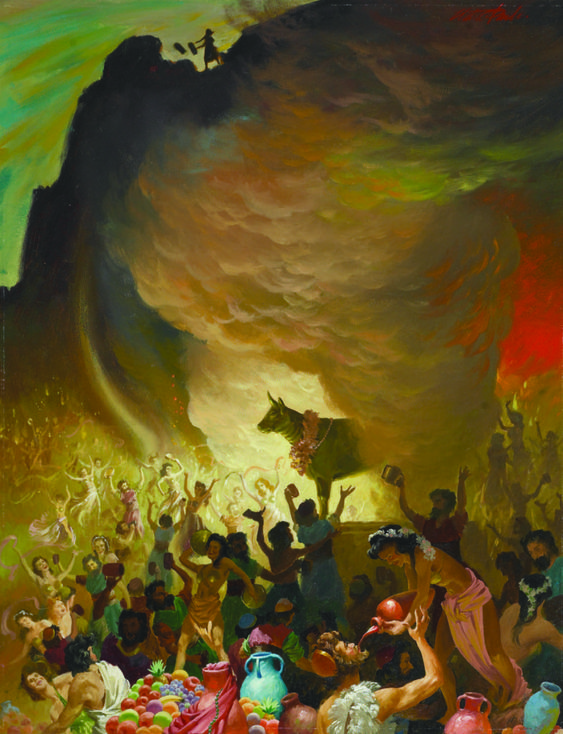
This magician related the story of the golden calf and the Israelites, explaining it through the lens of high magic and astro-theology. When Moses went up Mount Sinai to receive the Ten Commandments, and appropriate to Lent, he was gone for forty days and nights, the Israelites allegorically turned back and began worshipping under the guidance of the stars during the Age of Taurus, the bull, and Moses was angry upon returning because he was trying to lead them into the Age of Aries. In a sense, this story is about the Israelites refusing to enter into a new state of consciousness with the establishment of the law between them and their God, which within magic circles, can be seen as new rites and rituals that allow them to commune with Divinity.
It is interesting that this magician’s interpretation is not so far from patristic wisdom, yet the implications of this misguided interpretation could be the difference between peace and anxiety.
The Israelites did turn around, as the above states, but only implicitly do they turn back to worship the age of Taurus, because this golden calf was certainly a god arising in that age. However, these Israelites were not simply bowing down to the conscious state of the previous age, but rather were in the desert, they were in the wilderness being tempted and waiting on God. Moses had left them alone and, in their state, where they could not simply sit and wait on the Word of the Lord, they reclaimed the bondage chains that the Lord just broke them from and built, using the looted goods from Egypt, to construct a god. This was not just a god they imagined, but a god they would have had demonstrable contact with during this time in the wilderness being amidst the polytheistic Canaanites, who certainly worshiped Ba’al.
Ba’al is a Ugaritic storm god, which for me likens this deity to the prince of the air that St. Paul writes about in Ephesians, not only that, but Ba’al is a god of economic promise. Ba’al, therefore, is the god of worldly gain and promise. Ba’al and the promise that he offers is, therefore, antithetical to the promise Yahweh makes with His people. The Israelites are not simply practicing the asto-theology of the previous age. They are abandoning God, abandoning their faith, and abandoning who they are by putting all their proverbial chips in the worldly basket.
The Israelites, wandering in the wilderness, give in to the temptations to follow false gods and their false promises. They are committing adultery against their spiritual husband, God. Prefiguring the relationship between Christ and His Church.
When I say the BS of occultism, I do not mean that I believe magic, occultism, or esotericism, etc. are not real in terms of the realities they produce. Crowley adds that all intentional acts are acts of magic (Hint hint: the Israelites didn’t just drop a bunch of gold and it turned into a calf). Magic is very real, and because of mankind is made in the image of God it does produce results. However, we have a choice of directing our intention toward doing the will of God or doing the will of ourselves, which is flighty at best.
We all have issues with wavering in our ability to stay on course. The people who commit their lives to God have the same temptations as those of us who commit our lives to something less eternal. We all wander the wilderness at certain points in our lives and occultism is one of those temptations that emerges during this liminal time of unknowing.
The spiritual path is one in which it really pays dividends to start by laying a foundation of humility which is why I believe the spirit of this age has nothing to do with astro-theology (we’re in the age of Pisces for about a hundred more years). Rather, the foundation that this modern world is founded on is still the golden calf of the Israelites’ anxieties. I believe that, whether we recognize it or not, we live spellbound to worship Ba’al. We still have the golden calf stationed appropriately in New York where the spell of finance and consumption permeates the networks and exchanges being played out on the airwaves of the world where the prince of this world binds us all to financial anxiety and cultural unease.
Ba’al is the god of this worldly marketplace. He is known by many names: Mammon, Beelzebub, NASDAQ. Ba’al established a covenant with the actors of affluence which is perhaps why corporations can never satisfy their profit margins, there is only ever a need for more, more, and more. This is because Ba’al is not self-sustaining, this deity needs to be fed, spiritually nourished by the sacrifices of humans giving up themselves in quest for more.
I believe it is far easier to abandon God than we think, especially when we are inundated by anxieties about the financial market the world of tomorrow. We might consider that God does not understand this contemporary world; He could not have foreseen the stock exchange, He could not have foreseen our financial worries and stock bubbles bursting; inflation, hyperinflation, and Reaganomics.
God belongs in the church. I will handle my finances.
This is our insidious way of excusing God from our lives, situating Him in a confined space so that where we are comfortable.
The same corporate greed that is, unaware as it is, worshipping Ba’al is the same type of avarice that trickles down into the communities toward the bottom of the pyramid. We grow anxious about not having which becomes an incessant need to consume. We consume in a variety of ways, it is not simply money that is sought after, but sexual encounters are a part of this, too. Perhaps because we are all lonely deep down, wandering the wilderness not knowing we’re entering into a time of patience where we need to simply sit and wait for the Word of the Lord.
Drugs, booze, shoes…
Whatever it is, all we’re doing is numbing ourselves to the anxieties brought on by the prince of this world and the spirit of the age. We’re giving in and producing a golden calf through these numbing agents that help us cope with living in this world.
Occultism is a very reasonable answer during unreasonable times. It has been since recorded history and probably before that, too. Occultism’s rise can be generally correlated to worldly unease. Its current iteration tracing its lineage back to the decades following the Middle Ages, arising again in the wake of the Napoleonic wars and the first Industrial Revolution, seeing a huge boom in the days after the first World War, and now being popular once again as a result of the pandemic. The instability of the world engenders an individual’s need for something they can count on, something they can rely on—something they can touch and see.
What is happening to all of us we’re all turning into (oc)cultists. Abandoning God, faith and trust, and putting it into objects.
Objectifying creation where everything becomes a means to an end. Which, as a result, means nothing has any inherent value. This secular spirituality produces a nominalism in its adherents and a philosophical nihilism that drives us all into our own bubbles. Anxiety will do that.
I am by no means a paragon of peace, but I know what it is like to cling desperately to worldly things and false promises. Especially those promises we make to ourselves. Occultism is one of the tools that paves the way toward communities of unhumble magicians claiming to know better than everyone else. Their minds like wizard’s towers rejecting any type of information that disagrees with their own understanding. This is precisely why I am writing this now, because this wizard’s tower is so very appealing to someone like me. It was where I set up show for years, listing to the gospel of the above magician and unable to approach reality because it was easer to assume I could control it with my thoughts, my rituals, and my will.
The Israelites are a picture of mankind endeavoring to will themselves God rather than surrendering to God and being made holy and perfect. It is a scary proposition to be made perfect, to be holy, to follow God into the wilderness without our charms, sigils, or fancy sports cars. The false gods dress up our insecurities with conspicuous consumption and profit-chasing as if they were thunder vests. The True God wants us to come to Him without anything, to arrive naked in a sense, vulnerable, and trusting in Him. This is what it means to be truly liberated: cleaving to God and His promise.
That promise tells us that we are not home in this world, and we are not meant to stay here. We are meant to hope in His promise and to be made whole by Him. We will never be made whole by the things of this world; we will only lose who we are by feeding the deity Ba’al through constructing idolatrous coping mechanisms to numb ourselves to the spirit’s evocative anxieties. Ba’al, the demons, and Satan want us to seek control of our lives, to numb ourselves in the wilderness, to at the first sign of anxiety build a golden calf. They do not care whether one is openly worshipping them, and I would posit that if one were openly worshipping them, it would make their entrance into eternal death that much more enjoyable for the devils there.
No, they do not care if we worship them. What they want is for us to turn away from God, to be divorced from Him and His promise.
These spirits wants us to believe that this world is all there is and because of that what we are missing, what will fix us, will be of this world. We only need to find it through unfocused greed, laziness, and lusting after the new thing that comes along thinking it will fix us.
None of this will fix us though. We can have all the money in the world, all the sexual partners, all the sweet, sweet booze we could ever want, but it will not fix us. It will take everything from us, eventually, until we won’t even know who we are… Which is what the demons want.
Only God can fix us.
There is nothing that can fill the God-shaped hole in our heart regardless of how it makes us feel in the moment. I hope that we can all find some sort of peace in realizing the things of this world will not fix us, and in fact this world is not our home. I pray that we might all find peace by allowing ourselves to enter the state of unknowing, being in the wilderness and meeting temptations with silence. Meeting anxieties with silence. Acknowledging that God is God and God is with us. And unlike stock prices, stars, or the names of Ugaritic gods that never changes.
God and His promise are eternal.
Si comprehendis, non est Deus
 Witness, NM