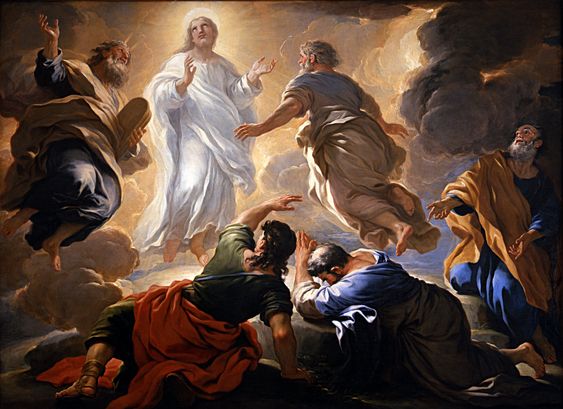
The Last Sunday after Epiphany
“Six days later, Jesus took with him Peter and James and John and led them up a high mountain apart, by themselves. And he was transfigured before them, and his clothes became dazzling bright, such as no one on earth could brighten them. And there appeared to them Elijah with Moses, who were talking with Jesus.
Then Peter said to Jesus, ‘Rabbi, it is good for us to be here; let us set up three tents: one for you, one for Moses, and one for Elijah.’ He did not know what to say, for they were terrified. Then a cloud overshadowed them, and from the cloud there came a voice, ‘This is my Son, the Beloved; listen to him!’ Suddenly when they looked around, they saw no one with them any more, but only Jesus.
As they were coming down the mountain, he ordered them to tell no one about what they had seen, until after the Son of Man had risen from the dead” (Mark 9:2-9).
When I was practicing magic all I wanted was to conjure an experience such as this, what is called a theophany: an observable, tangible manifestation of God wherein He breaks through the fabric of our physcial reality of time and space to make Himself known in, usually, a terrifying way. It is terrifying, as noted by the disciples reactions to the Transfiguration of Christ, because as I continued practicing eventually, I was given what I wanted.
Although, I would question whether it was God Who manifested in the room with me the times that ritual took a considerably darker turn. The point stands, though, it is terrifying. Whether it be God or a demon, it is certainly a bit much for the old nervous system. This is why my go-to response for people who wonder why God does not perform miracles like He does in the Bible, anymore has become to suggest that if He did it would be very difficult for us to get on with our day-to-day, seeing as how we’d all be in a perpetual state of shock and awe.
But still, it is good for us to be here.
I wonder how many of us seek a theophany such as this. How many of us want God to reveal Himself to us in a powerfully, awe-inspiring, and somewhat scary fashion? How many of us thirst for revelation?
When I sought a theophany, I imagined myself riding a fiery chariot in a whirlwind, taken up by a cloud such as the case in Transfiguration Sunday’s First Lesson, found in the second book of Kings, in the second chapter. The Scripture reading shows us Elijah translated to Heaven in just such a whirlwind and when his predecessor, Elisha, sees him no more he tears his clothes in two. I’d have probably gone mute.
The miracles found under the Old Covenant surely were stupefying and otherwise humbling, that was the point, after all, however these miracles could only point to the glory of God, what they could not do was provide a participation in that glory. This was the mission of the prophets that stand beside Christ at the Transfiguration: to point God’s people toward Him, to return them back to Him, and to keep them alive.
The prophet Elijah and his disciple Elisha are two of the most important prophets after the time of Moses when they were called to bring the peoples of Israel back into obedience unto God. They were called by God during a time of schism in Israel, where the kingdom had been divided into two tribes, the Northern and the Southern with Elijah’s work, continued by Elisha, taking place in the North. In the North, under the King, Omri, different religious principles were allowed into the public domain, such as priests from outside the line of Levites as well as building temples dedicated to the Canaanite god, Ba’al.
This was a time of crisis for the Hebrews, a time where they were perishing by following those gods that could only lead unto death, because they were not God.
Elijah’s divinely ordained mission was to call the people back to God, back to the sacramental life under the Old Covenant, still practiced in the Southern Kingdom where Jerusalem was located.
We see here how important God’s people are to Him and how division reaps famine, pestilence, and death.
Elijah battled against the priests of Ba’al and Asherah, proving the power and might of God to the nations, yet this is only a type and shadow of what was to come through the Incarnation. These signs and wonders could only point to what the Transfiguration represents in the full glory of God.
I wonder if our yearning for revelation obstructs our ability to see the revelation of God that is right in front of us, how easy it is to be blinded by the gospels of the world, the contemporary priests of Ba’al and Asherah, that veil our eyes to the Lord.
The Epistle reading of Transfiguration Sunday is found in the second letter to the Church of Corinth where the Apostle writes, “And even if our gospel is veiled, it is veiled to those who are perishing. In their case the god of this world has blinded the minds of the unbelievers, to keep them from seeing clearly the light of the gospel of the glory of Christ, who is the image of God. For we do not proclaim ourselves; we proclaim Jesus Christ as Lord and ourselves as your slaves for Jesus’s sake. For it is the God who said, ‘Light will shine out of darkness,’ who has shone in our hearts to give the light of the knowledge of the glory of God in the face of Christ” (2 Corinthians 4:3-6).
Now, while the Hebrew Bible is packed with amazing stories that would rival event the more competently produced Marvel movies the signs and wonders under that covenant merely typify the miracles under the New Covenant and they are both based on how important God’s people are to Him. St. Paul writes of the light of the gospel of the glory of Christ, that glory that shone forth on the mountain with His disciples, and the light that shines out of darkness. That darkness is exactly the signs and wonders that are mere shadows of Christ’s glory, and those are what keep our eyes and attention averted from His very Presence.
They don’t call it magic for nothing.
In this present age, theophanies are no longer bound to being external manifestations of God breaking forth into the reality of time and space, because the Incarnate Word broke through this reality, taking on flesh and dwelling amongst us. In this present age, we are under the New Covenant, which to me means that miracles are more common than under the Old, because now miracles take place in the human heart.
The light that shines out of darkness is the glory of God realized in the heart of those who come to Him openly, and just as it takes a moment to adjust to the morning light after sleeping it is a process to adjust to the light of the glory of Christ. Christ came to reconcile us to the Father, and we are reconciled, just like with the call of Elijah, through obedience and repentance. We who, blinded by the god of this world, have lived in darkness following our own gospel, our desires and captivated by our passions find it difficult to bear the Presence of Christ’s glory.
I wonder how many of us have been like me in the past, seeking signs and wonders to materialize externally to be given insight into spiritual realities. How, perhaps, our hearts might be hardened to the manifestation of His Presence through the theophany we call Scripture.
Sometimes it feels like we would rather manna fall from the heavens than to pick up the Bible and truly read and understand, to listen to God’s Beloved Son, His Word, written.
“It is written,
‘Man shall not live by bread alone,
but by every word that comes from the mouth of God’” (Matthew 4:4).
The Transfiguration is a cosmic event, there is no other way to describe it, but how can we understand it now? How do we apply something as earth-splitting as the Transfiguration?
This is where our gospel might get us into trouble, because it is sometimes easy to pick up God’s Word, written, and simply not find anyway to apply it to our life. At least, it might be easy to suggest that God’s Word, written, was written a long time ago and times have changed. Sure, there is good stuff in there, but some of it is a little outdated…
This is my beloved Son, listen to Him…
The Transfiguration presents us with the light of the gospel of the glory of Christ, that which shines out of darkness, and the darkness cannot comprehend it. When we are confronted by the light of His Word do we allow it to penetrate our being, or do we willingly not comprehend His Word by muting it?
Would we, in the place of St. Peter, on that sacred mountain ask our Lord to maybe turn it down, be a little less brilliant and therefore, perhaps, a little less effective?
The gospel we follow by either muting Scripture or not reading it at all is the gospel written in the dark by our shadow self, to put it in Jungian terms. This shadow self seeks signs and wonders; types and shadows, because it is seeking more of what it itself is, and therefore taking us way from confronting ourselves by standing in the Presence of Christ’s shining glory. The god of this world exploits the shadows self by keeping our attention diverted from confronting the theophany of God’s Word, keeping us chasing after external miracles rather than letting Christ dwell in our hearts by obedience unto Him.
Magic is the practice of conforming reality to one’s own wants, desires, and way things ought to be, but listening to the Apostle’s words we know that true freedom is being obedient unto God, doing His will, listening to His Word. Magic is muting Scripture that we do not like or that is going to make us confront ourselves and, God forbid, change us. When we mute Scripture, we are muting His Word, listening to ourselves rather than God, proving that the Bible may have been written over a millennia ago, yet God’s people still follow the rituals of the priests of Ba’al and Asherah.
Why would God grant us a tangible, manifestation of His glory when our hearts are so hard to Him?
It is easier for us to remain perishing than it is for us to listen to God’s Word. I know it is for me.
It is good for us to be here, though, because if we can stand His Presence and see with softened eyes then we might see the Transfiguration for what it was, what it is, and what it always will be: which is prefiguring the miracle of the New Covenant. A miracle that nothing under the Old Covenant could even come close to bringing God’s people, because this sign, this wonder, brings us the very Bread of Life—Christ.
We no longer await the heavens to be rent and for manna to fall, because on that sacred mountain we see that Christ and Christ alone is the mooring rope between Heaven and earth, the heavenly realities exist among us because of His sacrifice and the New Covenant. Elijah was not simply calling the Israelites to repentance, but to obey the sacraments given by God and be reconciled to Him.
The Eucharist calls God’s people back to Him, for it is the Body of Christ that we are being translated into through the whirlwind of the Eucharistic Mystery. The Transfiguration lives perpetually through the Liturgy, through the Sacraments of the Church, through the Chalice.
Transfiguration Sunday reminds us that no matter how pressing these current sufferings get, how difficult it is to try and become stronger, leaving behind the veil that darkened our minds to the gospel, leaving behind the veil that obscured our ability to see ourselves, God, and our neighbors… No matter how trying it might seem the light shines in the darkness and the darkness will not overtake it.
We are strengthened and transformed by the Spirit of God.
May God soften our hearts through the revelation of His Word that we might recognize that in the sanctuary we are with the disciples on Mount Tabor standing in the Presence of Christ come again in glory, transfiguring our soul through His Body and Blood.
We are bearing witness to and becoming a miracle.
If you were looking for a sign, this is it. This is the cosmic-altering theophany that we all yearn for in our hearts. The very hearts that this theophany dwells in eternally. There is no need for elaborate magical salt circles or works of the law of Moses. We need only approach God’s glorified Presence with an open and penitent heart, knowing that it is His light that unveils us to His countenance.
It is His glory that heals us.
Truly, it is good for us to be here.
The Transfiguration is a taste of the heavenly realities that we participate in by approaching the Chalice with fear and trembling, examining ourselves, confessing our sins, and knowing that God will never leave us, for He is with us, all around and dwelling in our hearts. Let us take this Lenten spring to allow the seeds of the rose to be planted in our souls, carefully acknowledge what will bring this beautiful bud to fruition, even amongst the thorns, and do our best to put away what is impeding its growth.
May we all find the Way and be transformed into the likeness of Christ, Who is the image of God. Selah.
“O God, who before the passion of your only-begotten Son revealed his glory upon the holy mountain: Grant to us that we, beholding by faith the light of his countenance, may be strengthened to bear our cross, and be changed into his likeness from glory to glory; through Jesus Christ our Lord, who lives and reigns with you and the Holy Spirit, one God, for ever and ever. Amen.”
Si comprehendis, non est Deus
 Witness, NM