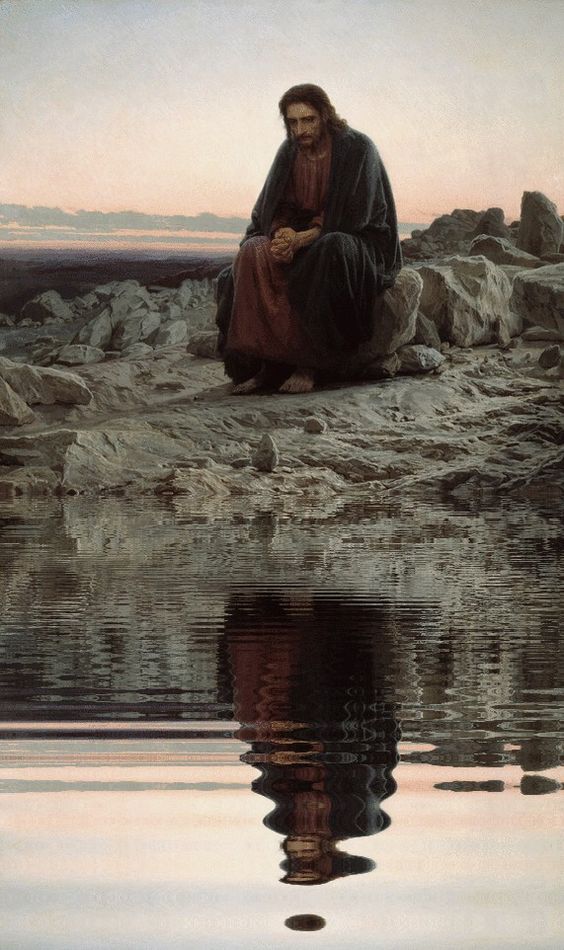
Demuirgic epistemology
“Pride and egoism lead to the abyss, to non-being, and to death. By isolating himself in himself, and by taking as the centre of his life not being but his own self, man is not only separated from God and from the sphere of the divine, but is also deprived of all true riches of his being. Being is a hierarchy, and is only affirmed through the preservation of harmony, which is itself the inevitable result of a true hierarchy.
Self-affirmation and egoism destroy this harmony, and by so doing destroy human personality by separating it from the source of life. Man no longer finds his place in the divine sphere and must therefore seek it elsewhere and outside himself. But outside Gid and the divine sphere there is only non-being, the realm of illusions and lies” (Berdyaev, Freedom and the Spirit).
We seek coherence when we seek God.
We weaken our immune system by seeking our own desires and fleeting wants that are not eternal, but reflections of eternity, distorted by our lens that have been darkened through habits, environmental factors, traumas, by self-inflicted fears and unconscious influences.
We are sometimes too arrogant to admit that we live in a reality of our own making, too busy explaining everything that happens to us as something outside our control, when really, because we lack eternity the world becomes simply a reflection of our internal lenses: projections charged and released in a feedback loop of stimuli and passion.
Reincarnation is a state of day-to-day death and rebirth; the habitual nature of our actions and projections which are tied to sensory perception, thought, and emotion are indicators of our own captivity to the entrenched reality of the λογίσμοι in our νοῦς, disabling our ability to transcend Samsara by realizing Hagia Sophia.
To my unilluminated mind, the way to pursue moksha is to pursue God,
“Revelation for man means in some way a release of the spirit which has been imprisoned in his consciousness and in material nature. Revelation unveils the inmost depths of the spirit, at the same time uniting them with the surface life of the soul… The revelation of God is not a transcendent event taking place on the objective and natural plane of reality, nor is it an illumination from without. It is on the contrary something which transpires within us, a light springing up in our inmost depths, a fact of the spiritual life which has no connection with spiritual realities” (Berdyaev, Freedom and the Spirit 95/90).
“Sophia, as Wisdom, is the self-revelation of the Logos” (Bulgakov, The Lamb of God 108).
Revelation is a product of the spiritual life, the self-surrender to God, the antithesis of my personal truth. Christ is unity. We are brought to Absolute Truth, in conforming our minds to the Eternal Logos allowing Hagia Sophia to emerge from the Image of God that is within us. Combating the λογίσμοι is the path toward cleansing the νοῦς which facilitates revelation, and this is where I find myself in this Epiphanytide.
When abolish the idea of God and His Image then we left with evil and by extension, we are left to toil under a slavery of our own conjuration, because the demiurgic impulse hardens our hearts like the Pharaoh and positions us as his slaves as needing to justify the working conditions thrust upon the latter by the former and participating in the conditions as the slave.
Thus, we are left forming our personality (habits, choices, thought, emotion, etc.) under being dominated by desire and chasing that desire to be known.
We cannot know ourselves without God, though, therefore we can only know these temporal conditions as the fullness of reality. The enslavement that we find under our own tutelage as “God,” crafting our life in the demiurgic spiritual blindness and ignorance of the self leads to an openness to dialogue with the λογίσμοι which is a part of the process in which the λογίσμοι becomes an entrenched reality. The step toward Absolute Truth us, therefore, dethroning ourselves and acknowledging not only the reality of God, but also our distance from Him that we ourselves have created due to our subjective truth.
This is how we begin moving up the ladder of Leary’s Eight-Circuit Model of Consciousness, to the sixth stage, where we begin re-understanding reality. Leary might suggest this is where the mind begins realizing the relativization of reality, but I would dispute this, because when one awakens to reality’s plasticity this does not erode Absolute Truth. Regardless, re-understanding reality under the consideration that the material world is a reflection of the eternal world furthers the need to re-categorize the natural state of Man and the world that Man inhabits. It also defines evil as a mode of existence which is not a reflection of eternity, and a creation of Man in the absence of good, Who is God.
This illustrates why it pays to remain captive to the λογίσμοι, to conform to the crabs in the bucket and their mentality, because accepting that there is a God means accepting responsibility for our life, our choices, and actions. Accepting the reality of a loving God means being open to His healing light. These are the conditions of surrendering to He Who is. It is easy to live creating our life with the demiurgic impulse to craft in ignorance of God and self, chasing every desire and being open to the temptations of the enemy, so much so that we become embodiments of the enemy in the natural world.
It is easy to do this which is why the reality of subjective truth is crucial to this current age and likely will become stronger before we all are finally ready to admit that we are powerless over our addictions, passions, and whims. We are ready to become and are open to healing when we come to believe that a power greater than ourselves can restore us to sanity: coherence and unity.
Christ is unity.
Herein lies the antidote that is a lot easier to type than it is to practice: forgetting the self.
Ego and it’s want to judge, a component of subjective truth, is predicated on setting the self up as leader, as superior, as its own God. Forgetting the self is an act of utmost humility and being open to God via kenotic love that Christ so exemplified. Forgetting the self is a form of combating the λογίσμοι, because it is pride that rules this openness to temptation and its eventual sinful manifestation in the natural world. Pride rules everything around me,
P.R.E.A.M.?
And it is precisely this pride that makes such fertile ground for the λογίσμοι to inflame me, personally, with rage. Rage is an addiction and, for me, lies below the surface addiction of alcohol as if drinking was meant to mask the rage. And as St. Mark the ascetic said, it cannot be reasoned with because it is pride. This anger is a spiritual confusion and blindness that only wants more when it is given over to itself. It is not a safety feature, it’s a form of explosive judgment. It may be argued against by material objectivist philosophers, but in epistemological terms, true knowledge—knowledge of Absolute Truth—is found in God through forgetting the self.
As previously stated, my whole being is full of presuppositions about truth and knowing and even God whereby any logical conclusions I come about a transcendent Being will be colored by the shades that I wear internally, God here is a projection. Perhaps this God is a shadow of the Truth, but a distorted image, nonetheless.
Knowledge is thus acquired through a process of letting go, as stated by the scholar of Chinese philosophy, Gi Ming Shien:
“The ultimate teachings of Buddhism, Taoism and Confucianism are in essence completely similar. It is said: ‘The more you know, the less you really know; and the less you know, the more you really know.’
What is the reason for this? ‘The more you know’ pertains to a knowledge merely discursive and rational. ‘The more you do not know’ pertains to divine knowing of the pure intellect. Because profane knowledge comes from the outside, there is a distinction between the knower and the thing outside the knower. So you have the separate entity that knows, and the thing or object known. When this distinction exists, what is known is only the appearance of things, the gross corporeal modality, while nothing is known of our true self or inner being. Therefore, the more you know of appearances the less you know of reality” (The Epistemology of Buddhism, Taoism and Confucianism).
The dissection opens us to further chasing desire and being dominated by desire. Knowledge is not found in this duality and game of Pong, but as the Eastern philosophies understand knowledge is in less, not more. The less I know of myself, and by this, I mean the less attachments I have to things like identifying characteristics, habits, and patterns of thought the more open I am to the emergence of Hagia Sophia from this, a crucified mind.
The Church Fathers and blessed monks of Mt. Athos recognized the need to forget the self in this manner, the self-interest of ego. The monks, far more dedicated to spiritual life than us, train themselves to question everything that comes to their mind. They recognize the subtle art of spiritual warfare as a constant battle and that every image or thought that comes to the mind should not be entertained, but rather, should be let go. The monks understand these images as λογίσμοι, seeking to entice the mind with glitter which pulls the soul back into the material world.
Knowledge is not a destination for biased intellects and egotistical self-seeking interest. True knowledge is “to lose awareness of oneself through going out to God in ecstasy” (The Philokalia 252). Ecstasy here refers to an altered state of consciousness, an expanded interior state and spiritual awareness, the revelation of God. What Berdyaev states is “something which transpires within us, a light springing up in our inmost depths,” the light of the intellect emerging is Christ,
Who “first appears in our intellect like a torch which, carried in the hand of the intellect, guides us along the tracks of the mind; then He appears like a full moon, circling the heart’s firmament; then He appears to us like the sun, radiating justice, clearly revealing Himself in full light of spiritual vision” (St. Hesychios the Priest, On Watchfulness and Holiness, The Philokalia 191).
This is Wisdom.
Wisdom is the application of knowledge, so we might see Wisdom as an emergence of eternity in temporal time through us as we become cleansed of worldly things such as our unconscious influences, traumas, and other factors that pull us into the material world. This is the aim of a Christian practice; Absolute Truth wants to propagate itself; Truth seeks to be known. That is the underlying principle of God’s love for humanity. It is us who stand in the way of eternity breaking forth into time. So, forgetting the self is the practical means to give birth to the Incarnation here and now. Our humanity is able to perform this action due to being made in God’s Image, endowing us with a Sophianic impulse which can seek evil, or it can become:
“All men are made in God’s image; but to be in His likeness is granted only to those who through great love have brought their own freedom into subjection to God. For only when we do not belong to ourselves do we become like Him who through love has reconciled us to Himself. No one achieves this unless he persuades his soul not to be distracted by the false glitter of this life” (St. Diadochos of Photiki, On Spiritual Knowledge and Discrimination: One Hundred Texts, The Philokalia 253).
Si comprehendis, non est Deus
 Witness, NM