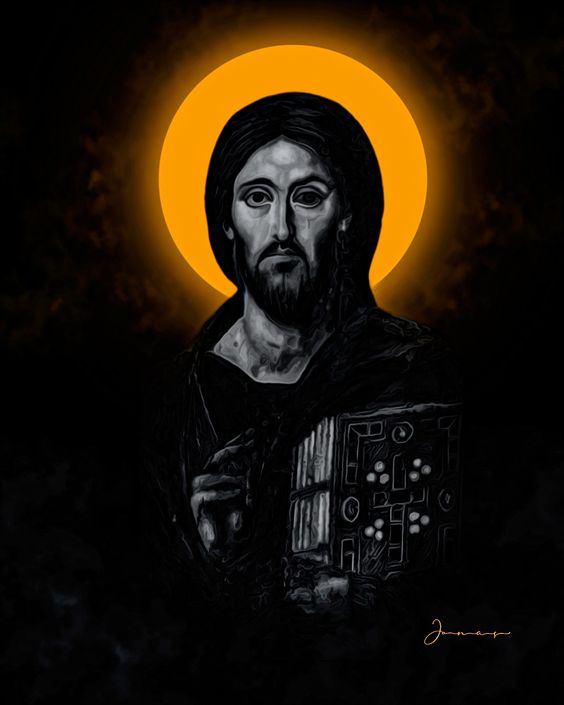
A search for Truth above all truths
“Nevertheless, I would confess to thee my shame to thy glory. Bear with me, I beseech thee, and give me the grace to retrace in my present memory the devious ways of my past errors and thus be able to ‘offer to thee the sacrifice of thanksgiving.’ For what am I to myself without thee but a guide to my own downfall? Or what am I, even at the best, but one suckled on thy milk and feeding on thee, O Food that never perishes? What indeed is any man, seeing that he is but a man? Therefore, let the strong and the mighty laugh at us, but let us who are ‘poor and needy’ confess to thee”. — St. Augustine of Hippo, Confessions, Book IV
I’ve spent the last month and a half like the youngest child in a Russian play, sick and emaciated, unsure if I’d ever get better. COVID then the flu and now, halfway through Christmastide, I have finally started feeling better. It was the kind of sickness that makes you wonder if you’ll ever feel OK, again, as if you caught something life-changing like the chronic cold. It has given me pause as to how I’d like to continue with this project.
When I look at Buddhism and Christianity side-by-side an obvious connection is the demon Mara in Buddhist cosmology and the Christian λογίσμοι (logismoi; pronounced loh-yeez-mee). See, the thing about being sick for a long time is that it is easy to fall into despair, of which I admit to teetering on the edge of in the days before Christmas. Furthermore, sickness is not simply a matter of our biology and our ability to fight off infections or viruses.
Sickness has a spiritual aspect, too.
The Church is not a country club. The Church is a hospital.
When we treat it like it is a place to meet and greet then we are losing the fight against a spiritual sickness that has invaded the Western world through cultural degradation and societal values shifting from the things above to material objectivism and conspicuous consumption. There is a floating idea infecting all our thoughts with the concept that truth, objective truth, is unknowable and, not only that, but objective truth is also not a reality. Rather, truth is subjective and a matter of perspective, this philosophical model goes back to the fifth century with the pre-Socratic sophist philosopher Protagoras who argued that absolute truth is not real, and everything is a matter of opinion.
This is the quintessential issue in our age, because defining absolute truth then becomes an ambiguous pursuit of one’s own truth and application of that truth in the material world. This is a slow roll into solipsistic understanding of reality, where everyone is a witness and bearer of their own personal, subjective truth.
This is not reality, though.
My thinking behind this is that our thoughts, emotions, and even sensory perceptions are colored by unconscious influences, thereby our actions, behaviors, and habits are persuaded by various causes that we are unaware of, making the search for objective truth an extremely difficult undertaking due to these distortions.
For example: Something I learned in my first week (of this most recent and successful attempt) quitting cigarettes was that the thoughts that came to me during that time were not mine. I mean, they were in my head, yes, but they were clearly emerging from a different origin than other thoughts. Phenomenologically these thoughts can be best described as coming from the outer rim of my invisible, mental interior—as if coming into my thoughts from the margins of my skull, but not having me as their genesis. It may be difficult to understand, perhaps as difficult to explain, but these thoughts that I was with, for lack of a better phrase, were not mine yet I was the one that thought them.
Think about it like this, when you walk into a room there are energetic pieces of data flowing in the space, some of them we can encounter, and others are so subtle or thin that it is as if there is nothing at all filling the space. These pieces of energetic data can be picked up by our subtle senses and somewhat become entangled with our distinct interior. It is why when you enter a room after someone has just cried or been angry, we can feel it.
So, the idea here is that I introduced an energetic piece of data to my body through years of smoking, which slowly became my interior’s lens in which it engaged with the world, had feelings and thoughts. Though this data set was totally foreign to my body’s natural state, over time, my thoughts became entwined with the cigarette’s processing.
If cigarettes could so insidiously engineer a neural pathway within my mind to make me believe that my want to smoke actually comes from within me rather than without, then how much more can we say about the unconscious thought patterns of which we typically feel are our “normal” mode of being?
Enter the λογίσμοι.
The λογίσμοι is a concept in Christianity meaning assaulting, or tempting, thoughts.
Essentially, these thoughts are engineered to guide our minds back to the things of this world, to the fleeting desires of the flesh and when we open a dialogue with these thoughts, we are taking steps to generate their reality in the material world. These are evil thoughts in a neoplatonic sense, whereby evil is a word used to describe things that have no basis in reality yet have been generated from an absence of good.
Evil is a parasite that is given life through our actions being led by this absence. To put it another way, evil needs a host to exist, otherwise it will perish like a virus that does not find a suitable host to attach itself to. λογίσμοι, like viruses, commandeer a host cell and use its own machinery to propagate itself.
Psychologically, the λογίσμοι may be primed to affect our living temple, our healthy cells, due to childhood trauma, past romantic relationships, external factors like a diet of war-mongering television and doom-scrolling, physical dietary habits like processed foods, and of course our upbringing in general. This is not exhaustive; however, I am merely trying to highlight what sort of conditions may distort our reality.
Our thoughts, emotions, and sensory perceptions are charged by the filters that we use which were adopted through various life occurrences such as from the list above and that charge is released after going through an incubation period, which may be only a few seconds in some cases. This release is expressed in a variety of ways that typically leads to a wash-and-repeat cycle.
Another example: I’ve been getting in touch with my anger in the latter part of this year and because I am not equipped with the correct way to approach my anger/rage I end up in a cyclical behavioral issue where something triggers my anger, I become inflamed in it and that leads me to explode. Rage is not processed nor can be let go of under the circumstances of this perpetuating cycle, because rage builds.
“Now let us say something about the senseless passion of anger, which ravages, confuses and darkens every soul… This passion is strengthened particularly by pride… Thus the structure of evil in the soul is impossible to destroy so long as it is rooted firmly in pride” (St. Mark the Ascetic, Letter to Nicolas the Solitary, The Philokalia).
Anger, the emotional outburst is an in-the-moment expression toward a boundary being crossed—it is a safety feature—whereas rage, the senseless passion of anger St. Mark writes about, is a manifestation of suppressed anger from an earlier period, like childhood or teenage years, where the expression of in-the-moment anger would have been a bio-survival risk. Rage thus positions us, using Timothy Leary’s Eight-Circuit Model of Consciousness, on the bottom two rungs of consciousness. This example might help to show that while we might be adepts in one area of our life, we are but children in others, offering us a clearer definition of being unilluminated, such is the case for those of us that are not wholly known to ourselves.
Which means that we can never be fully realized.
Rage is a λογίσμοι, tempting us to be delivered into the type of anger that is like a consuming fire that does not change us, but keeps us the same, enfolding into ourselves via pride.
The λογίσμοι are like viruses seeking a healthy host and keeping us within the constraints of these lower rungs of consciousness. The λογίσμοι perfectly represents the nature of sin in our world and our minds, because sin is precisely the way in which we continue perpetuating cycles of unconscious behaviors, habits, and thought.
Sin is a virus, and it is contagious.
The λογίσμοι introduce sin into our thoughts, because our minds are a thoroughfare, and when we do not have control or awareness of where our mind is and what we allow into it then we will become entangled in the thoughts of others, not only that, but also the thoughts of substances.
Truly, the λογίσμοι are merely the steppingstone to full on obsession, what some spiritual modalities call possession, regardless of what name we give it this means, according to Fr. Maximos in “The Mountain of Silence,” that the λογίσμοι has become an entrenched reality within the νοῦς (nous). What this means is that the λογίσμοι has become the conscious filter in which thought, emotion, and sensory perceptions are processed by, charging the mind and being released through sinful manifestations.
“The person becomes a captive of obsessive logismoi, leading to ongoing destructive acts to oneself and to others… The holy elders have warned us that when we become dominated by such passions it is like giving the key of our heart to Satan so that he can get in and out any time he wishes” (Markides, The Mountain of Silence 129).
This is an extreme case; however, it seems to me that we all have our personal λογίσμοι to combat, which highlights the issue of objective truth. When we are all predisposed to certain environmental triggers (the holidays are a good example of that) and certain habitual reactions to thought, emotion, and stimuli then it is far easier to assume that reality has no objective basis, but this a projection of our fallen nature. If there is no objective truth then there is no need to pursue Absolute Truth, we can remain–like crabs in a bucket–pulling each other down into our world of sin through the perpetual generation and manifestation of sin brought on by the λογίσμοι.
Another thing I learned in recovery, early by the grace of God, is that people are not interested in your good. People are interested in the affirmation of their sinful behavior and when you take steps to course correct those people either exit your life or try to convince you that you are wrong. The argument here is that the existence of toxicity and substance abuse is right because most of the world is living under these conditions.
In this case, right could very well be substituted for easy, which is why Protagoras was taking the easy way out by declaring that there is no objective reality and that everything is a matter of opinion. This philosophy has infected New Age communities, for one example, that ultimately lead to spiritual dead ends because when everyone’s truth is valid there are no objective answers leading to the spiritual seeker to simply go around in circles leading, typically, to self-interested behavior and hedonism, which is a form of obsession.
To quote the Blessed Fr. Seraphim Rose, “The logic of un-belief leads inexorably to the abyss; he who will not return to the truth must follow error to its end.”
So, we see this is not about right or wrong.
This is about Absolute Truth.
Si comprehendis, non est Deus
 Witness, NM