Pabst discovers high drama
“Εἰς ὃ καὶ κοπιῶ ἀγωνιζόμενος κατὰ τὴν ἐνέργειαν αὐτοῦ τὴν ἐνεργουμένην ἐν ἐμοὶ ἐν δυνάμει. Θέλω γὰρ ὑμᾶς εἰδέναι ἡλίκον ἀγῶνα ἔχω ὑπὲρ ὑμῶν καὶ τῶν ἐν Λαοδικείᾳ καὶ ὅσοι οὐχ ἑόρακαν τὸ πρόσωπόν μου ἐν σαρκί, ἵνα παρακληθῶσιν αἱ καρδίαι αὐτῶν, συμβιβασθέντες ἐν ἀγάπῃ καὶ εἰς πᾶν πλοῦτος τῆς πληροφορίας τῆς συνέσεως, εἰς ἐπίγνωσιν τοῦ μυστηρίου τοῦ Θεοῦ, Χριστοῦ, ἐν ᾧ εἰσιν πάντες οἱ θησαυροὶ τῆς σοφίας καὶ γνώσεως ἀπόκρυφοι.”
— The Apostle
Now, that we have some of the basic ideas of pathworking, it might be helpful to look at the ways in which a system that I know a little about works in relation to the map we are trying to draw for the rosary. This map of consciousness is called the Tree of Life found in the Jewish mystical system of Kabballah.
This map was later adopted by the Hermeticists, calling it Qabalah so as not to confuse the two paths because the maps may look the same, but the territory is different. The spheres in the Tree of Life are called the sephiroth, meaning emanations, with twenty-two channels connecting the them. The magician is working their way from the bottom, a sephira called Malkuth, which means Kingdom, to Kether, which means Crown. The sephira are numbered from one to ten, with Kether being one and Malkuth being ten, so the magician is working backwards through the emanations, returning to God.
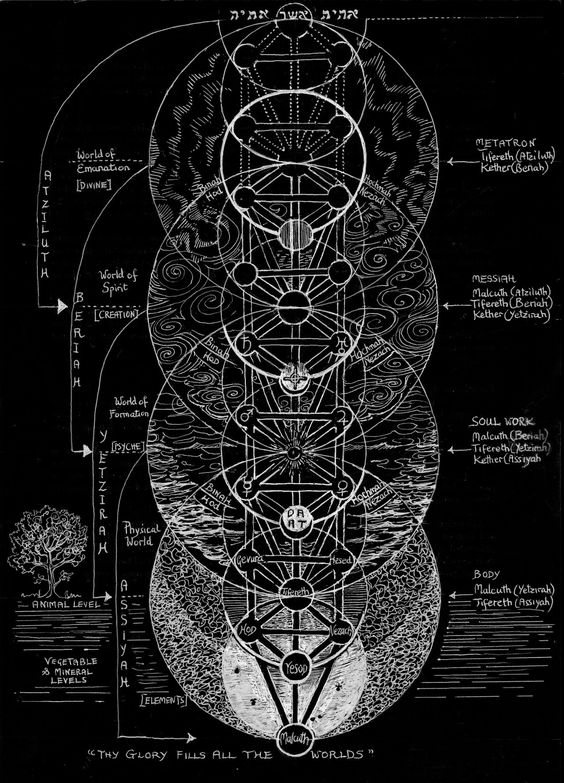
There is an infinite number of things that can be said about this, so for our purposes let’s keep the scope broad to say that working through the channels and sephiroth is the way of the magi, Hermeticists, and Jewish mystics. This is the idea that I am endeavoring to apply to the rosary: i.e. pathworking. Lastly, this map of divinity/consciousness has another model wherein the sephiroth are grouped according to their placement on the Tree of Life which corresponds to the four worlds which will help us understand our map: Assiah (World of Action; Malkuth), Yetzirah, Briah, and Atziluth (World of Emanation; Kether).
The concept of the Four Worlds will help guide us in a moment.
I mentioned in the posts about the Lesser Banishing Ritual of the Pentagram and the rosary that Christian mysticism can be summed up in the symbol of the cross. I believe this is our map. The cross. When considering that within the emanations of the Tree of Life are other Trees of Life, as in even the guideposts on the map have maps, then the cross comes into sharper focus, because it is not simply one cross that is our map, but a series of crosses representing intersections where Divinity and Humanity meet.
Pathworking this map requires stepping into the Mysteries as imaginative exercises registering that the moments we visualize as living witnesses to these Biblical events are also moments that exist within us. The marriage of heaven and earth, symbolized by the cross, comes to fruition from within, beginning with the Joyful Mysteries corresponding to Assiah, the Luminous Mysteries corresponding to Yetzirah, the Sorrowful Mysteries corresponding to Briah, and the Glorious Mysteries corresponding to Atziluth.
The cross represents the Christian mystical path a lot better than the complex Tree of Life or even the beautiful chakra system, because it is telling us exactly what the path looks like, cultivating virtues on the horizontal and ascending from our Fallen State (i.e., overcoming the false self) and uniting with God. Then descending from the World of Emanations becoming modes of Divinity in the World of Action. The cross represents the how of Christian mysticism, which is death to the self.
The kenotic self-emptying which corresponds to the sephira Da’ath, the Sorrowful Mysteries. To put it more precisely, in the same way the magician descends the sephiroth by ascending the Tree of Life, the Christian mystic draws near to God by mirroring God in pouring themselves out to be filled with His emanating Spirit.
This is why mystics say that Malkuth is in Kether and Kether is in Malkuth.
It is a Neoplatonic model that grants us an illustration of the illumined faculties of the mystic, filled with the light of God, “The rays of primordial Light that illumine purified souls with spiritual knowledge not only fill them with benediction and luminosity; they also, by means of the contemplation of the inner essences of created things, lead them up to the noetic heavens. The effects of the divine energy, however, do not stop here; they continue until through wisdom and through knowledge of indescribable things they unite purified souls with the One, bringing them out of a state of multiplicity into a state of oneness in Him” (The Philokalia, On Spiritual Knowledge, Love and the Perfection of Living: One Hundred Texts, 21).
Initially, my investigation was to draw a map for Christian pathworking using the rosary, because the LBRP is the way in which magicians facilitate their safety and progress pathworking the Tree of Life. I did not want to use a map from a different tradition, nor did I want to assume that no Christian mystic had ever drawn up a map before from their own experiences. This is an incorrect assumption anyway: St. Teresa of Avila, Jacob Boehme, St. John of the Cross, Thomas a Kempis, Evelyn Underhill, the Anonymous author of the Cloud of Unknowing, etc., etc. are our Christian consciousness cartographers guiding us all in the work of mysticism. The guiding principle tying these spiritual adventurers together is their love of Christ which is what we develop pathworking the Mysteries of the rosary.
The cross is the map and, in the center, holding the tension of the horizontal and vertical, of heaven and earth, of Divinity and Humanity is the heart of Christ, corresponding to the sephira Tiphareth, which means Beauty, Glory. This is the heart of our beloved and the heart that we are trying to attain. This is where we aim to be.
The LBRP and practices like Zen are not only facilitating pathworking and keeping us safe on the spiritual path, but they explicitly bring us to center, and the rosary is no different. Tiphareth is in the center of the Tree of Life which demonstrates the Way of Christ, which is the royal path of Christianity. The middle way of Buddhism. The middle path of magic. Therefore, the Cross is our map because we are interacting with the intersections of polarity.
The extremes that live within us can be safely interacted with through this form of pathworking with the rosary. The Mysteries bring us in to the extremes within: the awe of being spoken to by God, the awe of being the voice of God to the Theotokos, the initiatory waters of baptism, the self-emptying will in the garden of Gethsemane, and the part of us that has been crucified by the world.
The Mysteries are states of consciousness that, through visualization, we are acknowledging, reclaiming, and purifying our True Self and our connection to God, which go hand-in-hand. The rosary may not involve the physical movement and gesture of the LBRP, but they both facilitate the drama in which one comes to realize themselves. In a sense, the visualizations and embodying both the witness and actor in these mystical events is a form of theatre.
“Theatre – through the actor’s technique, his art in which the living organism strives for higher motives – provides an opportunity for what could be called integration, the discarding of masks, the revealing of the real substance: a totality of physical and mental reactions… Here we can see the theatre’s therapeutic function for people in our present day civilization. It is true that the actor accomplishes this act, but he can only do so through an encounter with the spectator” (Jerzy Grotowski, Statement of Principles).
It is true that these mystical events have been accomplished, they exist as a part of linear time, and yet they accomplish something within us when we participate in them. The rosary facilitates the communion of Divinity and Humanity, the Spirit descends like a dove and our Humanity rises like a prisoner liberated from Plato’s cave. “The actor’s act – discarding half measures, revealing, opening up, emerging from himself as opposed to closing up – is an invitation to the spectator. This act could be compared to an act of the most deeply rooted, genuine love between two human beings” (Jerzy Grotowski, Statement of Principles). The Cross that is our map opens up like an unfolding rose, revealing the intersections of God and Man through the eyes of the Theotokos and life of Christ. These figures are inviting us to reveal ourselves in totality just as they open up to us. Out of genuine love.
This is pathworking and the map is not the territory.
We become the map by using it.
 Witness, NM