Pabst prays the rosary
“Whoever is willing to enter the magic path should regard it as his sacred duty to practice regular exercises. He ought to be kind, generous and tolerant with his fellow men, but relentless and hard with himself. Only such behavior will be followed by success in magic.” — Franz Bardon
I’ve begun a rosary practice which I talked about last week, and I’ve been thinking about it and wanted to compare this Christian tradition with a practice from the Hermetic Order of the Golden Dawn. It’s time, again, to talk about one of my favorite things: magic.
A thing happens when we begin taking our spiritual life seriously and by practicing prayers and rituals intended to purify us, to guide us to God. One of the things that happens is entities that do not have our best interest in mind begin assaulting our lives with ways to hinder our spiritual progress.
Another thing that happens is a gradual stripping away of one’s ability to rely on themselves. Through this process we become vulnerable and are confronted with a lot of hidden traumas, working similarly to the malevolent entities trying to distract us from the spiritual path, these traumas are often buried underneath the skin and deep within the body. Life changes for those who take steps toward a dedicated spiritual practice; not always in a good way, at least at first.
It is difficult to put into words exactly what happens, because it really must be experienced to be understood. The basic principle that lies beneath the difficulty of the spiritual path is that we are afraid of change.
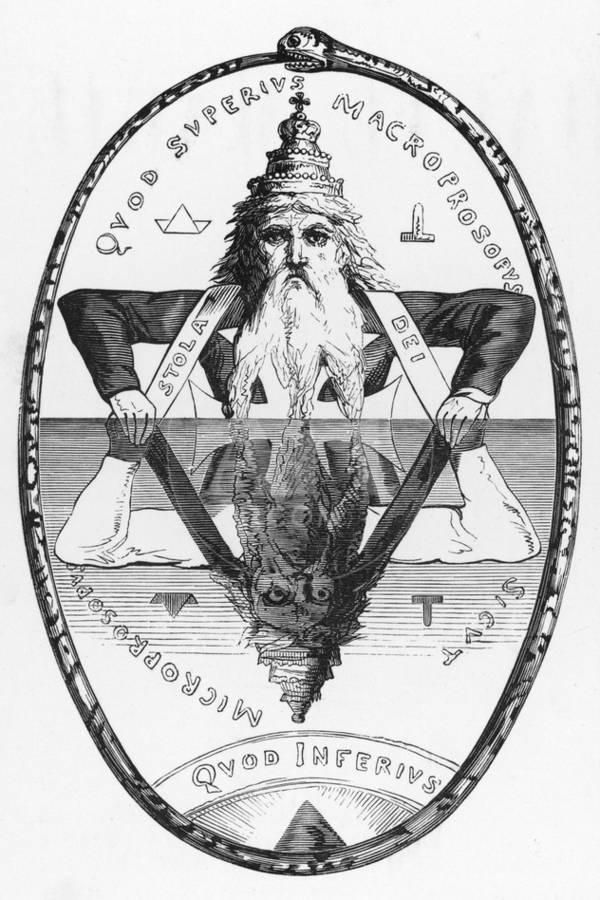
Transformation is a scary thing, and the spiritual journey transforms us, by necessity we are transformed that we may approach our beloved, Who is God.
It may not be what Protestants who adhere to the doctrine of sola fida want to hear, but we don’t just stand in the presence of God without a period of purgation. We do not become like God, we do not unite with Him because we really, really want to unite with Him. My introduction to the alchemical purification process was through the first ritual given to neophytes within the Hermetic Order of the Golden Dawn’s system: the Lesser Banishing Ritual of the Pentagram (LBRP).
Fundamentally, the LBRP banishes unwanted psychic energies from the practitioner’s aura and purifies the astral body, or the subtle aspects of the self. There are sources that claim that this one ritual can be used, solely, as a way to unite the self with God, though there are other rituals and prayers that help speed the process. The benefits of practice emerge as one continues performing it daily. The above is to demonstrate that the superficial benefits of the practice are only scratching the surface.
The LBRP was likely developed by S. L. MacGregor Mathers as a ritual for the Hermetic Order of the Golden Dawn, a magical order he helped found in the late 19th century. The curriculum of the order are forms of decoded Masonic and Rosicrucian rituals and teachings, basically, with a large influence from Hermeticism. Astrology, tarot, alchemy, and kabbalah encompass the Hermetic Order of the Golden Dawn’s theory and praxis.
The LBRP, specifically, is a modification of the work done by the Anglican-priest-turned-occultist, Éliphas Lévi who outlined a basic structure in his work, Transcendental Magic and Dogma and Ritual of High Magic. These seminal texts within magic form the blueprint from which Victorian era magic find their root.
The basic mechanics of this ritual involve the Christian sign of the cross, Hebrew divine names, and a modification of this Jewish prayer:
“In the name of Adonai the God of Israel:
May the angel Michael be at my right,
and the angel Gabriel be at my left;
and in front of me the angel Uriel,
and behind me the angel Raphael…
and above my head the Sh’khinah” (Jewish prayer for protection at night).
Energy work and breathing techniques are utilized with stacking visualizations and vibratory intonement. It is a complex ritual of movement that takes a while to figure out how to perform, comfortably, but eventually does become second nature.
The LBRP is one of the most important rituals of a magician’s work, predicating all magical operations as the opening of the temple and generally used to close the temple once an operation is complete. I started practicing this ritual a few months into sobriety, so I got pretty obsessed with it, and there is a lot of cool stuff this formula can do, but the ritual’s explicit purpose and the reason all magicians, new and old, practice it daily is because it purifies the self, preparing the vessel to approach God. See: Merkabah mysticism.
This process takes a long time, revealing more and more subtle aspects of the self, purifying the unconscious mind and incorporeal form. I have never been able to say this as well as I would like, but when we take steps toward God we are confronted with all the ways in which our life is cut off from Him; it is the true meaning of sin: the ways in which we are severed from God, the things we do intentionally and the things we do unintentionally; the things we are unaware of like childhood trauma, or maybe the things we do not want to look at like childhood trauma; stuff we might assume is unchangeable, unfixable.
The stuff that is not our fault, but our responsibility.
That is what comes up through the practice of the Lesser Banishing Ritual of the Pentagram. It’s not very long before one realizes the practice of real magic is not acquiring the ability to perform parlor tricks, it’s not about wearing our practice on our sleeves like dangling pentagram earrings… Real magic will bring you to your knees, it will humble you, because it needs to.
Magic has to humble us so that we may actually grow spiritually, reliant on God.
Franz Bardon, a 20th century Hermetic magician, taught that magic was to be done in service to God, the entire act is a service to Him. Therefore, it can be said that the intentional practice of magic is making our whole life a prayer.
When I was nearing the end of my time performing ceremonial magic, not that I knew that, I began questioning the formulae of the LBRP, because it seemed to me that something was going on beyond the visualizations and the intoning of the divine names, something that I could not quite capture, but I understood it as something going on in the subconscious mind. The ritual practice was akin to transcendental meditation (TM), where the mantra given in TM means nothing and is meant to keep the conscious mind busy so the connection between conscious and subconscious can take place.
Note: do not buy a mantra from TM teachers. These are free and are energetically powerful:
1) Aum or Om
2) Ham-Sah
3) Aham Prema
4) Om Shanti, Shanti, Shanti
5) Om Tat Sat
6) Namo Amitabha
7) Ehyeh asher ehyeh
8) Oṃ maṇi padme hūṃ
9) Kyrie eleison, Christe eleison, kyrie eleison
10) Extra Credit: turn a magical sigil into a mantra.
TM is similar to how I feel the LBRP functions, except the entire ritual is incredibly important, every part of it does something: the symbols, the divine names, the visualizations and movements, they are for the conscious mind, and it is a way to speak to the unconscious. The angels being called are completely autonomous spiritual beings, energetic intelligences making up the spiritual ecology of the cosmos, they are near to us when they are called and… they are communing with the subconscious.
This is where true, lasting change occurs, from deep within our interior. It is where God meets us, completely.
It was for this reason that I was hesitant to put down the work when I was being called away from this practice to pursue a Christian spirituality, because I could not reconcile the idea of Christianity and true, lasting change.
I was ignorant to say the least.
I have been practicing an intentional spiritual life for the past four years which means I know nothing about any of this so pardon my continued ignorance, but the thing that I keep coming back to is seeing ritual magic, meditation, yoga, and prayer as avenues in which we connect to our subconscious and through that transform our lives. These practices are intentionally bypassing the conscious mind and communicating with the subconscious, marrying them (more about that next week).
So, with that we return to the Nativity Fast, because I cannot help but understand the practice of the rosary in a similar manner to the LBRP. In fact, I would go as far as to say that the rosary is the Christian tradition’s LBRP.
The rosary has an incredible history having two origins, one in the East and the other in the West, the latter is what we predominately understand as the rosary and is widely practiced. The rosary in the East is said to have developed by the eighth century, which fell out of practice in the East and was adopted by the West. This could be true, it is not unlikely, however it feels like the East is trying to claim something that is totally Western, because they would rather say the rosary comes out of the East than to adopt something Latin.
The story of the Western rosary starts with the group that populate many great stories: the Gnostic Christians.
This is where we will begin in the next and final post for this most peripheral look at the rosary.
Si comprehendis, non est Deus
 Witness, NM