Unidentified White Males
The Episcopal Church is the church for outcasts, what my godmother describes as mutts.
An outcast is like refuse, literally one who is cast out of society, living on the fringes. These days the fringes are more virtual than they have ever been. In the “The Comedians: Drunks, Thieves, Scoundrels and the History of American Comedy,” the author Kliph Nesteroff, talks about the early days of vaudeville and the burgeoning stand-up medium as a time when performers would ride the rails from town to town—even actors of those days were seen as degenerates, moving from one cathouse to a saloon to a strip club. Specifically with comedians, it’s only been in recent decades that they’ve been seen as modern-day philosophers which gives me a rash.
Interestingly, an analogue is seen in itinerant preachers and the frontier circuit riders of the Methodist tradition. My grandfather was also an itinerant preacher, driving from one town to the next mirroring road work in comedy. Which was the best way to do stand-up, I assume it is similar to preaching.

I loved doing stand-up, especially on the road; it’s why I am who I am, but I started doing stand-up in high school which meant I was raised by pubs, bars, and occasional theaters which made their money off booze. Stand-up is not a substitute for philosophy. Stand-up is a medium for outcasts. That’s been changing, recently, but historically comedy has called the mutts of society to ride the rails, perform for very little money, and even fewer fame points.
That’s what I loved about it. That’s why I wanted to do it in the first place. That’s why I didn’t make it very far in the business. And that’s OK.
The Episcopal Church is my home because it is a home for outcasts. And with such an inclusive environment the question becomes: Who are the outcasts in society now?
If this Church is to be universal, then its doors need to be opened to all. It’s done a good job advertising as a sanctuary for the LGBT+ community, but at this point the marketing strategy has worked. They are here, or at least, know they are welcome. Women can be priests here, not long-ago women priests were called witches, which shows how far we’ve come. Ivan Illich’s “Gender” details how that is a consequence of the church’s de-divinizing femininity.
This brings up an overlooked part of our society that are our current outcasts: light-skinned males. We might colloquially refer to them as White, Caucasian, or European.
The reason they come up is that I’ve been looking into the emerging Christianities taking place on both conservative and liberal sides of the aisle: mainstream churches and Orthodoxy. The latter is seeing an increase in numbers in the West, and I’ve been wondering why.
I’m not special to say, but my interest in Orthodoxy was because of my background in the occult. I joined the Church because I was interested in reclaiming ritual and my ancestral heritage that I felt was taken from me by my fundamentalist upbringing. There are people, however, that are not joining the Church because they are wizards sympathetic to Jesus. These people are joining because they feel abandoned by society. These are the outcasts: light-skinned males.
This has been on my mind since last year, when an Orthodox catechumen committed suicide. The community was divided, because suicide is seen as such a grave sin… In Roman Catholicism (and Protestantism), but the Orthodox have space for God’s mercy. Suicide, while not the answer to the burdens of life, is not the Catholic mortal sin that it is touted to be culturally. God’s love and forgiveness is greater than the despair and mental disorders that plague our society.
The silent epidemic occurring underneath all the talks of war and Covid is the successful suicides taking place in the West by light-skinned males of all ages. It’s predominantly going on in older males, of lower economic classes, in rural areas. What is so fascinating about this is the articles that talk about it seem to downplay this current trend, an article describing this behavior said,
“White older men, however, may be less psychologically equipped to deal with the normal challenges of aging, likely because of their privilege up until late adulthood, Canetto asserts” (Anne Manning, Why White, Older Men Are More Likely to Die of Suicide). The article continues, “An important factor in white men’s psychological brittleness and vulnerability to suicide once they reach late life, Canetto says, may be dominant scripts of masculinity, aging and suicide” (Ibid.).
Another article echoes the above quote asking its reader whether we as a society should create a new interpretation of masculinity or build a gender-neutral world…
Neither of these approaches seem particularly imbued with humanity. Maybe I’m wrong, but the above quotes read as if to say, If only these white men weren’t so psychologically weak, they’d appreciate that they have privilege that no other group has (even though the suicide rates are higher among lower socioeconomic individuals). What’s more is that some of the articles I read present the rates of suicide between different racial backgrounds as increasing, like among Black males and non-Hispanic Native males while the Caucasian rates are declining.
Checking the CDC demographics, we see quite a different outlook:
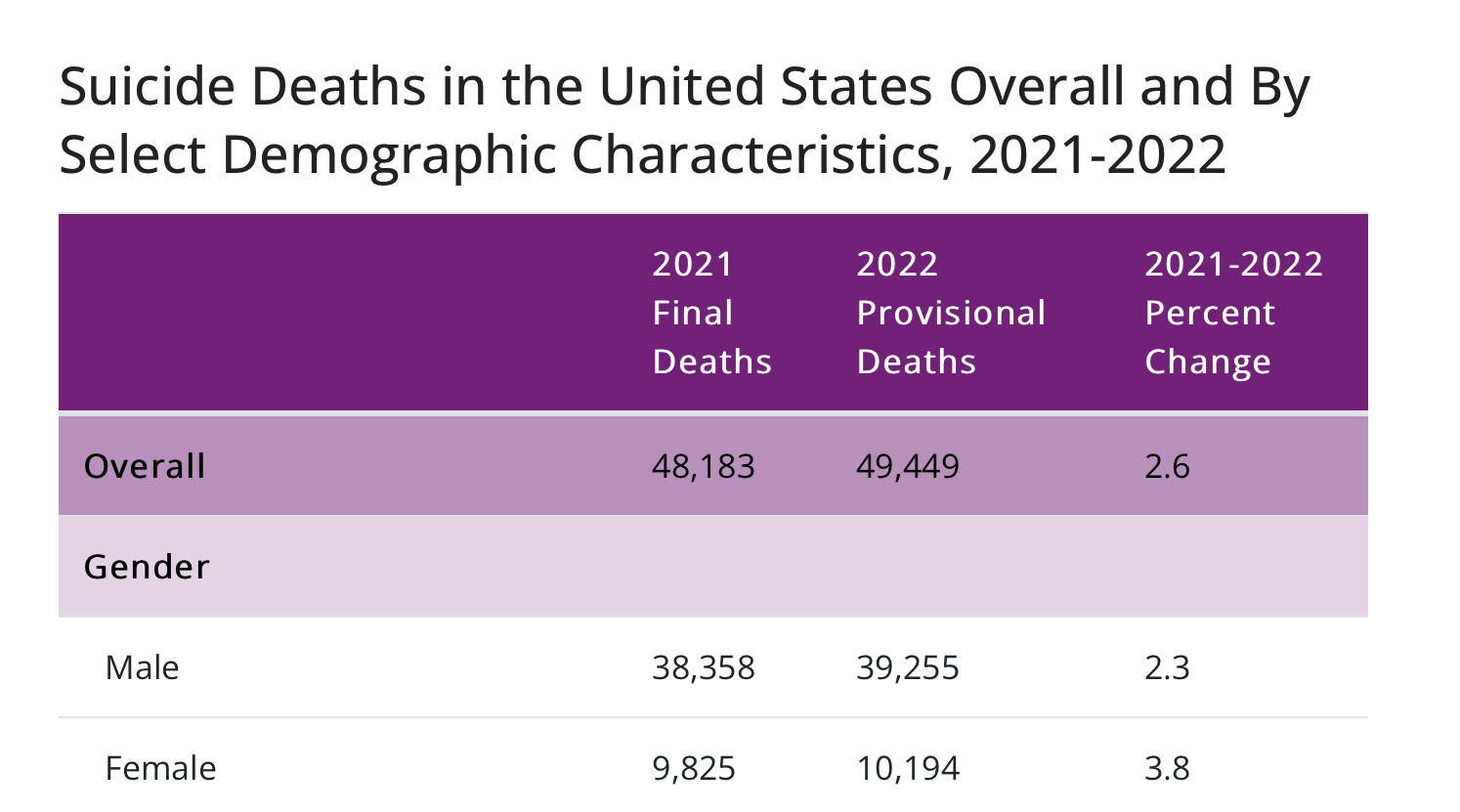
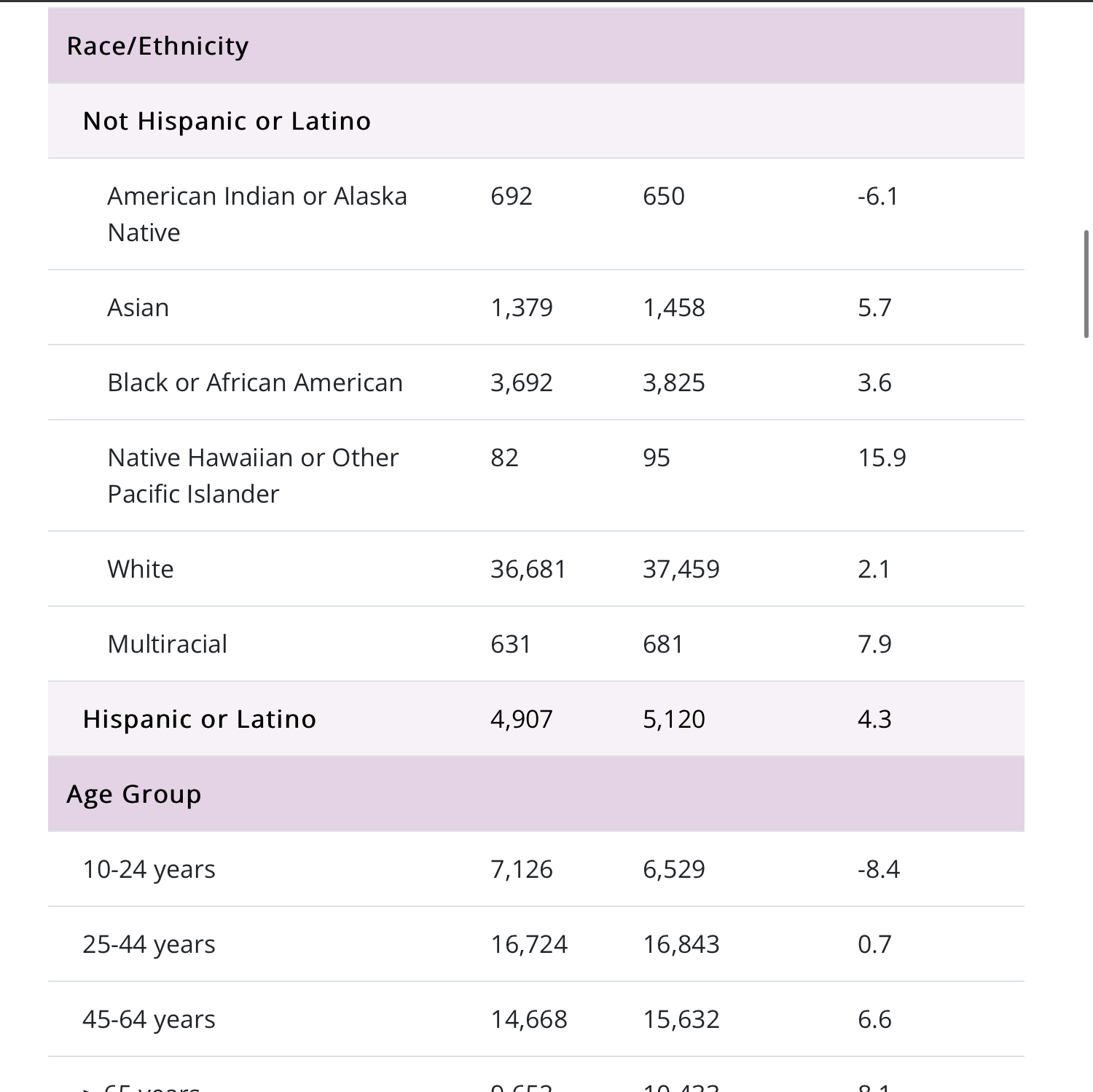
Definitely a higher percentage among adults of any racial make-up.
Now, as stated above, my reason to join the Church was seeking a magical worldview, but people who look like I do (light-skinned, male, between 18-40) are seeking a community that has strong masculine ideals. The Orthodox Church is explicitly a patriarchal system, and the church is proud of that. At first, it feels somewhat strange to be proud of this framing, however one need only look at our current society to appreciate why it is that people are seeking not simply a patriarchal structure, but seeking order, tradition, and community founded on similar values.
How this connects to the Ecclesia Omnia Benedicat is related to the above question of whether it’s better to forge a new interpretation of masculinity or build a gender-neutral world. I suggest that it is neither and both of the above would have dangerous consequences. In the spirit of the Universal Church and social Trinitarianism masculinity is defined by femininity. The answer isn’t patriarchal, the answer isn’t matriarchal. The answer is re-divinizing both femininity, masculinity, and using them both as pillars to hold a communal roof and steeple.
The answer certainly is not ignoring the above rates of suicide with light-skinned males. Not featured on the above graph is “A larger segment of this group has chosen the slow suicide route. Many are succumbing to things like alcohol liver disease or a drug overdose” (Philip Perry, This May Be Responsible for the High Suicide Rate Among White, American Men). Now, this I can understand. And this is almost easier to ignore than the growth rate of successful suicides. Being from the Southeastern United States the above has taken hold of communities far and wide due to factory towns becoming overnight… towns. The opioid epidemic, alcoholism, general despair.
It’s a wonder why the rates aren’t higher.
“White men without a college degree have seen their employment prospects dwindle in the last few decades, mostly due to mechanization. Their mental health has withered as a result. In terms of economics, globalization and income inequality have worsened the problem as well, though most economists agree mechanization is the biggest cause. However, middle-aged black and Hispanic men at the same education level, have also been impacted by these same economic forces. Yet, the suicide rate among these groups hasn’t risen” (Philip Perry, This May Be Responsible for the High Suicide Rate Among White, American Men).
While darker-skinned communities have a probable resiliency to these economic woes related to their historical position in the United States it doesn’t seem to provide insight to suggest that light-skinned men are committing suicide because they have not had the same unfortunate circumstances that facilitates the resilient nature of dark-skinned communities. It may be a part of the reason, but just as likely is the societal casting out of light-skinned males. I mean, the articles describe a group that is at a high risk of suicide as “privileged” and “psychologically brittle.”
We don’t think that is somehow implicitly the problem?
If George Bush doesn’t care about Black people, then our society doesn’t care about white men. This is seen as a fine orientation to have because of the way the culture talks about light-skinned people, even to the point where light-skinned people do better to profess a self-hating narrative than to be proud of their heritage. But to even say that is risking someone calling you out for being a racist. Simply, for embracing an ancestry.
This is currently a problem in neo-pagan circles, too, otherwise known as heathenry. These spiritual modalities are a reconstructed truth that has only some basis in reality, due in no small part to the typical lack of record-keeping among animists. I mean, the Druids supposedly wrote on leaves, so… you can imagine how easy it is for historians to define the ancient society, formally.
But I don’t know much about that.
What I do understand is being an outcast, forgotten, without a home, without a community… and the communities that one finds, riding the rails, are not always healthy, but even a rusty buoy is better than nothing when lost at sea. Personally, I’ve found myself in some pretty bad situations because of the nature of being an outcast. And I know people who have dealt with worse for the same reasons.
If we’re going to fix this situation, recovering the divine feminine is a step in the right direction. There is a masculine urge among men to protect things, men want order, they like hierarchy, and they like serving a purpose. I know it may not be very woke to say this, but men like protecting women, men like protecting their community.
If my recovery can help define it, then masculinity is the courage to confront the present moment; bravery, strength, and compassion. The Church needs to support the cultivation of these attributes if it is to have a place for men. Men need mentors in the Church who appreciate and exhibit these masculine qualities. If the church does not have a place for either the divine masculine or feminine then it cannot shepherd young people into leadership roles in their lives.
Our masculinity is defined by the feminine and vice versa. There’s room in society for strong, female leaders just as much as there is room for men becoming scribes (or something analogous and less “masculine”). However, the Universal Church recognizes that men and women need each other. “We know that all things work together for good for those who love God, who are called according to his purpose” (Romans 8:28).
The divine masculine is easily corrupted without the opposing tension of the divine feminine which works both ways. It is a Christian heresy to lean toward one extreme to the detriment of the other because Christianity is a faith tradition of holding the center between two opposing poles. Holding the paradox within us and without: male and female, God and Man, servant and master. What the Orthodox Church offers the light-skinned men of our society the Church, as a whole, needs to offer all.
Initially, this started because the Episcopal Church’s numbers are on the decline, the Orthodox numbers are increasing. My interest was looking into reactionary Christian thought, which involves the groups that seek Christianity not to reclaim their ancestral spiritual homeland, sacred rituals, and rites of passage, but endeavor to seek shelter from the societal storm of radical wokeness: an orientation that has not made light-skinned males feel they are welcome in our collective future. They have taken this message into their own hands.
Instead of seeking ways in which we can boost the Episcopal Church’s numbers, attendance, and pledge cards. It seems more prescient to seek ways we can, societally, decrease the number of attempted suicides among the at-risk. If the Episcopal Church really is the church for outcasts, mutts, drunks, and scoundrels then it must open its doors, as a mother, to all—recognizing the worth and value of everyone. Gender fluidity is not the answer to our problems. Our God is One, our God functions via multiplicity, and as such our humanity is informed by our understanding of our God.
We are One. We are a multiplicity.
We’re not here to tell anyone to ride the rails to the next town, and certainly not ride them unto death by their own hand. We are also not here to reinterpret what masculinity or femininity is… The Church has always known what these principles mean, but they were lost along the way, like someone falling out of a train car because it took a turn too fast.
The Universal Church recovers and blesses all things.
Si comprehendis, non est Deus
Sources: Anne Manning. “Why White, Older Men Are More Likely to Die of Suicide.” https://source.colostate.edu/why-white-older-men-are-more-likely-to-die-of-suicide/
Philip Perry. “This May Be Responsible for the High Suicide Rate Among White, American Men.” https://bigthink.com/politics-current-affairs/this-may-be-responsible-for-the-high-suicide-rate-among-white-american-men/
 Witness, NM