The High Magical Record
“That verse [‘For pure will, unassuaged of purpose, delivered from the lust of result, is every way perfect.’] condenses the whole magical technique. It makes clear when you have understood it—the secret of success in the Great Work. Of course at first it appears a paradox. You must have an aim, and one aim only: yet on no account must you want to achieve it!!!”
–Crowley, “Magick Without Tears”
I found myself reading Chick Tracts the other day. I did not grow up with them nor ever heard of them until I was older, but the anti-Catholic sentiments are something of extreme interest to me because my family did have similar opinions. My mom went so far as to judge my practicing Lutheran grandparents for their belief in the Real Presence of the Eucharist.
I thought they would make me laugh, but mostly Chick Tracts are hateful and mean-spirited bigotry. Whether or not they have agreeable things to say, the way they say them lacks so much grace to lose their truth altogether. For instance, and I’m not sure if y’all know this, but Satan is the reason Catholics call Mary “The Mother of God.”
It’s seems rather blasphemous to ascribe that title as a Satan-given moniker, but nonetheless it’s there in these comics, along with other abhorrent ways of categorizing religious expression that is not emphatically Evangelical Protestantism, leaning heavily on the fire-and-brimstone preaching that I was all too accustomed to growing up with a Church of Christ family. And whether anyone would admit it or not, this is the exact type of theological orientation that led to so much trauma within my own family, how much more for others?
Regardless, the Evangelical Protestant movement made ritual, for me, something of a forbidden curiosity. I mean, I remember crying when I was six or seven because I told my mom that I wanted to be a priest and she informed me that Catholics aren’t Christian. I feel like as many expressions as there are of magic there are many ways to attract people to its practice.
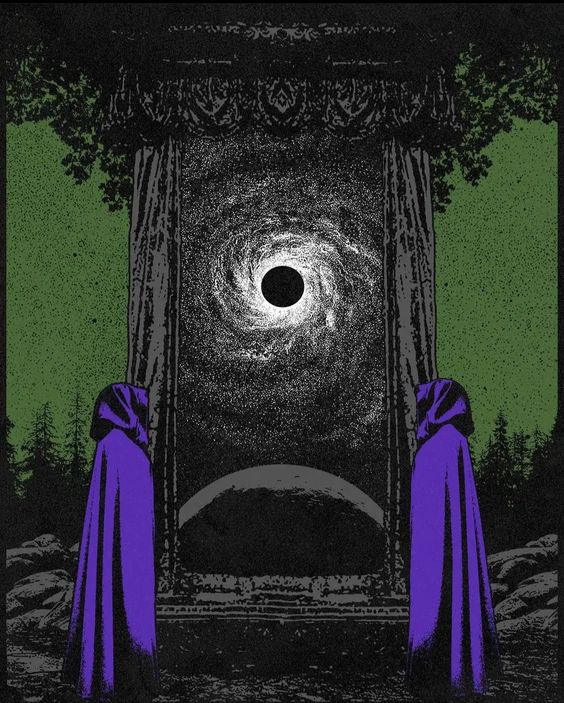
High magic has a lot to offer those of us growing up in the Christian West, whose views on Christianity are somewhat obfuscated by American exceptionalism and the tragic loss of its mystical roots.
The latter served as my bridge between chaos and high magic, where I felt the chaos paradigm served only to sever one’s connection between a living system because of its utilizing spiritual modalities as tools.
This form of practice is a relatively new development within practical spirituality, where belief is a tool. This disqualifies the thousands of years preceding this apprehension of what it means to ‘believe,’ because ‘belief’ was not always, nor should be now, a simple head matter. Paradigm shifting within chaos magic revels in an implicit perennialism where religious figures and narratives become cultural expressions of archetypal forms. Pantheons can be adjusted and even created as long as there is a structure to this basis, and maybe even if not, it’s chaos magic after all.
Belief is not a matter of deciding who my god is today. Chaos magic exploded in the latter decades of the 20th century only to fall short in the past twenty years as people found that older systems of magic, and the gods associated with them, work far better than crafting a hymn to the Sun using Superman as a stand-in. It is no different than the early days of the atheist movement in the 21st century gaining steam with middle schoolers and the Bill Mahers of the world before collapsing under the weight of its own flawed hypothesis.
Belief is a matter of the heart, which expands from within connecting the mind and the body; these three aspects of the human being, physical, spiritual, and psycho-corporeal makeup belief.
So, ditching the implicit nihilism of chaos magic, where there is no Truth nor is there a wrong way to get there, picking up the magic robes and—with a full heart, clear eyes, and an inherent piety taking to the world of high magic in search of the Holy Grail.
Here, within this paradigm of ritual magic, there is but one goal: union with God.
There are benchmarks along the way toward this ineffable summit with three keys that allow the magician to open the doors leading to their aspiration: qabalah (or kabbalah, or cabala), a controlled concentration, and the building up of the light body.
The practices of ceremonial magic, as I understood them when I began experimenting with ritual, involve eliminating unwanted etheric patterns, unwelcome states of consciousness, as well as banishing spiritual entities that live parasitically with us. This is done, if we are to look at this purely psychologically, by invoking spiritual intelligences using visualizations that are unconsciously associated with aspects of our psyche, bringing both our mind and body into balance.
Theoretically, this is consistent with Eastern models as well as an Eastern Christian orientation. However, it lends itself more to the Buddhist concept of karma, which is related to intention and action, found immediately on the Eightfold Path with Right View, or that our actions have consequences in this life and the next. Right view is a clearing up of misconceptions and confused thinking enabling one, along with the other Buddhist practices of the Eightfold Path, to become liberated from samsara.
“Before the first imprint is made, the consciousness of the infant is ‘formless and void’ –like the beginning of the universe in Genesis […] As soon as the first imprint is made, structure emerges out of the creative void. The growing mind, alas, becomes trapped in this structure. It identifies with the structure: in a sense, it becomes the structure” (Wilson, “Prometheus Rising”).
The practice of high magic thus begins with the banishment of Buddhism’s three poisons:
Raga which is essentially attachment to passing sensual pleasures, desire, and greed. Dvesha, or disgust, hatred. Lastly, moha, which is an ignorance toward metaphysical truths, that of impermanence and anattā, this is the root cause of suffering, or dukkha, that leads to being trapped in samsara. Buddhism’s Eightfold Path is meant to free one from these three poisons and so does magic have a similar goal in uprooting these poisons through the use of ritual.
While Hinduism and different forms of Buddhism hope to gradually liberate the self, or no-self, from samsara through successive lifetimes, high magic is dedicated to liberating the self in this lifetime.
High magic was my way of beginning to untangle myself from the drinking structure that grew from the first imprinting of substance-reality, and because the self-identified with the structure of substance-reality it was, in a sense, a part of that substance-reality. What I could not understand at the time was that, while I wanted union with God, what I had to go through first was absolute hell of separating myself from the structure of substance-reality.
This is coming into amoha, or non-deludedness, which. Fucking. Sucks.
I would never start drinking again just because of how much this part of recovery sucks. Utter loss of self, loss of motivation, loss of meaning, loss of community.
Absolute loss.
It is in this space of anguish and confusion that made escaping samsara, ASAP, the ‘Good News’ I so desperately needed that first year. High magic became plans B through Z and it was not simply spiritual escapism, it was salvation. I was so dead set on eradicating all my unwanted etheric patterns and unwelcome states of consciousness I spent hours doing magic every day. If I was not practicing it, I was studying it.
In fact, the end of my first magical record ends with my girlfriend leaving me. Go figure.
While on one hand it is easy to see an interest turn into obsession, while on the other hand the banishing rituals that I was performing daily was still eliminating structures from the substance-reality, because with these things the cycle was bound to repeat itself or manifest as a different expression of the same problem. Magic expelled all the elements that were getting in the way of my dharma (or True Will), which is kind of like one’s ‘Divine duty.’
There is a Thelemic understanding of True Will, from which the term originates, influenced by the work of Éliphas Lévi that wrote True Will is similar to one’s true self or identity, which informs the practitioner of who they are in relation to the cosmos, as well as what they are bets fit to do. Lacking humility, this concept is a dangerous tool of self-satisfaction, being a corruption of the scripture, “Not my will but yours be done” (Luke 22:42).
This is magic, the realization of one’s divine work and the ability to carry it out. Magic, real magic is the eleventh step of AA: Sought through prayer and meditation to improve our conscious contact with God as we understood Him, praying only for knowledge of His Will for us and the power to carry that out.
This concept of His Will radically reoriented my approach to magic, because now union with God meant relationality rather than escaping samsara (moksha). High magic became a spiritual pathway to better embody the Scriptures, “just as the Son of Man came not to be served but to serve and to give his life a ransom for many” (Matthew 20:28). To me, this form of sacrifice is the Christian view of the bodhisattva, an awakened one who forgoes moksha in order to help others attain enlightenment.
“The first shall be last.”
Crowley adds in his own writings that one who accomplishes the Great Work—the accomplishment of the magician’s aspiration: realizing their True Will and attaining union with God—has made it easier for another to accomplish the same.
A magical system emerged out of the creative void, one in which the magical rituals lost their luster and started becoming curiosities of a Victorian mindset of perennial philosophy and spiritual colonialism. “The earth was a formless void and darkness covered the face of the deep, while a wind from God swept over the face of the waters” revealing a personal magical system: recovery.
Recovery is the highest magic.
Recovery is reclaiming the past through acts of service, prayer, and discerning the Will of God.
It is essentially a practice of the heart, not the mind, because the Grail is not sought through our mental faculties, but through our hearts. Jack Chick, the writer of eponymous tracts, was a hateful, ignorant man attached to his mental set of beliefs that informed his engagement with the world leading to a narrow, charged perspective deluding his view of reality. This form of Christianity does not do the same thing as what I believe Christianity does, because it is an expression of a Christian lens imbued by the three poisons.
This is how our dependance on our mental faculties can lead us astray and in the same vein this is what led me to becoming disillusioned with union with God, conceptually, as it seemed like a catch-all term for ineffable mystical heights where following the writings of Crowley, Renaissance alchemists, and Neoplatonists felt like using relativistic constructs instead of intuition.
I felt like this system of high magic was too unstable and imbalanced where spiritual ascension for spiritual ascension’s sake became the modus operandi for magical practitioners. As well as a aesthetically-pleasing way to rebel against the Protestant Evangelical movement that decried everything that was not like itself as Satanic.
Recovery, in contrast, is a magical approach that is embodied, where both Man’s spiritual nature and their physical being are, in a sense, purified and united. I found, through the intersession of the Theotokos, a representative of this goal in the θεάνθρωπος (Godman), Jesus Christ, and so He became my teacher, my friend, and Summum Bonum.
The quest for the Grail would continue as a recovery mission…
Si comprehendis, non est Deus
 Witness, NM