That bwessed awangement
“Therefore a man leaves his father and his mother and clings to his wife, and they become one flesh” (Genesis 2:24).
“So they are no longer two, but one flesh. Therefore what God has joined together, let no one separate” (Mark 10:8-9).
Mystagogy in the Christian tradition is a period between the Paschal vigil of Easter and Pentecost in which newly-formed Christians delve deeper into the Mysteries of the Church. Mystagogy in other forms, though the term is primarily used within the Christian faith, can be understood as a period of taking a neophyte and drawing them into the deeper waters of a spiritual tradition through initiation. Frankly, it is exactly the same within the Church.
The Mysteries of the Church, also known as the Sacraments, are here interpreted by one’s participation in them as well as their instruction of their place in the Christian system. Mysteries is an appropriate term for the Sacraments, and probably one to use rather than the latter due to their deep impact on the human experience; these are not merely rites of passage. They are transformative steps in which we experience, and are united with, God.
They are a mystery because there is no real way to intellectually comprehend or expound upon them, instead they are experiential steps toward union with He Who is, and it is by the power of the Holy Spirit that we come to recognize the functionality of these Mysteries. Furthermore, recognizing their position along the road toward union with God is a way in which we revere these steps even more.
While the Eucharist is the zenith of the Mysteries it is important to appreciate the other Mysteries as they make up the totality of the Christian tradition, deepening our relationship with each other and God. I cannot remember where I read this, but someone was describing the Eucharist as a tool for self-realization, which makes sense, because through the lens of θέωσις the more we grow closer to God and become more like Him, the more we understand ourselves. This is due in no small part to our being made in His image.
So, with this Eucharistic self-realization in mind I’d like to offer some reflections made, recently, on the Mystery of Marriage, that dweam wifin a dweam.
A couple days ago, while I was in morning prayer, I was practicing renunciation which I learned from a sponsor in AA (I am not affiliated with AA). The practice that was explained to me is one in which we surrender ourselves to God, fully. We surrender all the things we have, all the things we are, all the ways of being: our victories, our blessings, and even our trials, for without trials we would never become fully realized in our humanity. All these things are granted to us by God, perhaps especially trials, and so they do not belong to us… Yes, we become through the experience of them, but the things are not ours to possess.
We would end up clinging from this possessive perspective and from there living with suffering.
This is a practice founded on one of the most significant and profound teachings of the truly radical lived Christianity: Memento mori.
Remember that you have to die.
This is where we plant ourselves each and every day. Inviting God in and surrendering to Him, all to Him, every morning and each evening in prayer, because it belongs to Him, anyway.
By the way, this practice is not easy and, like the Mysteries, the more I have done it the more I have gotten out of it. So, a couple days ago I was practicing renunciation and, while declaring that all things are His I made the leap to say… except for my anger.
It was like a release valve turned on and an epiphany lit up over me. My anger is not of God, and so in renouncing it I thought I cannot redeem this, so whether or not this is from God, I surrender it to Him and to my surprise the light bulb went off: the anger is an expression of something deeper, that is of God.
The anger is pointing to the radical Memento mori, pointing me toward further renunciation. Renunciation of the past, letting go of the thought that if I cling to it enough, I can conjure a better one and this means letting go of friends, family, and my identity, too. Letting go of the past so that peace might emerge in the breath taken between the two. What we hold onto will block our ability to become. Clinging will keep us tied to a sense of self that no longer is compatible with the life that we are leading or the life in which we want to live. It is enslaving us to the past; it is keeping us bound to that which no longer exists.
Change cannot occur when we hold onto the past and refuse to live in the present.
This prayer and practice of renunciation, on the surface make sense even if they are difficult to do, but they make sense. Clinging leads to suffering and all the Noble Truths in-between, but what makes this practice revelatory is the way in which prayer and renunciation work together facilitating self-realization.
And self-confrontation.
This is a Mystery in practice; this is the profundity of the true Christian stream of spiritual Truth.
This is magic.
So, all this to say that marriage is a Mystery, is magic, because when two people come together in Christ’s Name, well…
“Truly I tell you, if two of you agree on earth about anything you ask, it will be done for you by my Father in heaven. For where two or three are gathered in my name, I am there among them” (Matthew 18:19-20).
If we are joined in Christ’s Name then He is there among us which does not mean that whatever the couple wants shall be granted them, but rather that everything they need, everything that allows them to become, revealing the image of God in both through the transformative process of marriage will be granted.
This means victories, this means blessings, and this means trials.
The Eucharist is the summit of the Christian Mysteries and as such the corresponding summit of the Mystery of Marriage is sexual intimacy, because of its facilitation of self-realization. I believe that when sex is life-affirming and proCreative then the act itself reveals oneself to another and to themselves, like realizing the self in relation to one’s growing closer to God. Sex, to put it as blunt and as woo woo as possible, is a ritualized portal to heaven, it is a window like an icon found in Orthodox churches, wherein God’s love is written between two people; His love is written, and Paradise enters into this world through their sexual union.
And yes, that means the conception of a child which I guess could be the summit of sexual union as it is a manifestation of heaven reflecting the Mystery of the Eucharist and Christ’s own words, “Abide in me, as I abide in you” (John 15:4), but I digress.
Sexual intimacy is a reflection of Paradise because if the couple deepens their emotional connection with and without sexual intimacy then the sex becomes better and better, revealing more of who they are to each other and themselves.
This is Paradise.
Marriage is a Mystery because by participating in it one comes to know themselves and through sexual intimacy realizes the self and God being with us, in union with their spouse. I guess it is important to say that I do believe that God and self can be realized in sexual union occurring outside of the Mystery of Marriage and the Church, however I would suggest that the blessing of the priest, the standing before the Body of Christ, and the liturgical solidification of God’s Love and these two person’s commitment to each other adds to the depths in which the marriage can deepen and grow.
This is because of the cosmic imprinting of vows; marriage vows, ordination vows, and baptismal vows all re-organize and change the etheric patterns of the universe, they re-order the natural landscape by being manifestations of miracles taking place within and without the body of the person taking their vows, by the power of the Holy Spirit.
Marriage between two yoked Christians is better for the Mystery to take place and transform them, so beware of unyoked relation because of the fruits they offer pale in comparison to the product of a yoked union. This goes for other spiritual traditions, too, by the way, not exclusive to the Christian religion. When you marry someone it is in everyone’s best interest that they share the same value-system and method of meaning-making, not to mention the spiritual component that deepens all relations, especially marriage.
The profound Mystery of Marriage is, paradoxically, taught through the practice of renunciation, because when you take vows and step into this Mystery, changing the very order of the cosmos by doing so, you are expressing your willingness to surrender a part of yourself that no longer is helping you to grow, that no longer is applicable in the life that you are trying to lead, that is going to become an obstacle in your own transformative becoming alongside this person that you have chosen to walk with on your sojourn through this world.
Remember that you have to die…
The Mystery of Holy Baptism is a public death, however all the Mysteries of the Church are practices in which we die to ourselves and come alive in Christ, fully-realizing our humanity through the ritual nature of living the Sacraments. By living the Sacraments, we are sacrificing ourselves in order to grow in God’s Love.
This is not different from the Buddhist renunciation done at the beginning of the practitioner’s journey to finally put an end to their wandering on the wheel of Samsara. Living the Mysteries of the Church is precisely this form of renunciation. Renunciation in relation to the Mystery of Marriage can be seen as putting an end to this wandering the wheel of shallow sexual encounters and destructive forms of intimacy that dissolve boundaries at worst and waste our time at best.
The vow of marriage is actively of renouncing the world, the passions, and the bondage that we are under when we are led by our clinging to fleeting desires, vanities, and a past that no longer exists.
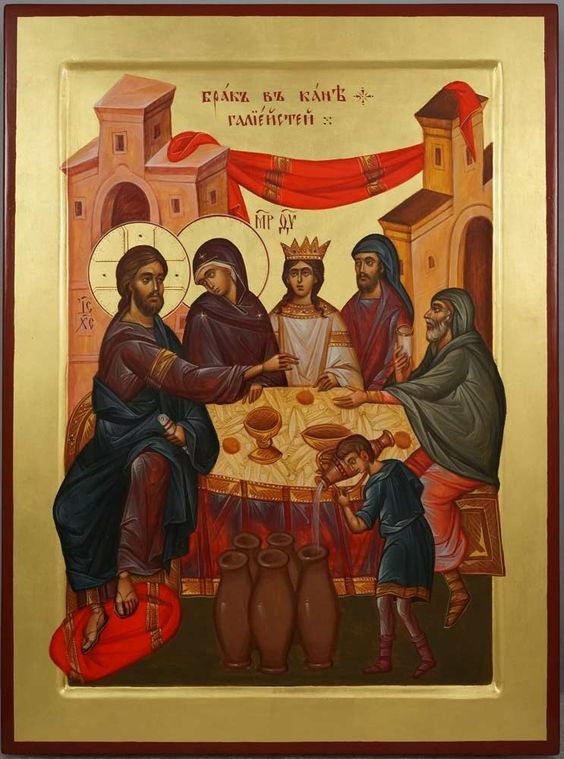
The relationship between this Mystery of Marriage, initiation, and renunciation is found at the beginning of Christ’s ministry at the Wedding at Cana,
“On the third day there was a wedding in Cana of Galilee, and the mother of Jesus was there. Jesus and his disciples had also been invited to the wedding. When the wine gave out, the mother of Jesus said to him, ‘They have no wine.’ And Jesus said to her, ‘Woman, what concern is that to me and to you? My hour has not yet come.’ His mother said to the servants, ‘Do whatever he tells you.’
Now standing there were six stone water jars for the Jewish rites of purification, each holding twenty or thirty gallons. Jesus said to them, ‘Fill the jars with water.’ And they filled them up to the brim. He said to them, ‘Now draw some out, and take it to the person in charge of the banquet.’ So they took it.
When the person in charge tasted the water that had become wine and did not know where it came from (though the servants who had drawn the water knew), that person called the bridegroom and said to him, ‘Everyone serves the good wine first and then the inferior wine after the guests have become drunk. But you have kept the good wine until now.’
Jesus did this, the first of his signs, in Cana of Galilee and revealed his glory, and his disciples believed in him” (John 2:1-11).
Lots to say from a Christian lens: six water jars being incomplete from the sacred and important Jewish and Christian number, seven. The jars used for purification ceremonies under the old Law being used for something completely new, bringing the wedding party together, alluding to the Eucharist and the Body of Christ.
The spiritual marriage between God and His people.
The Theotokos calling on her Son to rectify the social faux pas of not having any wine to serve to the guests showing that the blessed mother of God has her son’s ear and is by His right side.
Not to mention the alchemical ‘royal wedding’ and allegorical Gnostic interpretations of this story.
People spend their lives studying these eleven verses.
That being said, our focus is on the conjunction of this being Christ’s first miracle and His filling the jars with water, turning it into wine. This is a reflection of the kenotic relationship of the Mysteries of the Church, our becoming like Christ by pouring ourselves out as a libation as St. Paul writes in his epistle to the Philippians.
It is in this self-emptying of ourselves that Christ pours Himself into us and changes us from within, we are becoming the wine and Christ is “the true vine, and my Father is the vinegrower. He removes every branch in me that bears no fruit. Every branch that bears fruit he prunes to make it bear more fruit. You have already been cleansed by the word that I have spoken to you. Abide in me as I abide in you” (John 15:1-4).
The renunciation process begins by acknowledging that we are these six stone water jars—incomplete, imperfect and our purposes are for what is old, such as chasing after passions and giving up ourselves to sexual encounters that do not affirm our personhood.
Notably, these jars are specifically named as being for the Jewish rites of purification, but here we see the purifying nature of θέωσις and Christ’s Word, “You have already been cleansed by the word that I have spoken to you.”
“I am the vine; you are the branches. Those who abide in me and I in them bear much fruit, because apart from me you can do nothing” (John 15:5), abiding in God by becoming like Christ through surrendering ourselves in order that Christ might pour Himself into us and grow from within, by the power of the Holy Spirit, turning us into wine.
The vow of marriage is putting an end to one life and, together with another, creating something new, reveling in the ever-deepening revealing of the image of God within yourself and your partner. We are coming together acknowledging our own imperfection and incompleteness, putting off the old man and opening ourselves up to be changed by the Love of God and the person standing before us at the altar.
This means that both of you, when taking vows, are committing to one another to cultivate forgiveness, honor, praise, and patience because this is the step of a lifetime. Not only that, but as Christ and the Church teaches the Mystery of Marriage, like the transformative process of θέωσις only continues in the life to come, “Truly I tell you, whatever you bind on earth will be bound in heaven, and whatever you loose on earth will be loosed in heaven” (Matthew 20:18). There is no ’till death do us part, there is a continuation toward spiritual perfection in Paradise alongside one another, experiencing the ecstasy of self-realization and ever-deepening relationship eternally.
Remember that you have to die… and remember that death is not the end.
As “The Princess Bride” reminds us,
Westley: I told you I would always come for you. Why didn’t you wait for me?
Buttercup: Well … you were dead.
Westley: Death cannot stop true love. All it can do is delay it for a while.
Buttercup: I will never doubt again.
Westley: There will never be a need.
The Mystery of Marriage can be best thought of as: Forever we become.
And becoming is a practice of renunciation. The Mystery of Marriage is a practice of renunciation. A daily practice of surrendering the self to fully realize our humanity alongside another, wherein we no longer live for ourselves, but for the Kingdom of God being built anew between two mystagogue’s diving deep into the Mysteries, experiencing God and themselves, one step at a time. Forever.
… And wuv, tru wuv, will fowow you foweva …
So tweasure your wuv.
Si comprehendis, non est Deus
 Witness, NM