Catharsis, Calvinism, and Conniption Fits
“These are the ways you also once followed, when you were living that life. But now you must get rid of all such things: anger, wrath, malice, slander, and abusive language from your mouth. Do not lie to one another, seeing that you have stripped off the old self with its practices and have clothed yourselves with the new self, which is being renewed in knowledge according to the image of its creator” (Colossians 3:7-10).
I’ve been reading “Unseen Warfare” recently because I thought it would be a good supplement to the ongoing recovery project that I’ve been wanting to put together, and I have to be honest: it’s been pissing me off.
There’s so much that feels impossible about the text, waging war everyday… all day long? “Your attitude should be as of one already dead” (Unseen Warfare 93), keeping our minds in hell, and seeing demons everywhere you look. It feels paranoid and I don’t like spiritual literature that feels paranoid. It feels like the kind of works that cause spiritual psychosis wherein a practitioner is looking for spirit in everything; everything is a sign, everything an omen.
This is delusion and the Church calls it prelest. Granted, the spiritual works I find most edifying are recommended for monastics more than laity. I guess herein lies the danger of wanting to be a monk without a monastery.
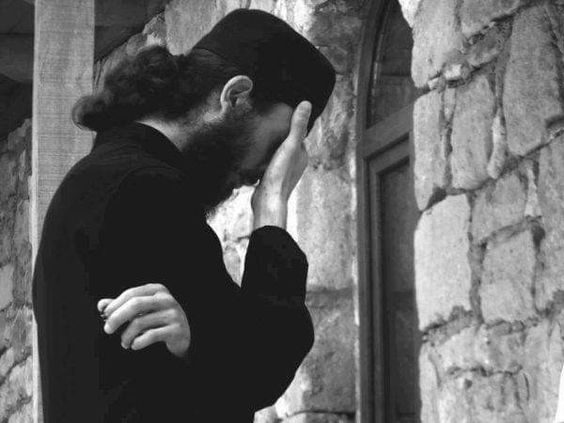
In any case, the book necessitates digestion in between bites, devouring this type of work might lead to spiritual psychosis at worst, and at best spiritual burnout.
What the book is a constant reminder of is humanity’s fallen nature, something I can get behind, theologically, but in practice it just seems so much like overkill. Yes, we have a fallen nature, so are we good? Does that make us all bad? Is there anything good in any of us?
There is the Calvinist view called total depravity which describes human nature as intrinsically sinful, essentially stating that human’s cannot choose to do anything but sin which throws theological wrench into the concept of God’s love. Through this lens God’s love is conditional where God can only love the elect, because God does not love sin and if human nature is sinful then God would not love our essence. This paints God as a strict, unloving parent which goes against everything we know about God, as well as implying the elect, who God loves, have a different nature than the rest of humanity.
If this were true it implies humanity has no free will which is problematic since humanity is made in God’s image and God has free will (unless we would dare to posit that God does not have free will). Ultimately, my issue with this theology is that it opposed to recovery which makes it incompatible with the transformative process of θέωσις.
Sin is not intrinsic to human nature.
It’s not our human nature that is corrupt, it is the environment in which we find ourselves that is corrupt. Our fallen nature is a result of inheriting Adam’s fallen nature, not his sin which means we are responsible for our own sins proving that whatever pisses me off just means that there is work to do on me, things need tempering, and there is room to grow. “It’s not your fault, but it’s your responsibility…” and that pisses me off.
Spiritual warfare is recovery, too. In the sense that I have no luxury to allow a slip-up here or a goof-up there. This is my life we’re talking about, and as much as it absolutely pisses me off that I can’t be like everyone else who gets to enjoy tying one on I just can’t… The one who gets pissed is the addict, still, wanting nothing more but to shift the focus back to me and my (dry) pity party.
But what is a luxury is that we have the choice to do something about it; we are not fixed in a natural state of sin as the Calvinists might believe but have the ability to partake in the Divine nature of God. We accomplish this by becoming a person which is the manifestation of the underlying essence of our individual selves by participating in the energies of God and seeking Wisdom.
Christianity is about becoming human, fully. This effectively means that we must cleanse our passions which render our noetic faculties corrupt due to their fallen nature.
The addict isn’t going anywhere, because he is me so this is where we need to start cultivating “right view;” this is where we need to start looking in order to continue down the narrow path that leads to life.
And that pisses me off.
“The order in which it is necessary to fight your enemies and struggle with your bad desires and passions, is the following: enter with attention into the heart and examine carefully with what thoughts, dispositions and passionate attachments it is specially occupied, and which passions is most predominant and tyrannically rules there. Then against this passion first of all take up arms and struggle to overcome it. On this one concentrate all your attention and care” (Unseen Warfare 116).
Anger is a unique tool, and it feels so good… It’s like taking a sledgehammer to a kitchen at the beginning of a remodel, it feels good to smash the things of old in order to start the painstaking, tedious project of rebuilding. It just feels better to destroy things, it’s a lot easier than rebuilding, it’s so much more fun to burn every bridge than it is attending to them or mending them.
Why, though?
Why is anger such as it is where overindulging is not just a possibility, but inevitable?
What about it is so addictive?
In the last few months, I’ve thought about anger in a practical sense. Anger sends signals to our brain that something in our life needs to change, or that something in our life is causing us harm. It’s a shield that we put up when we interact with people or situations that cause us pain, either physically or emotionally. These causalities leave in their wake a deep sadness within us, a longing.
A void.
Anger is a mask that we use to hide that deep sense of sadness and longing. And I have to assume this is why anger is so addicting, because we don’t want to feel our pain; we do not want to feel that deep sense of sadness within us or let others in on the fact that it is there.
It’s hard to express that sadness. it’s hard to open up to others about it, because to do so opens us up to more harm, the risk of abandonment, or we worry that by allowing ourselves to feel our pain we will be stuck forever in it, unable to get up, as if every wound we’ve incurred has been fatal. As if holding onto anger is allowing us to move forward. Choosing anger over expressing pain openly proves to be the fatal wound if it is the only tool we use to engage with others. It’s like assuming everyone we meet is going to hurt us, eventually, so why bother?
It’s like seeing demons everywhere you look…
The anger is something we need to grow to work with instead of allowing it to lead us such as it does because it leads to death, every time. This death is not one that gives way to resurrection. Death emerges from this death.
It’s Hades.
Anger is not a crucifixion… but if we crucify our anger then we allow ourselves to become vulnerable. Crucifying our anger allows our pain to express itself and heal. It is not anger that poisons us. I had that wrong back in March when I was trying to force all my anger out on the heavy bags at the gym. Anger is not the poison. The pain within us, the deep sense of sadness and longing, not allowed to express itself, is the poison.
If we don’t find a way to release this poison, then we will die.
It’s like running across No Man’s Land, being hit by the enemies’ arrows from unseen watchtowers and dark canopies of the forests lining the battlefield. Anger pushes us forward while we take damage; it keeps us safe long enough to find cover where we can reevaluate our strategy and attend to our wounds.
If we cannot find that cover or refuse to take it then we continue on with our anger, exhausting our faculties and growing weaker with every blow dealt to us by our enemy (who do not look like demons most of the time, but rather look like our friends and family), but if we don’t heal then we continue on with our anger, it becomes more and more apart of us, how we see ourselves, and how we see the world.
We’re in hell, always.
I was stuck in relationships, friendships, and with a family that made anger a defense mechanism in which I was able to take on a lot of damage from anyone who needed to inflict their own hurt on the world, because they also did not know how to heal. So, the only thing I could do was become angry; there was no safe place to heal and if we keep trudging through No Man’s Land… Well, you walk long enough with anger and eventually you forget why you started walking in the first place. And as a consequence, you forget where you’re going.
It was up until my baptism that I lived seeking out familiar terrain that would continue inflicting harm upon me in such a way that I could remain walking with anger. I think it would be crazy to say that I was enjoying living with anger, but maybe I was… What is more likely, or maybe what made it enjoyable, is that anger feels good because in my mind anger is normal. If I am upset, then everything is going accordingly. If someone is hurting me then all things are right in the world. If I’m not aware of the exits or potential hiding spots then something is wrong.
Truthfully, it makes more sense to me to keep trudging through No Man’s Land than healing ever could.
Through experience, it is simpler to remain angry because there really is no space allotted for healing in this world. If there was then I might not be infected with this passion as if it were a product of intergenerational wealth.
My problem is exactly this: I hold onto anger long after it’s served it’s usefulness and maybe it is because I don’t have a place I feel safe to heal, maybe it’s because it’s familiar, or maybe it’s because I’m a fucking asshole who likes being angry.
None of these options are going to help me grow, though. I’d put money on the third only because anger, as far as I’ve experienced and endured it, is like a Pyrrhic victory where one thinks they’ve gained control over their lives, but in reality they are powerless over their addictions—and their lives have become unmanageable.
Turns out if we don’t figure out how to get out of our habitual cycles of suffering then all we can hope for is assured destruction at the hands of our own pride. You watch as your whole is destroyed because you have to be right, you have to be better, you have to be validated.
Turns out if there is no crucifixion you’re just a fucking asshole who likes to be angry.
And that pisses me off.
The passions are improperly directed due as a consequence of our fallen nature, which is significant, because it this shows that the passions and demons are not the same.
There is such a thing as righteous anger, after all.
The mistake to not distinguish between them is what gives birth to puritanical thought (or, Puritanical view).
That being said, the passions cannot simply be ignored, that’s how the poison turns you into an asshole. The passions must be confronted because our passions are the branches of a sick tree which needs attending. Cutting off branches or vines will not heal the pain in our roots. The branches and vines are what make us human and we cannot become a person if we’re taking an axe to what needs tempering. The pain won’t go away, anyway. It will grow again and again, until we become exhausted by pruning the bad fruit and ignoring the problems below the soil. It’s like kicking the heavy bag until you’re too tired to think about your problems, hoping that this will make them go away (talk about prelest).
The Orthodox tradition talks about κατάνυξις (compunction); the gift of tears where one is completely overwhelmed by repentance and a change of heart that they cry over their sins and the beauty and healing of God. These tears act as rain for the hard soil that our trees grow from, allowing us a better view of the roots and the ability to trim them and uproot them. Most importantly, the gift of tears allows God’s love to shine upon them.
I believe this gift of tears is accessible to us by giving ourselves the gift of feeling the pain that we mask with our passions. When we take the time to truly find a space to let go of our anger and acknowledge the hurt underneath it a profound practice of catharsis reveals itself to us, in which we can cleanse our passions by getting to the root of them. The theological principle behind this is the idea that our passions are not bad, but grow out of an unhealthy environment.
The Way is liberation from the fallen world by redeeming our passions through their crucifixion.
Through the lens of the resurrection anger can be seen as a tool that is helping us get away from environments which are unhealthy, wherein we are unable to become persons. And because of the crucifixion we are able to detach from our anger which has served its purpose.
Crucifixion is the cathartic practice of thanking our anger, offering our anger to God, and letting it go instead of feeding off of it and allowing it to blind us to reality and bind us in place. As much as I do not wish to admit it, this is warfare and we can never leave the battlefield once we’ve begun.
This is a practice because we are not going to be good at it right away. Dying to the self is hard like that. I’ve been trying to get good at it for months now and I’m still getting mad at a book for trying to help me. So, don’t be discouraged if you find yourself reaching for the intoxicating tonic that is anger, or whichever passion is being improperly used to guard ourselves from the love of God.
If we keep going this practice will help us see things as they really are, not how we would want them to be, and with a healthier perspective, a right view, purifying the noetic faculties to help “set your minds on the things that are above, not on the things that are on the earth, for you have died, and your life is hidden with Christ in God. When Christ who is your life is revealed, then you also will be revealed with him in glory” (Colossians 3:2-4).
This glory is Wisdom. Sophia. Selah.
Si comprehendis, non est Deus
 Witness, NM