In conclusion…
“No one can drink, at the same time, of the cup of the Lord and of the cup of the demons. Nor can you, at the same time, be partakers of the table of the Lord and of the table of the demons. Or would we set ourselves against the selfhood power given by the Lord? Or are we, perhaps, stronger than he?” (1 Corinthians 10:21-22)
Divine will, or the will of God, is a concept introduced in the Hebrew Bible going on to influence Christianity and Islam. There is, to my knowledge, nowhere this concept is recorded before the Hebrew Bible, even the texts that may have inspired the Hebrew Bible do not make mention of the concept of Divine will.
This raises some questions such as: Does the “will of God” pertain to other cultures’ ideas of God, gods, and their relation to persons? Do other religions or spiritual traditions have this concept or is it exclusively an Abrahamic construct?
If so, then that would, of course, be reason enough for a Christian worldview that necessitates a sort of want to further God’s plan however if we do not really know what that “will of God” is then it seems to me that it’s really a misnomer justifying the actions of men.
The Roman cult of emperors was crucial to the state’s livelihood that to turn against the pantheon of divinized emperors was committing treason. The system worked with the Roman Senate voting on a deceased emperor’s deification—seeing a post-mortem apotheosis process which was, essentially, a continuation of older traditions of the Greeks and Roman cultures going back to Mesopotamia.
It was a Western mandate of Heaven that allowed rulers to trace their authority to the gods, giving their political power and influence an aura of sanctification.
The godman, Augustus Caesar, was also seen as a savior of his day in the early first century bringing might and power to the world, he was the benefactor of a world gone mad with chaos and uniting it under his military strength and command–his birth was seen as the evangelion of the age. These words ascribed to the emperor are recorded on a stone found in Turkey that are dated to 9 BCE.
This Roman cult of emperors would, of course, lose its state significance with the adoption of Christianity, but the divine rule would continue on through Christianity via the political legitimacy of absolute monarchies and aristocratic societies. The monarch was accountable to God alone and ruled as an extension of this divine authority; A political system where the royal head strategically conquers the world, Dei Gratia.
This form of God’s will, if we could call it that, is national Providentialism, which can be seen in modern times by Christian Zionist. National providence is the idea that God judges nations based on the virtue of their leaders as well as there being a special role–ordained by God–for nations that are particular to God’s plan.
Deus vult is the header of this interpretive framework that only seems to justify a nationalistic and imperialism lens of Christian authority–making the same authorities the same powers and principalities spoken of by St. Paul. The issue of these powers using the concept of God’s will as a war cry to take from others as well as to crucify lesser nations upon the cross of our Lord through oppressive missionary tactics and military occupations of third world nations that just so happen to have natural resources… or land. This… this is not what God’s will feels like it is supposed to mean. Christ came with a sword, but He did not come for oil and precious minerals.
Humans do that.
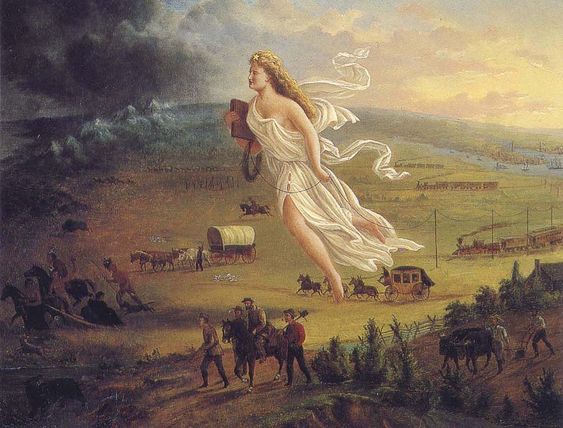
This form of national providentialism became popular in the 19th Century, during a time of British imperialism in Africa and the islands in the Pacific, the height of the Victorian period coinciding alongside Manifest Destiny and the Second Great Awakening in the burgeoning United States. National providentialism harkens back to the Roman Empire’s own unification of the Christian religion as a means of fashioning a stronger republic in the days of the early church.
National providence stands in stark contrast to personal providentialism which fell out of favor during this time, as both English and American religious leaders viewed the latter as superstitious. The rejection of personal providence may also have its roots in cessationist thought which is a product of the Protestant Reformation and a valued doctrine of some restorationist Christian sects such as the Churches of Christ, the stripped-down view of the gospels where one must adhere strictly to the law given by Christ without a grace-inspired conversion. The dismissal of personal providence is an implication of two other evolutions of Christianity: the refusal of single authority a la divine rulership (rejection of a Dei Gratia perspective) and the logical next step to a theology that has left behind its mystical foundations.
Regardless, personal providentialism is the belief that God has ordained people and has more of a personal role in persons’ lives would have fallen out of favor during this time as a nationalistic perspective took over exemplified in the concept of Manifest Destiny. This idea would negate personal providentialism where Anglos become responsible for wrenching the poor, darker communities out of their ungodly and savage ways by bringing them into the 20th century.
Or kill them trying.
In the Name of God, it is the white man’s burden.
Save the man, kill the Indian.
Deus vult.
The rejection of a single authority having Divine inspiration or connection can be seen in Protestant denominations that describe Catholicism as anti-Christian. The Protestant Reformation is mirrored in the colonies’ own breaking from the British crown, removing themselves from being under the authority of a monarch. This is a direct product of the Enlightenment era, of which the Protestant Reformation was a precursor. This form of liberation from Britain was just the right catalyst to instill an American psyche of independence. This notion would not be solely related to British authority, but eventually would even be the reason for some denominations to break away from Luther’s vision with some forms of Christianity developing a system of belief antagonistic toward even a modicum of catholicity.
It is this writer’s opinion that when we move away from the Nicaean creed than we are losing a foundational Christian thought giving the Second Great Awakening’s products such as Mormonism and Jehovah’s Witness ample room to grow, like weeds, in the field of God. Therefore, Lutheranism becomes yet another form of Christianity to reject by groups that are removed from the creed and see the Lutheran tradition as a step towards the traditions of men.
By that logic, it seems rational for denominations like the Churches of Christ to balk at the Sacraments, Liturgy, and argue over faith versus works. It turns everything on its head and develops doctrines that are separate from the councils, which means rejecting orthodox Christian thought. This is how we arrive at a place where denominations of Christianity crop up with no connection to the phronema of the church.
This disconnect is likely due to a rejection of church authority based on the Roman Catholic Church’s abuse of power, and—to the American perspective—a rebellious attitude toward the crown. This is perfectly illustrated by the near-extinction the Anglican Church faced in the days of the Revolution where it was, finally, made illegal to swear allegiances to British royalty nor pray for them. Notably, at the time of the Revolution it was assumed that high church Anglicans were Loyalists and low church persons were assumed Patriots. The Episcopal tradition survived due to the influence of the Scottish Episcopal Church which broke away from the crown prior to the Revolutionary War.
The First and Second Great Awakenings both saw a rise in membership for the Baptist (a sect that originally started by a group splintering from the Church of England in the 17th century) denomination in the U.S., it was not until Reconstruction that the Baptist church became a Southern institution by supporting segregation and the “Lost Cause” myth of the Confederacy.
Alexander Campbell and Barton Stone, the two heads that formed what would be later called the Churches of Christ, were both allied with the Baptist church during the time when their restorationist movement was getting started in the mid-19th century.
In both cases of the Anglican tradition still holding sway in the U.S. and denominations such as Baptist accruing membership while the Churches of Christ were gaining traction it seems reasonable to assume that the splintering off in the U.S. was a class-based, racially motivated schism. Lower-class (poor whites) rejecting the upper-class (rich whites), moving away from their own prescribed ways of worship. A likely result of the precedent set by the Loyalists and Patriots distinction between high and low church. Thus, we get the Churches of Christ, based not on pomp and circumstances, but solely on the Bible, without ecclesiastical tradition, form, or dogma. This conception of the Christian church was one that wanted to restore Christianity to its primitive model of the Apostolic tradition, wherein the house churches of early Christianity fit well into Campbell and Stone’s vision for church structure. They both saw that a unified Christian religion would usher in the apocalypse, in other words, becoming a predecessor of the modern Christian Zionist movement.
The First Great Awakening gave way for the Deist model of the universe which argues against Christian thought while having its basis in a rejection of a papal church system—seeing the intercessory role of Bishops and priests in communities as a means of control. This relationship would thus create a separation between God and man where our personal relationship to God is based on our relationship with a person.
This person, also, might be the only person in the community who can read the Bible since it is written in Latin.
This model of authority is contradictory to church teachings and the method of delivering the “Good News” to the masses in Eastern cultures via the Orthodox tradition. It is a blatant disregard of the words of Christ and St. Paul and if the defining principle of Gnostic Christianity is something that is hidden and revealed than the church under Rome’s authority created a Gnostic Christianity by its own missionary efforts.
So, with a Deist model of approaching Scripture then there is a precedent made for interpreting Jesus as either a man, a prophet, or nonexistent—but certainly not Divine. Biblical criticism, too, founded in the age of Enlightenment would have its own roots in a culture that was shifting toward a grounded, critical approach to scripture. This approach would be divorced of spirituality. And if one is reading the gospels not according to the Spirit then they run the risk of interpreting the words with their own biases and cultural perspectives. As in, the Bible’s own codification during the adoption process by the Roman state. All of this is how we get men claiming to know what is really going on in the Bible during a time like the Enlightenment or the Roman adoption of Christianity, spiritual upheaval and confusion.
This is why we must enter ourselves into the life of the church and the sacraments, because Rome does not have a monopoly on Christianity; Rome did not create Christianity, Rome did not invent the sacred mysteries of God (which St. Paul writes about in his first epistle to the Corinthians postdated to 53-54 CE), nor did they conjure the Messiah—they co-opted our Lord and sold His teachings as they could use them and propped up men who, puffed up on an earthly authority, took and took using the Word of God as their weapon of choice.
Now, when I was younger I was a lover of all things hardcore, specifically I loved the D.C. punk scene from the eighties and the concept I bring to you is a concept I learned about from that type of scene: Recuperation.
The idea of recuperation is a process, taking years sometimes, wherein the mainstream culture modifies or co-opts a (usually political) radical idea, organization, or subculture to blend it into the larger culture to nullify its subversive stance. Basically, domesticating it and rendering it powerless by being incorporated into the commodity culture and landscape, becoming a fad rather than an effective revolutionary schema.
For a light example Spencer’s Gifts and Target took punk culture and made it suburban, harmless, and even on some levels… pathetic. A more frightening example of Black Code and Jim Crow laws being implicitly utilized in the United States’ prison industrial complex.
The cultural impact of recuperation was felt immediately by the adoption of Christianity by the Roman Empire. This religio-political group was a radical cult of loose organizations tied to One, that is God, Who gave them Himself as a way for us to become like Him by grace, unifying our will with His, unifying our person to His energies. I am not sure one can get more radical than becoming like God, Who rose from the dead after the main authority, the mainstream culture, the corporate and bourgeois class put Him to death on the cross.
There is another term opposing recuperation: détournement. This French word means “hijacking,” and it is where symbols and expressions of capitalism and oppressive authoritative, commodity culture are flipped on themselves, used against that same authority.
Christ hijacked the symbol of authority used by the Romans. They neutralized Him with a humiliating death and then He humiliated the Roman Empire through His resurrection.
The cross was no longer their symbol of authority and control, but a symbol of the power of God. So, they, rather than giving the Followers of The Way greater credence by persecuting them took the symbol of God and made it a symbol of Rome. What was hijacked became authoritative and mainstream.
Radical Christianity is Christianity, but it was taken and co-opted at the very beginning by the Roman power structure. The same Romans who, for centuries, called Followers of the Way “cannibals” for celebrating the Eucharist and declaring their God as weak for having died, therefore it was extremely alarming to the Romans to see the religion become stronger in the region, not only that but to see the language used for Roman Emperors be co-opted by Christians calling their God, the risen savior—the Son of God.
The Romans saw Christianity, in its early form, for what it was: rabble rousers and revolutionaries following in the footsteps of their most radical liberator who disordered the very cosmos through His resurrection. And the Romans were rightfully scared of that proposition (since they had a hand in killing Him), so they moved the church into Rome, they did not conjure it or its hierarchy.
The codification of the Christian faith tradition under Rome may have given it great power and influence in the world, and to reiterate it did not need the Roman Empire supporting it to do that, but with the stabilization of a unified religion the Christian path was obscured for a national one.
Where the proto-orthodox and the Gnostic sects agreed was within the Christian faith there needing a student-teacher relationship, spiritual mothers and fathers, who could guide their spiritual children in the practice of faith and relationship within the community and with God. This would necessitate following the words of St. Paul, by feeding their children with milk and honey before they were ready for solid food. In this writer’s opinion, the Roman government’s adoption of Christianity as its state religion meant that milk and honey became the pinnacle of the mystical religion of the Way.
The Church, the Body of Christ, does not belong to the Roman tradition of power, violence, and imperialism. It does not belong to one man who claims Dei Gratia. The sacraments belong to the Way, and the Church is the great mother, whose womb is the given parameters for which we grow steadily in the image of our Lord: where we are fed milk and honey to become stronger until we are ready for solid food. When we move away from the creeds, doctrines of faith, and theology of the early church—yes, we move away from Rome, but we also move away from almost two thousand years of church tradition that was preserved despite Rome’s influence, even despite the proto-orthodox church.
These traditions are preserved in the East, having been applied with vigor since the Great Schism in 1054 CE, almost seven hundred years after the adoption by Rome, but without the almighty influence of the Roman state. It is my belief that what was once lost in the West is now being rediscovered through our own want to leave behind the Roman world and go out into the spiritual oasis of the deserts outside Hellenistic Egypt. There we will find a theology based on a true relationship with God, His will, and community. We will rediscover the Christian virtues of kenosis and theosis, that make all the other virtues pale in comparison. The virtues that are the solid food we seek in the field of our Lord. This movement of rediscovering true, radical Christianity: the Way promised by the cross returning us back to Him, reconciled and transformed.
This is the meaning of the cross, the meaning of the Way: we are called to return to Him and grow in His field; we are called above that to tend His garden. Some plant, some water, but we all tend His field and there is much work to do. We cannot tend His field while doing the will of those who would use their authority to gain the world nor should we give in to those same powers and principalities, because they will always try to thwart the Good for their own self-interest, they have, and they will again. To paraphrase a letter between St. Augustine and St. Ambrose, written a few years after the official adoption of Christianity by Rome:
When in Rome… “Do not allow the outer circumstances of the age to enter into you in such a manner that they dictate your way of being. Rather, strive for a transformation of your soul through constant renewal of your awareness, so that you develop perception for what is God’s will, for the Good, for what is harmonious and the aim of consecration of the world” (Romans 12:2).
Si comprehendis, non est Deus
 Witness, NM