Marcion of Sinope
“‘No servant can serve two masters simultaneously; either he will hate the one and love the other, or he will be attached to the one and despise the other. You cannot serve both God and the powers of all merely earthly existence at the same time.’
“The Pharisees, who were greedy for money, heard these words and made fun of him. And he said to them, ‘You put yourselves forward as moral examples before people; but God sees into your hearts. What is highly regarded among human beings may be hideous in the sigh of God.
“The Law and the prophets were valid until John came. From now on, the Gospel of the Kingdom of God takes effect, and everyone can enter it through inner effort’” (Luke 16:13-16).
Marcion of Sinope lived roughly 1800 years before the founding of the Churches of Christ, during the late first century CE into the second and he produced the proto-canon of the New Testament.
He believed that the Christ of the New Testament was revealing an unknown, alien God to the people of Israel and the Gentiles, where the soteriological perspective regarding this Christ figure is not one of reconciliation of the estranged, but a conciliation of strangers. Marcion viewed the God of the Hebrew Bible as a creator deity, but not the Supreme Father God that Christ preached about during His ministry. And while Christ is the Son of the Father, He is a spiritual entity, made of heavenly material, sent by the Father. This fashioning of divine material made His presence corporeal therefore Marcion was not explicitly docetic as Christ was able to and did suffer on the cross.
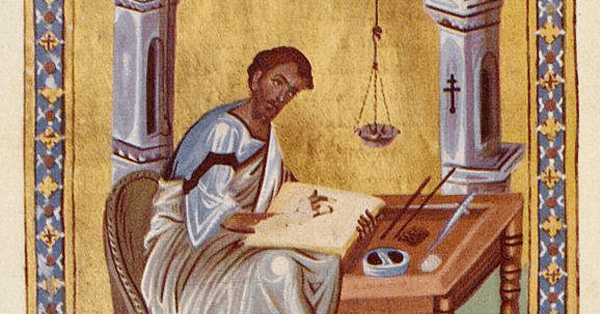
The docetic view comes from the idea that Christ cannot be the Son of the Highest God and a creature formed by the creator deity of the material world (known in some Gnostic traditions as the Demiurge).
Marcion built his theology and canon around the apostle Paul, who—to Marcion—was the only one who understood the teachings of Christ making St. Paul the only true apostle as the twelve failed to understand Christ’s teachings and ran away at the hour of His death.
Marcion’s canon includes only the Gospel According to St. Luke and ten Pauline epistles: Galatians, the first and second letter to the Corinthians, Romans, the first and second letter to the Thessalonians, Laodiceans, Colossians, Philemon, and Philippians.
Note: The Epistle to the Laodiceans is considered a “lost” letter with some scholars arguing that it is not really lost, but St. Paul re-using another letter, typically identified as the epistle to the Ephesians. Additionally, Scholars are divided on whether the second letter to the Thessalonians is authentic or a pseudo-Pauline epistle.
Marcion of Sinope felt that any diversion away from St. Paul’s letters would be a distraction or falling back into the teachings of the Hebrew Bible which were in opposition to the Pauline tradition (The Epistle to the Galatians comes to mind).
Marcion saw works as dead and faith above all else where the Law of Moses was given by a wrathful, jealous, and inconsistent creator deity. This deity is argued by scholars some to be a syncretic god formed from the Ugaritic/Canaanite Yahweh and El, a thunder god and a supreme, ruler god, respectively. These two gods may have been conflated through conquest becoming one single deity worshiped by the people of Israel (this is not the forum for an investigation, though). So, in Marcion’s cosmological model the deity of the Hebrew Bible is a different entity than the supreme, loving God of the Christian New Testament.
This type of theology is typically identified with the Gnostic Christians; however, it is interesting to see this type of disagreement amongst various Christian sects this early in Christianity’s history outside of the usual Gnostic v. proto-orthodox perspectives—furthering the notion that a unified theology was not conclusive until the third century with the Council of Nicaea in 325 CE, under Constantine I and, again, at the First Council of Constantinople under Theodosius the Great in 381 CE.
It may be easy to disregard Marcion of Sinope as a Gnostic or heretic, especially using a historical presentism perspective, it isn’t quite the whole story. According to the Patristic hypothesis, Marcion produced his proto-canon by revising the Gospel According to St. Luke, fitting it to his own pre-determined theological views. This would mean that the Gospel of St. Luke was written prior to Marcion’s canon, and that the original does not agree with his interpretation.
There are scholars that reject this hypothesis in favor of another: Marcion’s canon was produced before the Gospel of St. Luke that is found in our Bibles was codified, and the latter was a revision of Marcion’s text. A third hypothesis states that both Gospel recordings were independently written of one another, using the same source, and Marcion’s version was more faithful to the source material.
This common source that both would have used as the basis of their gospels is known as the “L Source,” an oral or textual tradition of the book of Luke and Acts that would have been used to compose the Gospel narrative.
There are various hypotheses floating around regarding the composition and dating of the gospels, especially considering the “synoptic problem” which focuses on where the synoptic gospels were gathered, how were they composed, what sources did they have available to write them—much less the question of who authored these narrative accounts. The Fathers of the Church disagree, continuing the issue of Christian in-fighting, with Clement of Alexandria, Tertullian, and St. Augustine all differing on when these gospels were written and who authored them.
The question of authorship was given new life during the age of German rationalism occurring during the Enlightenment era, with a variety of hypotheses springing up due to the newly founded biblical criticism school. Some argued that Matthew was written before Luke, and both were before Mark. Another hypothesis argued that Mark was the foundation of the synoptic gospels, being written before the two others, with Matthew and Luke taking from the Gospel of Mark and presenting it for different audiences.
My favorite, so far, is B. H. Streeter’s 1925 hypothesis taking from the two-source hypothesis, the Gospel according to Sts. Matthew and Luke were based on the Gospel of St. Mark and a hypothetical oral source called Q; and developing the four-source hypothesis, which adds the hypothetical oral sources deemed M and L which are also hypothetical materials which formed the Gospels of Matthew and Luke. This hypothesis posits that the Gospels arose separately of each other with the Gospel accounts being written over a period of time, dating far into the second century, composed of cut-and-paste writing style from written sources which had their basis in oral traditions and folklore. This hypothesis is not supported by scholarly evidence.
The late dating of the Gospel narratives, however, does point to another hypothesis that brings us back to Marcion with some scholars posing that not only was it his composition of the Gospel According to St. Luke that predates all other gospels, but it was his Gospel narrative that influenced the synoptic gospels and the Gospel According to St. John.
The implications of this cannot be overstated, especially considering the high theology of the latter work. This would mean that Marcion of Sinope, anathema to the church, is responsible for an early Pauline Christian tradition and is foundational to the speculative Johannine community.
And while the official academic position on the composition of the synoptic gospels is “practically insoluble,” as stated by the reposed Fr. Joseph Fitzmeyer, Catholic priest and biblical studies scholar. It is also the official position of scholars that the Gospels were most assuredly not written on the day of Pentecost, circa 33 CE.
Marcion of Sinope’s contributions to early Christianity cannot be understated as he was the first compiler of a New Testament within the church, regardless of his connection to the proto-orthodox movement at the time. The proto-orthodox labeled Marcion a Gnostic in an attempt to discredit his theology, and while Marcion was a dualist, certainly, that does not make him a Gnostic Christian. He believed that the Hebrew Bible’s referencing a Jewish Messiah figure was not the Christ of the New Testament (something the Jewish tradition would support), and this entity known as Christ was sent by the Monad—the Father God—to come to us and reveal the truth of existence, to help us escape from the material world which was built by the creator deity of the Hebrew Bible.
Marcion’s cosmology includes an unknown, alien God that Christ revealed through His ministry, an unknown God Who can only be known through His Son, Jesus Christ. This God was previously disconnected from this world until the Incarnation of His Son.
This Christ is not a savior deity, but a liberator.
Now, in light of the Incarnation Marcion is wrongfully attributed to the Gnostic school of thought because his theology comes directly from scripture, his teachings and philosophy are not revealed through esoteric initiations like the Gnostics nor are they a secret wisdom taught to only a select few of congregants.
Marcion argues his theology using the epistles of Paul.
Christ as liberator typically gets categorized as Gnostic, however Christ did liberate us, using Orthodox theology, from the sting of death and the consequences of sin. Christ is a liberator.
St. Paul being regarded as the only true apostle is Gnostic, too, however, to reiterate the Gnostic schools portray Pauline wisdom as secret and revealed therefore Marcion’s Pauline tradition does not fit into this Gnostic camp. This seems like a tactic of the early church to discredit his canon and teachings which were founded on Paul, who the church holds to such a high esteem. Marcion of Sinope was a student of the gospel and Paul, who he felt was the only apostle worthy to disseminate the true message of the Gospel. He felt that the gospel tradition lacked prominence in the church, or that it had become disfigured in Christian communities. He sought to reform the Christian truth by delivering it out of the hands of the Jewish faith tradition and restoring the Pauline school of the gospel to its rightful place at the core of Christianity. This restorationist vision Marcion had for the Christian tradition would be totally divorced from the Jewish faith and the Law of the Hebrew Bible.
He stood for a return to the wisdom of the gospel and its understanding brought to us by St. Paul which poses him as a first reformer rather than a Gnostic.
Regardless of Marcion’s vision of Christianity being purer than the proto-orthodox movement at the time, this further demonstrates that in the days of early Christianity there was no consensus among the Christian communities, even among the sources for the synoptic gospels there is evidence for them coming from oral and textual traditions of the day with no scholarly consensus on which came first, who wrote what, and where any of them originally came from.
Marcion of Sinope was excommunicated around 144 CE, before the adoption of Christianity by Rome. He was a bishop in Rome before his excommunication and had already developed his theology and was ousted by the church due to in-fighting between him and the other bishops leading to his organization of a separate community, based on his teachings. The Church Fathers were not kind to Marcion: painting him as a Gnostic, an explicit docetist, and recognizing his canon as a willfully ignorant attempt to rewrite the Gospel narrative (even if they hadn’t been written yet).
No matter where the texts that became the synoptic gospels came from it is the opinion of this writer that Marcion was incorrect in his views toward the Jewish tradition, his own perspective disqualifying a typological lens aimed at the Bible as a whole while also cutting a vital root of Christian theology through the negation of the Hebrew faith. It goes on to illustrate an unfortunate history of the Christian church expressing antisemitic ideas from the Gnostic Christians to Martin Luther. Even though both the Christ figure and St. Paul were both, you know… Jewish.
Christianity is not in opposition to Judaism; it is grateful to it and builds on it while being distinct from it.
Perhaps due to this rejection of Jewish tradition he also reaches a heretical view of Christ’s nature, while I would argue he is not the docetist his detractors would characterize him as, his view opposes Jesus Christ’s manhood and Divinity. His approach is similar to the heretical teaching of Arianism, stating that Christ is not coeternal with the Father; nevertheless, according to Arius, He was begotten by the Father before emergent time. Both Marcion and Arius’ teachings oppose the Homoousion doctrine of the early church, the latter being declared anathema by the First Council of Nicaea of 325 CE.
It should be noted that Nicene Christology, or trinitarian Christianity, became the official state religion of Rome in the year 380 CE. Arianism and unitarian teachings continued outside the Roman Empire with their modern incarnation being embodied by sects like the Jehovah’s Witness and Mormonism, two products of the Second Great Awakening, go figure. Furthermore, the Unitarian sect, gaining newfound popularity in the 16th century, was an early Protestant Restorationist movement. It considered the primitive church as the true Christian doctrine and the trinitarian belief was a corruption of the original Christian tradition, but I digress.
Marcion’s canon focusing on the Pauline epistles and the Gospel of Mary’s own allusion to St. Paul’s writings regarding the mystical elements of Christianity is where we must go now with a look at St. Paul, the earth-shaking magnitude of Judaism’s impact on the spread of Christianity, and the true core of the Way.
The Way as practiced and taught by Christ and, according to Gnostics, the heretic Marcion, and the proto-orthodox church, lived by Paul the Apostle.
Si comprehendis, non est Deus
 Witness, NM