I’ve been invited to do a podcast
“The opposite of faith is not doubt, but certainty. Certainty is missing the point entirely. Faith includes noticing the mess, the emptiness and discomfort, and letting it be there until some light returns. Faith also means reaching deeply within, for the sense one was born with, the sense, for example, to go for a walk.” — Anne Lamott
I was talking with a friend recently about his road to recovery and how it’s taking shape in this phase of his sobriety. He has a year on me in terms of putting the bottle down as well as a few years, so his wisdom and struggle have always helped me define my own.
In fact, the series I started working on in relation to the Twelve Steps was inspired by a talk I had with him when I was at a low point last fall.
He was the first person I ever confessed wanting to go sober to, waking up in his guest room after a night of doing nitrous, shots of moonshine, all glued together with a steady stream of whiskey sodas.
The show was a competition themed show with comedians on teams performing either drunk, sober, or high. I was team drunk and I got there late—so my night began with two whiskey cokes back-to-back. They hit me in the middle of my set. The only thing I remember is finding a wheelchair in the green room and rolling around like a drunk Ironside hunting down whip-its.
I stopped drinking whiskey not too long after this; it would be much longer until I actually got sober, of course. The easiest time to quit drinking is the morning after and the easiest time to forget all about wanting to quit is the afternoon of the same day.
He wants to start a podcast as a vehicle to further his recovery and asked me to be a guest on the first episode. He called a few days before we recorded to go over some things; this is a precious time in a podcast’s life, because they are usually all suck due to no one having a plan or wanting it to just be a “conversation between friends.” I’ve seen a lot of comic’s podcasts crash and burn, mostly because the only people who care about who’s talking are the ones doing it. So, I try to stay away from things like this, but this is one of my oldest friends and being able to talk about the journey-so-far sounds really nice.
I’m not an AA guy, so any chance I have to speak with another guy in recovery I’ll jump at the chance—even with AA recovery is a lonely business. It’s like being a part of a terrorist cell with members all over, blending into society, but no one in the organization knows about our fellow insurgents. We’re all just, to use a Christian term, working out our own salvation in the absence of others.
We have to become our own leaders, we need to take responsibility for our own lives, without the dependence on another person—hints the first step of AA.
Regardless, my friend and I were catching up, trading lamentations and he told me about his idea. I won’t ruin his premise but talking with people like me… like him… who didn’t necessarily wake up in a pile of trash with a note pinned on our jackets from a wife who’s taken the kids to have our epiphany, hitting bottom moment where we finally got our act together.
Real alcoholism isn’t nearly as romantic as that.
You don’t lose everything in one night of drinking—you gain, you lose, you break even, people leave, and people go. It feels like real life. The thing that is going on, however, is you lose a little bit more of yourself as the days turn to nights and the dawns break through the black. You just get sadder, little by little, you get more distant from who you are and what you want.
You hit bottom and you just keep digging.
There is no come to Jesus moment when it comes to this kind of life. You either decide to clean up or you don’t—it’s a choice. It’s always a fricking choice.
Even now, today… It’s a choice. Luckily, I’ve been making myself busy for the past three years making that choice very, very insignificant, but it’s still there. I’ll have a family one day: a wife and kids, a career, a joint-checking account and it’ll be there.
A part of me will always wonder if I just stopped drinking too early in life. That will always be a part of my recovery: that question. Did I sober up too early?
The fake teeth I have are as good of an answer as any, but what do I know. That’s the want to keep digging talking, I guess.
What I do know is that alcohol didn’t end with me losing everything in a fiery explosion of emotion and liquor. It just ended with me not wanting to wake up feeling like I was dying for the rest of my life. It was not as if I woke up with the worst hangover I’ve ever had; it was just the last hangover I ever wanted.
In any case, on our phone call I made mention that it was not until I actually went sober that I started losing things.
And by that, I mean everything.
I lost everything a fifteen months after I stopped drinking.
I think this is what people should talk about in relation to quitting drinking and recovery. It’s not talked about enough and I guess it has to do with a policy of honesty.
If people knew how hard it is to start recovering then no one would do it.
Truthfully, it comes back to change—always—because looking back, if I was not willing to let go of the life, I was comfortable with, then I would not be in the place I am now, which is living a life I am proud of. It’s not always comfortable, but it really shouldn’t be. If I clung to the life I knew or who I was then I might still be in a situation that I didn’t want to be in and couldn’t see a way out of, but because it was what I knew it was easier to stay.
But all of that ended abruptly, after I got sober and started my own recovery, because when you start getting your life together then things really start falling apart. It feels a lot like being cast adrift at sea with no sign of land, no sign of sunlight, and waves crashing all around atop your head. The reason is they have been held together by a string for so long that when you take steps to rectify your issues and become a high functioning alcoholic person then everything you’ve built has no more substance-fueled inertia and it collapses.
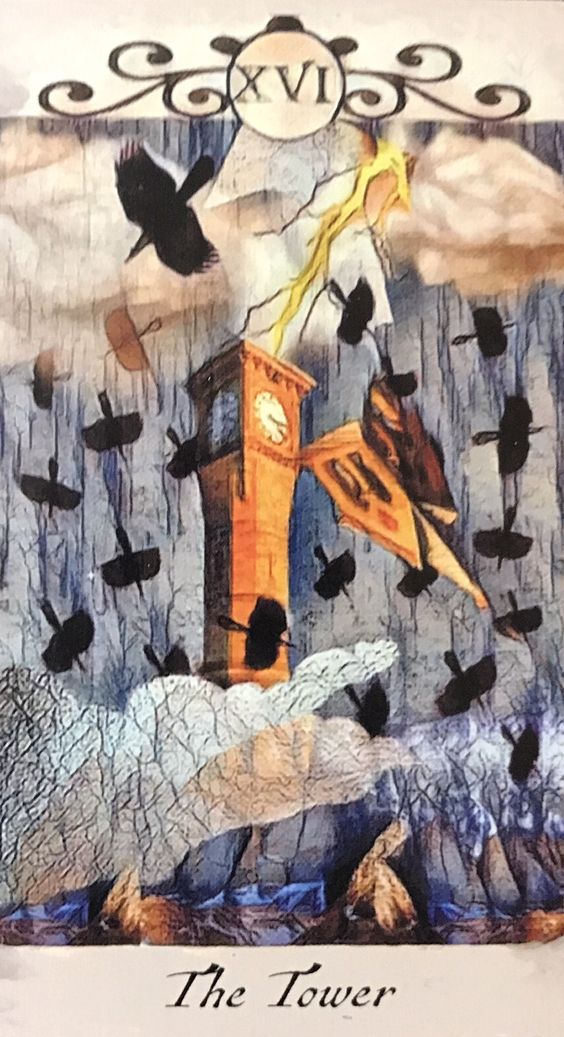
This is The Tower card moment where our castles crash because they were built on sand.
It is scary to take those steps toward a brighter future because when you do so you will lose everything, your whole, but paradoxically, that is what you are gaining by taking steps out of our own self-deluding cycles of misery.
The Tower moment is a good thing because it allows us to reshape our lives on a sturdier foundation and in that sense, it deserves to happen. I mean, you can live a lie–people do it every day—but what is the point in that? What kind of life is that? Where is the fun in staying locked in patterned behavior? Where is the excitement in remaining stagnant?
It’s boring.
I know it’s boring because I’ve been there.
So, when we don’t address the very real possibility that by taking steps toward sobriety and recovery, we will lose our lives that seems like more self-deluding thoughts that are qualities of the addict. Things need to be easy; things should not be challenging—but that’s not how life works and that is certainly not how breaking the cycles of addiction work.
It’s all samsara to me.
The addictive personality is, in my experience, characterized by a narcissistic perspective. It does not matter much to me where addictions stem from within our own traumas or guilt because the expression of addiction is inherently ego-centric that puts the one above all in an idolatrous relationship with substances.
I remember when I first saw this in other drinkers or substance abusers before doing it myself, much to my embarrassment, but when someone starts out on their journey away from their substance of choice, they want the accolades. If they are unserious about their attempt to get sober, then they are seeking serotonin-receptor hitting attention. They get a couple high-fives and a few congratulations when they tell others they have put down the bottle, then they pick it right back up because they got what they wanted out of “sobriety.”
It takes losing everything to find yourself, but you really cannot hope to find anything unless you do. The scary part comes from the fact that you have no control over this. If you really take steps to gain control of your life, then life begins by showing you how little control you’ve had the entire time. The plates stop spinning and everything crashes–there’s an awful lot to clean up before you can even begin putting things in order.
It’s taught through the Resurrection: death is a messy, horrifying thing, but if you willingly crucify yourself and die to these old patterns you will find life on the other side.
But you have to go all the way.
You do not get half-credit.
That life, by the way, is not comfortable—there’s new responsibilities and there’s the old wounds on the other side, wounds that have been carrying you for so long but now you have a choice in how you carry them.
Some days it feels like they carry me and on others I carry them on full display with every wide-eyed grin I offer to the world. Things come, things will go–I’m still here, learning to accept that faith and doubt are one and the same. It takes both working in unison to take steps toward life, because when the tower collapses they are all you have left: doubting the choices you made while having faith in the same, because something really special comes out of being with the discomfort and emptiness of laying down our lives and waiting for the light to return.
In absence of others can we choose to trust that the light will return?
I think salvation only happens with a lot of doubt and a lot of faith, but it does not happen with certainty. That’s why it’s hard to let go of everything we start losing when we try to take steps toward the uncertain dark that encompasses doubt and faith.
If it’s always a choice then I suppose I’m choosing to remain with the discomfort, the hunger, and the thirst for these things will be filled. Christ, like nature, abhors a vacuum.
So, with that in mind I’m still sweeping the ruins of my tower, trying to build a foundation, and at the drawing board every day planning what it will look like one day–uncertain of what it look like and choosing to be open to what reveals itself, in time, as more light returns to the shore.
Si comprehendis, non est Deus
 Witness, NM