Removing the Stone of an AA Awakening
Christ is in our midst! He is and ever shall be!
“All things were made through Him, and without Him nothing was made that was made. In Him was life, and the life was the light of men” (John 1:3-4).
The hotel room is nice… Too nice… The bill will be expensive, but that is what happens when one thing goes wrong: everything starts becoming unreasonable. I set up an altar with my icon of St. Antony (a Christmas gift from my girlfriend’s father) in front of the television and I pray.
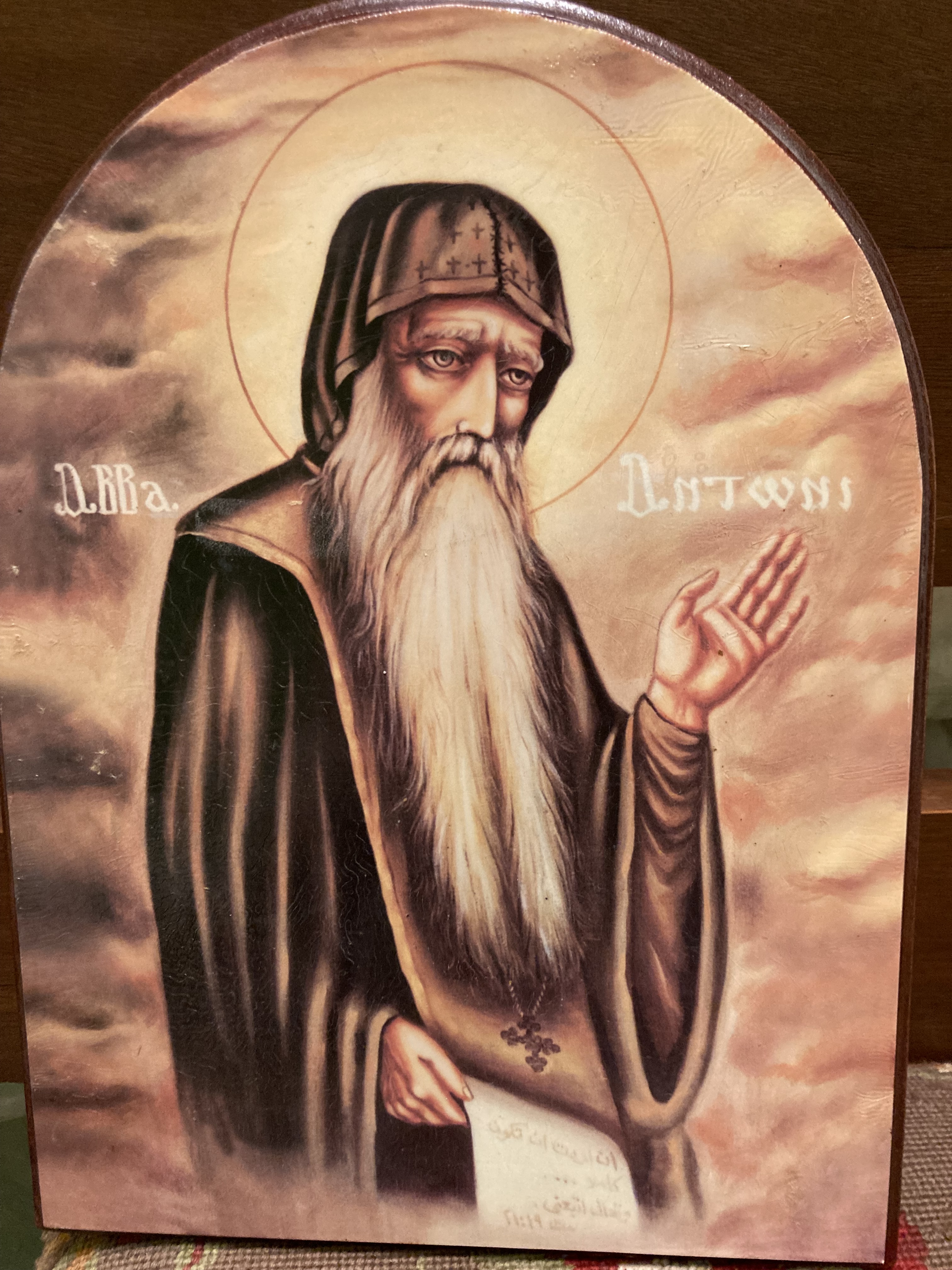
St. Antony pray for us.
Hades grows stronger with the sweet smell of one who thinks they can do everything on their own. Especially hide. And there the problems grow bigger and bigger until it consumes me and directs my path for me, becoming me. I have no idea how great they are in the dark, where even the smallest noise seems like a sonic boom. There is no perspective in the dark, things just get worse, far from God all our problems torment us into oblivion.
They drive us crazy. They drive us crazy enough to practice a form of apotheosis in reverse where all our worst qualities: self-loathing, cynicism, self-destructive tendencies (you name it), they’re all pushed down, conjuring an idol being fed with the blood sacrifices and fear.
In the tradition of the Palo religion, which is a syncretic system of belief that developed out of the African diaspora with connections to the Kongo religion, Roman Catholicism, and Spiritism. The religion came to fruition during the Atlantic slave trade wherein African slaves that were brought to Cuba blending their Central African traditions with Roman Catholic iconography. Through the use of Christian icons, the enslaved Africans were able to practice their beliefs in secret by using the symbols of Spanish slavers’ religion—Catholicism.
For example, the death loa and consort of Baron Samedi in Haitian vodou, Maman Brigitte, has been syncretized to the Catholic Saint of Ireland, Brigid of Kildare. Interestingly, the principal creator in Kongolese cosmology is named Nzambi Mpungu, who plays a more deistic partner to the world of the living and the dead in Kongo mythology, having grown bored with his creation and withdrawing from it. Nzambi Mpungu’s name, though, was chosen by European missionaries to represent the Christian concept of God the Creator.
Side note: this is a great example of how egregores morph and form through social construction and cultural overlap feeding these entities with a variety of worship and veneration, symbolizing the energetic relationship between God, gods, and humanity.
The Palo religion is based heavily on material elements that give the practitioner access to the world of spirit. The dead play an important role in Palo; their belief states that there is no death, rather a system of reincarnation, however the veneration of ancestors is important because it is the ancestors that have access to the world of spirit, and they are bound by duty to help the living.
So, the process of ancestrilization is critical to this religion, wherein a spirit becomes a part of the living world without moving on into the various forms of life through reincarnation. The question is: How does one become and remain an ancestor?
Ancestral veneration is not unique to the Palo religion or its mother traditions that came from Africa, nor is it unique for the bones of the deceased to be treated with solemnity. The saints and their relics are point enough for this reality, and in the same way that the Church saves and venerates the bones of the saints the Palo religion keeps the bones of their dead, believing that the person’s essence remains within them.
Side note: Transfiguration Sunday is coming up which is, in my mind, one of the most significant events in the Synoptic Gospels. Theologically, it is a revelation of the Nicene Creed before the Holy Spirit, Whom proceeds from the Father. The moment of the Transfiguration is a Theophany, complimenting the baptism of Christ our Lord in the river Jordan by St. John the Forerunner.
The Theophany is a revelation of the Christ being the Word of God, the perfection of humanity; He is the mooring rope between Heaven and earth—the door. Christ comes to us as a summation of the Law and the prophets, Moses and Elijah, but this is not simply a metaphorical vision of the two. The Holy Spirit and the metamorphosis of those who follow the Way are alluded to in this transfiguration. God incarnate comes to us fulfilling the Old covenant and bringing forth a new one, that is, everlasting life which is represented by the one whose face shone like the sun and the one who “went up by a whirlwind into heaven.”
The Theophany reveals to us who we might be through the power of God and His spirit, transfigured like Christ, The Word of God, the θεάνθρωπος, on the mountain. It also reveals the reality of the cloud of witnesses who pray to God for us and our salvation. Moses and the prophet Elijah are a window into Heaven, life in the age to come, more brilliant than the shining of the sun and with perfect, just as the Father is perfect.
Another quick point: the Theophany also demonstrates the invalidity of the doctrine of transubstantiation. Christ is not made the Son of God through baptism; He is not God incarnate in the Transfiguration. He is always God and always Man, always the Son of God since birth and these things God did in the sight of men were for our benefit that we might believe. So, the wine and the bread are not wine and bread, but they do not become the Body and Blood of Christ when the bells have rung, the correct prayers have been said over them, or when the collection plate has been offered. The reality is we do not know when they are made the Body and Blood: does it happen in the field as the wheat is sown? Does it happen on the vine? Does it happen during fermentation? Does it occur when the yeast rises?
I don’t know; it is the Body and Blood of Christ. It is a mystery of His Church. Selah.
Now, there are material objects used in the Palo religion that make up a central piece of the practice, these objects are cauldron-like containers that are spiritually charged and filled with dirt and sticks–earthy elements. This vessel is known as minkisi in the Kongolese tradition, where the container is used to heal the sick, abolish evil, and protection among others.
The Palo tradition took a different step with these containers, however with the cauldron-like object taking the name nganga (also the name for shamans in the Palo religion) that is filled with nfumbe, which is human remains. The human remains, containing the essence of the person, are now under control of the Palo practitioner where the spirits of the dead are called upon to the bidding of the living.
All this to say, when we hide our faults and problems from others and God were are creating a nganga within us, feeding it with the nfumbe of what we refuse to let go of; our fears, our addictions, our BS–all of them controlling us in our distorted apotheosis. The practice of hiding ourselves from others is distorting reality, wherein we believe that we can self-will ourselves to be in control, to be a god–to be God. So, it is a violence done on the world rather than heaven; it is a violence done on the self, constructing an ego as if it were a life-raft that will carry us from “glory to glory” (2 Corinthians 3:18). The nfumbe that we feed the nganga is the blood of the innocent, spilled in the form of wariness and disconnect from others, ruminating.
It drives us crazy.
We’re not able to comprehend the Light, convinced we are right and the world is wrong.
The idol that we carry within us, like an Ark that we use to traverse the turbulent seas of life is not in the form of a god or God; it is in the form of shit. Sweet-smelling shit. And we worship it by feeding it thoughts based on fear and pushing others away. “No one can serve two masters; for either he will hate the one and love the other, or else he will be loyal to the one and despise the other” (Matthew 6:24), therefore in the AA system relying on a Higher Power that is anything other than the One True, Triune God is a step toward fear; a step toward worshiping a nganga filled with our own nfumbe, as a walking corpse through the Hades of our own creation.
We are the nganga, filled with whatever sweet-smelling destruction crosses our path and the charred remains of what is left.
God demands we give up our attachments to this miserable existence of death.
“I am the Lord your God, who brought you out of the land of Egypt, out of the house of bondage. You shall have no other gods before Me. You shall not make for yourself a carved image—any likeness of anything that is in heaven above, or that is in the earth beneath, or that is in the water under the earth; you shall not bow down to them nor serve them” (Exodus 20:2-5).
Egypt is the land of death and enslavement; the false gods are the ones we create within ourselves, fashioned in the likeness of the prince of the world built on lost relationships, lost freedom, lost time, and lost humanity.
The loss of humanity is a given due to what we become which the god built in the dark, consuming us and taking over our lives–distorting our perception thus our reality. We are no longer there because we are become the dark, and the darkness overcomes us. Our lamp neither shines or brings in light, our hearts are hardened to love and those around us, while our appetitive faculties know no satisfaction, only wanting more—aimlessly wandering through Hades, until we can hardly recognize ourselves because any community left is used by us and the only mirror we have left is the idol lying within us reflecting back our own worst qualities, our secrets, our BS, convincing us of who we are until we believe it.
We no longer see God within us, nor do we see God in anyone else–we are becoming a satanic symbol, a divine reality inverted, enfolding into ourselves, away from others. Our hearts harden and we believe we are our worst qualities, our mistakes, our lack of love.
We believe because we forget that we are fashioned in His image.
Why do you think we are all so good at building?
And destroying?
When we build to have things all to ourselves, safe from the eyes of God or others, then we are making a tragic misstep of idolatry and ego, because it belongs to God. Everything belongs to God. Even if we hide it deep down, hide ourselves, there is no place God is not; even in our sorrow and our trauma, our brokenness… Our own personal Hades.
We see it readily with people who have extreme aversions to giving up their substance of choice, when someone is addicted to alcohol or a certain way of thinking the idea of letting it go means, to them, losing a part of themselves. It is scary because we feel we might disappear altogether.
Seriously, my first year of sobriety I thought I was going to disappear—not just in a metaphorical sense, either; I was consumed by the inevitability of my being snuffed out of reality because what used to fill me was no longer propping me up.
I know now, though, that this is absolutely not the case—if it were then the Buddhists attaining nirvana are working much too hard on their spiritual liberation. It is not true that we disappear when we let go of our addictions, because humanity is made in the image of God, therefore the practice of κένωσις means becoming more like who we really are, which is being a child of God.
“Birth, awakening and recall,” from the Meditations, are, in a Christian sense, recovery.
Our anonymous friend, the author of Meditations likens this recall to a miracle as well as to state, “that there is no freedom outside of the miraculous and that man is man only in so far as he lives from the miracle, through the miracle and for the miracle” (Meditations on the Tarot 349). The author compares the mystery of recall with Christ raising Lazarus from the dead,
“Now Jesus loved Martha and her sister and Lazarus […] “When Jesus came, He found that he had already been in the tomb four days […]
“Jesus wept.
“Jesus said, ‘Take away the stone.’
“Martha, the sister of him who was dead, said to Him, ‘Lord, by this time there is a stench, for he has been dead four days.’
“Jesus said to her, ‘Did I not say to you that if you would believe you would see the glory of God?’ Then they took away the stone from the place where the dead man was lying. And Jesus lifted up His eyes and said, ‘Father, I thank You that You have heard Me. And I know that You always hear Me, but because of the people who are standing by I said this, that they may believe that You sent Me.” Now when He had said these things, He cried with a loud voice, ‘Lazarus, come forth!’ And he who had died came out bound hand and foot with graveclothes, and his face was wrapped with a cloth.
“Jesus said to them, ‘Loose him, and let him go’ (John 11:5-44).
In this one story we have every bit of miracle that can help us on our road to recovery, the narrow way to life; Christ weeps for He loves us; His tears are a portrait of His grieving of those of us who are swallowed by death.
Christ shows us the gift of tears that are a part of κατάνυξις (compunction), the shedding of the filth within our souls that blocks us from God, even our own families. This blockage, the stone is taken away through prayer, through the opening of one’s heart, softening it in repentance. This is work; Christ cries aloud into the tomb, He is projecting His love into the shadows of death. This projection, this effort is mirrored in our practice of prayer, wherein the operation is meant to pull the manual labor of repeating such sacred magic as the Ave Maria or the Jesus prayer down into the heart, where it can radiate outwards from within. Christ calls forth Lazarus, recalling him from the bondage of forgetfulness, his “death, falling asleep and forgetting.”
This is love, this is the work, binding ourselves to the miracle of love, working through it and for it—this is not the alchemical Great Work; this is the most important work of a human being, becoming perfectly human–like Christ Who weeps from love, through love and recall we are freed of our enslavement and entombment, becoming like family through His Blood and His Body, shed for us from love, through love, and for love.
Christ calls Lazarus by name, much the same as we are all called by name whether it be in communion with His precious Blood or in a smoky church basement, we are called by name:
Hello, my name is Lazarus, and I’ve been dead for four days.
Hi, Lazarus, “Fear not, for I have redeemed you;
I have called you by your name;
You are Mine.
When you pass through the waters, I will be with you;
And through the rivers, they shall not overflow you.
When you walk through the fire, you shall not be burned,
Nor shall the flame scorch you” (Isaiah 43:1-2).
Christ is with us.
We cannot stuff anything down far enough that God is not, “For nothing is secret that will not be revealed, nor anything hidden that will not be known and come to light” (Luke 8:17). And that means being honest with ourselves and others—and God, removing the stone and letting the Light in.
God has defeated death by death, He has come down to Hades, He has trampled the leviathan and its jaws.
“Fear not, for I am with you” (Isaiah 43:5).
No matter how dark it seems or how far away from God you try hiding, He is with you. He will never not be with you.
He is in our midst.
Alway.
Si comprehendis, non est Deus
 Witness, NM