At the Intersection of an AA Awakening
“We will not regret the past nor wish to shut the door on it” (AA Promises).
“Jesus answered them, ‘Most assuredly, I say to you, whoever commits sin is a slave of sin. And a slave does not abide in the house forever, but a son abides forever. Therefore if the Son makes you free, you shall be free indeed’” (John 8:34-36).
I walk down the pick-up point to the first column, then back again to the last, over and over looking for a cheap hotel. I can’t get a Lyft to take me anywhere because every cheap hotel in town is too close to make it worth the driver’s time. I walk back and forth for an hour, it’s almost one in the morning, then I see someone arguing with a hotel’s shuttle’s driver. He doesn’t have a reservation, the driver says he needs one. I come up and confess the same circumstances, the driver looks at both of us, we look at each other and shrug while he calls the front desk. He’s on the phone for only a second before hanging up to tell us to get into the van.
Proof positive that even strangers are stronger as a team.
We head to an undetermined hotel bill and I think about the Second Step, a Power greater than ourselves in the Christian tradition is the Trinity—three Persons, distinct and unique unified in essence… a Power greater than ourselves that we use to structure our lives going forward, a blueprint of how to be; Christ is the prototype of the perfected human being, and by extension the Trinity is the model for perfected humanity: communal.
The Trinity exists in communion, so to become like God we need to exist in communion—with God and others. We need other people and we need a Savior; the resurrection is only possible through God, “For none of us liveth to himself, and no man dieth to himself. For whether we live, we live unto the Lord; and whether we die, we die unto the Lord: whether we live therefore, or die, we are the Lord’s” (Romans 14:7-8).
It begins snowing and the Fifth Step comes into focus, My God, My God…
This is The Way.
I’m responsible for my own feelings and I think it is difficult to appreciate that or allow the sobering power of this declaration to affect us because if that is true, if I am responsible for my own feelings, for my thoughts, and therefore for my actions then I have been responsible for my feelings. It’s self-deception to think differently; if I am not responsible for my own feelings then I have given up myself and put it on others. I’m back in the cycle of perpetuating a self-aggrandizing martyrdom.
This type of martyrdom is without question idolatry in every way, because we’re forcing others to feed us which is a form of worship, we are demanding their attention and for them to strengthen us through their words and actions. If we walk through life believing that others are responsible for our feelings then we have a god-complex and furthermore have turned our very being into an idea.
When we put our feelings onto other people, handing off responsibility for ourselves to others, we have essentially deconstructed our personhood. When others are responsible for our feelings, how different are we than a creature fashioned by the will of those we hold accountable for our very existence? This type of shifting responsibility to others is a form of tulpamancy in reverse. All we are is an imaginary friend to those around us, filled with whatever our environment feeds us, and a direct consequence of this is that we are only ever as strong as what is filling us in this moment.
I mean, this is not even technically idolatry, which is the worship of idols—this is becoming one.
The first three steps of AA are meant to draw us out of this refusal of responsibility, similar to the first steps of the hero’s journey. The Third Step’s decision to turn our will and our lives over to the care of God as we understood him is meant to be filled with God, we who are as dust. We, who have been puppets of whatever passion has taken hold of us, are coming into an intimate knowledge of God by His spirit taking possession of our lives because we have willingly turned ourselves over to Him. And I promise you that no matter what, unwilling or willing, we all turn our lives over to something, “Do you not know that to whom you present yourselves slaves to obey, you are that one’s slaves whom you obey, whether of sin leading to death, or of obedience leading to righteousness?” (Romans 6:16).
The humility that is crafted during the first Three Steps within us is in relation to understanding that following our own will is living in delusion, and—paradoxically—by turning our lives over to God as we understand Him, we are, in fact, taking responsibility for ourselves.
This is because by knowing God we know ourselves, as we are made in His image.
There is an unfathomable depth to us all, to each and every single person, an endless chasm within us that is inextricably human. The humanity we seek is becoming like God by grace, conforming ourselves to all that God is through θέωσις.
The Fourth Step wherein we made a searching and fearless moral inventory of ourselves involves a radical self-assessment. This step provides for us the grace of κατάνυξις (compunction) caused by κάθαρσις (catharsis), where we might soberly evaluate our own misalignment with God, thus our misalignment with others, providing us a way back into right relation with God. This stepping into God’s guidance and providence is enfolding us into community or: perfected humanity.
God is our Way back to others.
The work of the devil is to separate us from one another; to cut us off from each other through prideful thinking, judgmental thoughts, and—of course—addiction. The Twelve Steps allow for us to see how our actions affect those around us, be it drugs and alcohol, sex, or a martyr complex. They all play a role in how we participate with the world and how it engages with us in return. Too often do our thought patterns and habitual behaviors take us away from life and others where we put up a boundary between us and reality, content to stay stuck in our makeshift bubble where we cling to our need to control and run to blame others for our problems.
What we’re really running from is ourselves, because to come into relation with the self, objectively, is a very difficult thing to do. On that note, it is similar to standing before God wherein we cannot hide from Him. We use things like booze or a martyr complex to conceal our inner nature from ourselves. We do everything possible never to stand in front of the mirror and examine who we really are underneath all our worldly attachments.
The first three steps of the Twelve Step program are a place where the individual can craft a spirit of humility and build their cross to embody and carry them forward onto the fourth step and onward. We cannot progress toward communion with God without first slaying who we used to be—putting off the old man—stubborn, indignant, and self-willed. This process takes time and gentleness, because this is where we will be the most resistant.
We are naturally predisposed to being resistant to change; and in the period of time spent building a vessel that can withstand the storm of coming to terms with our behaviors, addictions, and sins we find any and every reason not to keep going and fall back into old patterns. Κατάνυξις is just too difficult of a process where we are wounded by the love God has for us despite our willful disregard of Him and our friends and family. The wounds of love are too painful to withstand and relapse comes…
Inevitably.
It is as if these behaviors have cast a spell upon us, making us believe that to leave them behind is to deny the self its own existence, and, like an abusive lover, when we crawl back to them they treat us even worse for even thinking of leaving them. Thoughts are people, drink and drugs are entities; these things that we ingest and embody make us their slaves. It might not look the same as a family going to church on Sunday to sing hymns and offer peace to their neighbors, but this bondage is a form of worship.
Worship itself is a form of sacrifice and we all give a part of ourselves to what we put energy in, therefore, we must be critical and objective in evaluating what we put energy into and what kind of person we’re becoming due to that. No matter what, when we give up a part of ourselves to something it changes us, because we become it.
This is going to sound harsh, but alcoholics are no longer a well-defined person; meth-heads are insipid; addicts are spiritless—their hue loses its personable shape, its parameters, becoming ethereal, like dissolving dendrites.
Addicts all look the same. They’re conformed to the magic of their substance of choice. Their personage is lost.
They become what they do—they are who they worship.
Ultimately, addiction to booze, sex, and codependency are all forms of self-worship. Paradoxically, the ones who choose to live with addiction stemming from a deep sense of self-loathing are still practicing a form of self-aggrandizing idolatry. This can only lead to one place, ruin, “for wide is the gate and broad is the way that leads to destruction, and there are many who go in by it” (Matthew 7:13).
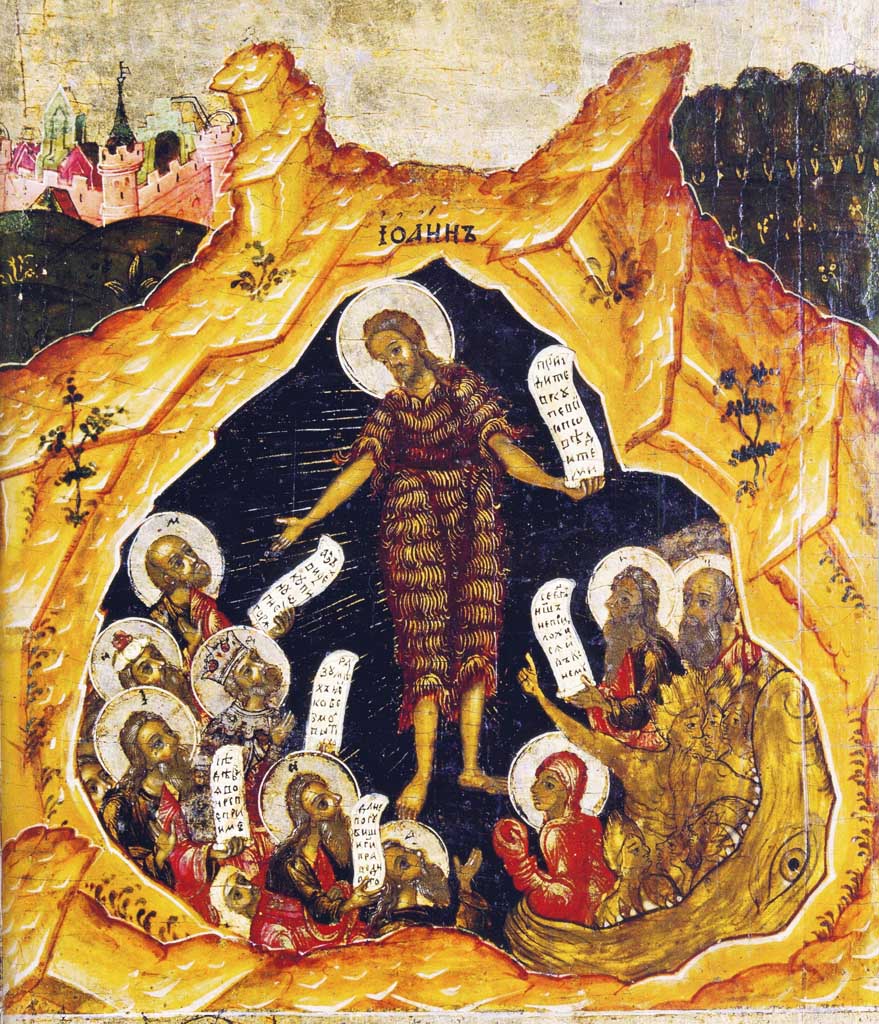
My patron saint is St. John the Forerunner, partly because of his connection to the world of magic, however I chose him because of his death: St. John the Forerunner and Baptist was imprisoned for condemning Herod’s unlawful marriage to his brother’s wife; he is beheaded at the behest of the daughter of his brother’s wife. He died as an example of one who would go to death rather than compromise his commitment to God.
He is one we can look up to, always speaking truth to power and being one who would rather die than give up the path toward union with God.
Furthermore, in accordance with church traditions St. John the Forerunner met death and went to Hades to continue his ministry of the coming of the Lord, fulfilling the mission of Elijah in life and death, preparing the Way for the Harrowing of Hades.
This is why St. John the Forerunner is my patron, because even in Hades St. John’s testimony rings out, “He came as a witness to testify about the Light, so that through him everyone might believe. He himself was not the Light, but he came to testify about the Light” (John 1:7-8). There is always a Way out of the darkness, out of the leviathan that swallows us in its mouth—the Hellmouth that has the aroma of sweetness ensnaring us in its deceptive perfume.
It’s like a trash bag full of freon. That sweet, voluptuous scent rising out of the edges of the glad stretch and seal, calling out to you to rip a huff from its bellowing jaws…
But what happens?
You just huff yourself stupid, that’s what, swinging wildly at the red and blue stars swirling around your head like a halo, knocking over bookshelves and annoying your friends. You’re wailing on invisible astronomical phenomena until you collapse into a rocking chair, drooling, half-watching the “Hitman’s Bodyguard” on blu-ray, and half-convinced you died. And you don’t really care, do you? You’ve done huffed yourself stupid—what is there to care about?
What the hell’s that crackling?
Sounds like a bowl of rice krispies… like spiders tap-dancing… Is that my hair growing… is that my brain cells dying?
I mean…
… is that your hair growing? Is that your brain cells dying?
What was I talking about?
Oh, yeah.
The leviathan, the embodiment of chaos, the seven-headed beast; in the last “day the Lord with His severe sword, great and strong,
Will punish Leviathan the fleeing serpent,
Leviathan that twisted serpent;
And He will slay the reptile that is in the sea” (Isaiah 27:1).
We are between two columns each with a choice: being pierced by the teeth of the serpent or the severe sword of the Lord. Κατάνυξις or departing “from the faith, giving heed to deceiving spirits and doctrines of demons, speaking lies in hypocrisy, having their own conscience seared with a hot iron” (1 Timothy 4:1-2).
It’s Truth or the glad bag, fella.
Which way do you go?
Si comprehendis, non est Deus
 Witness, NM